Israeli Prime Minister Benjamin Netanyahu has rejected US President Donald Trump’s 15-point Gaza peace plan, insisting that Israel will not withdraw its forces until Hamas is fully and genuinely disarmed, deepening tensions over the fragile ceasefire and prospects for lasting peace.
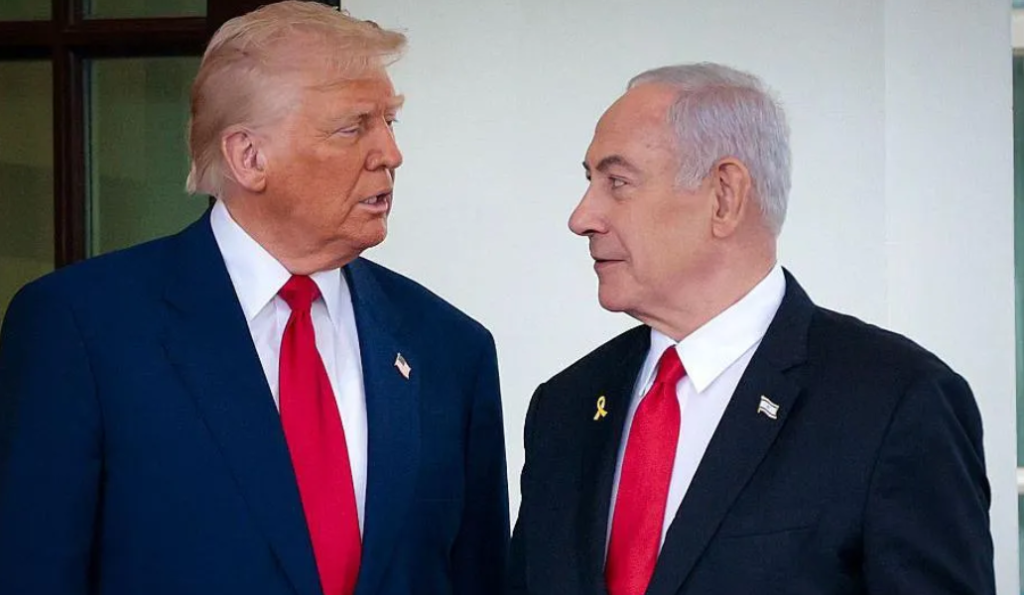
JERUSALEM — Israeli Prime Minister Benjamin Netanyahu has delivered a blunt rejection of US President Donald Trump’s 15-point Gaza peace framework, declaring that Israel will not withdraw its forces from the territory until Hamas has been completely and genuinely disarmed a position that threatens to deepen an already fragile dispute over how the war should finally come to an end.
Netanyahu’s declaration strikes at the heart of Trump’s ambitious plan, which envisions a path toward ending the conflict through the disarmament of Hamas and other armed groups, the withdrawal of Israeli forces, international oversight, and the reconstruction of Gaza.
At a cabinet meeting on Sunday, Netanyahu made Israel’s position unmistakably clear.
“Israel rejects the 15-point document,” he said, insisting that the Israeli military would not carry out a withdrawal until Hamas was “genuinely disarmed.”
Netanyahu further warned that Israeli forces would continue taking action against what his government considers threats to its soldiers and citizens.
The statement represents a major obstacle to Trump’s attempt to establish a framework for a lasting settlement in Gaza. While Washington has presented the proposal as a potential breakthrough, the fundamental disagreement between Israel and Hamas remains painfully clear. Hamas wants an Israeli withdrawal as part of the process leading to disarmament, while Netanyahu insists that disarmament must come first.
- Crypto, AI and Betting Firms Emerge as New U.S. Political Kingmakers
- US Warns Iran of Unprecedented Economic Pressure as Hormuz Shipping Nears Standstill

- Benjamin Netanyahu rejects Trump’s Gaza plan, demands Hamas disarm first
- Donald Trump Threatens Crushing Strike on Iran as Gaza Peace Plan
- Israel 2026 legislative election
- WASHINGTON: 15-Year-Old Suspect Arrested After Deadly Shootout at Seattle Food Festival Leaves Three Dead, Four Injured

- Donald Trump Says US ‘Locked and Loaded’ as Washington Pursues Talks With Iran
![Nablus in the Israeli-occupied West Bank, on Friday [Jaafar Ashtiyeh/AFP]](https://www.aptikons.com/view/Screenshot-2026-07-25-133516-150x150.png)
- Anthony Edwards Secret Wedding Surprises Fans Following Major Legal Victory And Family

That difference may appear to be a matter of sequencing, but in reality it is one of the most difficult political and military questions in the entire conflict.
Hamas has indicated that it remains committed to the broader agreement and is prepared to engage in serious negotiations over implementation. However, the group has maintained that handing over its heavy weapons is connected to an end to what it describes as Israeli aggression and the withdrawal of Israeli forces from Gaza.
The opposing positions leave the peace framework facing its most dangerous test.
For Trump, the announcement that Hamas had agreed in principle to disarm represented a significant diplomatic development. The proposal was designed to create a mechanism through which the conflict could move away from military confrontation and toward reconstruction and political stabilization.
The creation of a proposed Board of Peace was intended to help oversee implementation, while the broader framework called for the disarmament of Hamas and other armed groups, an Israeli military withdrawal, and a major reconstruction effort in Gaza.
But Netanyahu’s latest position demonstrates that reaching an agreement on paper is one thing—and convincing the parties to accept the difficult compromises required to implement it is another.
The Israeli prime minister’s rejection is hardly unexpected.
Netanyahu faces a complicated political reality at home. His government depends heavily on support from right-wing and far-right political forces that have repeatedly demanded a tougher policy toward Hamas and have resisted any arrangement they believe could leave the group capable of rebuilding its military capabilities.
Among those opposing the proposed framework is National Security Minister Itamar Ben Gvir, who has criticized the draft as unacceptable and urged a tougher approach.
That domestic pressure significantly narrows Netanyahu’s room for maneuver.
Any decision by the Israeli government to withdraw troops before Hamas has been fully disarmed could trigger a political backlash from Netanyahu’s coalition partners, who have long argued that Israel must maintain military pressure until Hamas no longer poses a significant threat.
At the same time, an outright rejection of Trump’s initiative risks creating friction between Netanyahu and the US president, whose administration remains Israel’s most important international ally.
That places Netanyahu in a difficult balancing act.
He must respond to pressure from Washington while also maintaining the confidence of a coalition that expects him to demonstrate strength. He must address international demands for an end to the fighting while insisting that Israel’s security requirements cannot be compromised.
Netanyahu has said discussions with US officials are continuing and acknowledged that some American proposals are acceptable to Israel while others are not.
His message was essentially that negotiations can continue—but Israel will not surrender what it considers fundamental security conditions simply to preserve the appearance of diplomatic progress.
The central dispute is therefore unlikely to be resolved through political statements alone.
Any realistic disarmament arrangement would almost certainly require detailed verification mechanisms, guarantees, sequencing, and international monitoring. Likewise, any Israeli military withdrawal would need to be carefully coordinated to prevent a security vacuum or the rapid rearmament of militant groups.
The question is not simply whether Hamas will surrender weapons.
The more difficult question is who will verify the disarmament, how it will be enforced, what happens if Hamas refuses, and what guarantees Israel will receive before its forces leave Gaza.
Those unresolved questions could determine whether Trump’s proposal becomes a genuine pathway toward peace or another diplomatic initiative overwhelmed by the realities of the battlefield.
The humanitarian consequences of the conflict make the stakes even higher.
The United Nations has estimated that approximately 1.9 million peoplearo und 90% of Gaza’s population—have been displaced since the war began. The conflict erupted following the Hamas-led attack on southern Israel on October 7, 2023, when about 1,200 people were killed and 251 others were taken hostage, according to Israeli figures.
Israel subsequently launched a massive military campaign in Gaza. Gaza’s health authorities have reported more than 73,000 Palestinian deaths during the conflict, figures that have been regarded by the United Nations as broadly credible, although casualty accounting in an active war zone remains inherently difficult.
Behind the political negotiations are millions of civilians who have endured displacement, destruction, shortages, and repeated uncertainty over whether another round of fighting could erupt.
For them, the dispute between Netanyahu and Hamas over the order of disarmament and withdrawal is not merely a diplomatic argument. It could determine whether the territory moves toward reconstruction or remains trapped in another cycle of violence.
Trump’s peace initiative now faces a fundamental reality, neither side appears prepared to accept the other’s preferred starting point.
Hamas wants guarantees that Israeli forces will withdraw and that military operations will end before it makes the most consequential concessions over its weapons. Netanyahu, meanwhile, insists that Israel cannot be expected to pull back while Hamas retains the ability to threaten Israeli civilians and soldiers.
That impasse could force Washington to intensify its mediation efforts.
- Young Filipino Baseball Stars Shock Powerful Japan With Historic Championship Victory Together

- Yemen Faces Imminent Famine, Millions on Brink as Aid Dries Up
- WASHINGTON: 15-Year-Old Suspect Arrested After Deadly Shootout at Seattle Food Festival Leaves Three Dead, Four Injured
- VP Duterte Budget “Insertions” Exposed; Tinio Calls for Probe
- Venezuela Earthquake Kills 164, Thousands Affected

- Venezuela Claims US Raid Kills 83 in Botched Maduro Abduction
- USA: Senate Battle Lines Drawn – GOP’s Big Bet, Voter Anger, and the Shadow of War
- US-Iran Tensions Escalate as Military Threats, Diplomatic Disputes, and Regional Mediation Efforts Intensify
Trump may now have to persuade Netanyahu that the proposed framework can provide Israel with sufficient security guarantees while simultaneously convincing Hamas that disarmament will be accompanied by a credible end to the war and a genuine Israeli withdrawal.
That will be an extraordinarily difficult diplomatic task.
The danger is that every delay creates another opportunity for the agreement to collapse.
For Netanyahu, the issue is ultimately about security and political survival. For Hamas, surrendering its weapons represents an existential decision that could fundamentally alter its position in Gaza. For Trump, the credibility of his peace initiative is now at stake.
And for the people of Gaza and Israel, the consequences could be measured not in diplomatic statements but in lives.
Netanyahu’s rejection therefore should not be viewed as a minor disagreement over wording in a peace document. It exposes the deepest unresolved contradiction in Trump’s Gaza strategy.
Peace may require both sides to compromise, but neither Israel nor Hamas appears willing to make the first concession without receiving a guarantee from the other.
Until that contradiction is resolved, Trump’s ambitious 15-point framework remains caught between diplomacy and reality while the possibility of another prolonged confrontation continues to hang over Gaza.