Two deadly school shootings in Zamboanga City and Tacloban City have intensified concerns over youth violence in the Philippines, raising urgent questions about bullying, firearm access, online influence and the possible manipulation of minors by violent or extremist networks. As authorities investigate the circumstances behind the attacks, the incidents have also fueled debate over whether schools, families, law-enforcement agencies and technology platforms are doing enough to identify warning signs and protect vulnerable young people before anger and online influence escalate into deadly violence.
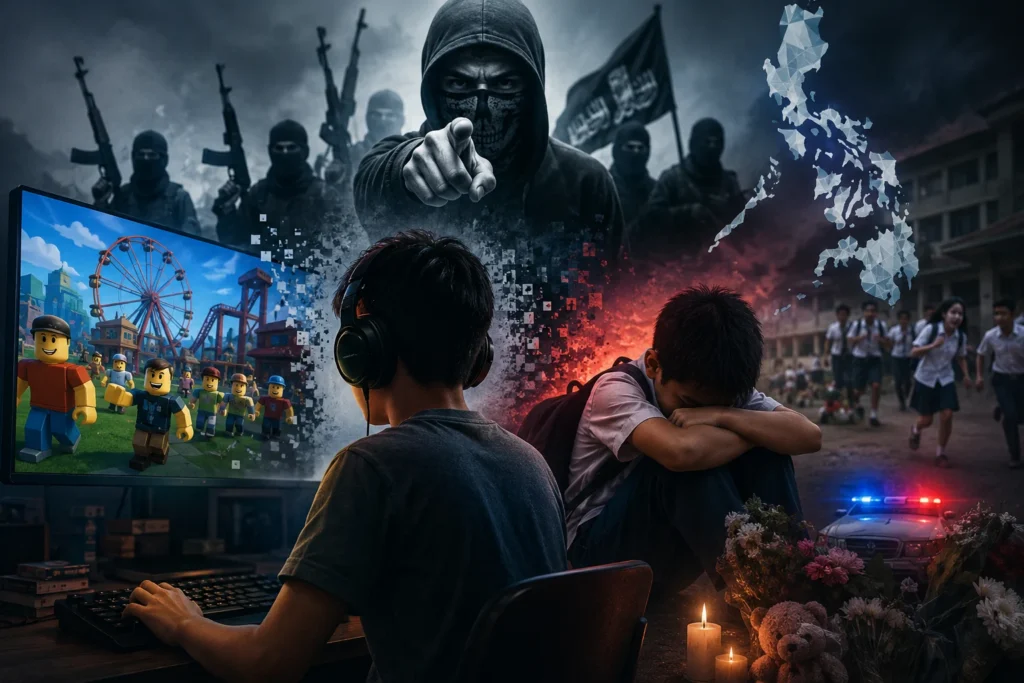
The deadly school shootings in Zamboanga City and Tacloban City have renewed urgent questions about how young people can become involved in extreme acts of violence, how firearms reach minors, and whether bullying, online influences and failures in supervision are contributing to a growing culture of aggression among some young people.
The latest tragedy occurred on August 18 at a high school campus affiliated with Ateneo de Zamboanga University in Tumaga, Zamboanga City. Authorities said a Grade 9 student brought firearms into the school and opened fire, killing a fellow student and injuring two others before the gunman died. Police and investigators are examining the circumstances surrounding the attack, including how the firearms entered the campus. One of the firearms was reportedly a government-issued weapon associated with the student’s father, a Bureau of Customs police commander.
The incident came only weeks after another devastating school shooting at San Jose National High School in Tacloban City on June 22. Two students, aged 14 and 15, were arrested after an attack that killed three students and injured numerous others. Initial police accounts indicated that the suspects had allegedly experienced bullying, although authorities emphasized that the investigation was continuing and that bullying alone could not automatically explain the violence.
Police later said the Tacloban attack appeared to have been planned for more than a month. The Department of Justice also said it was examining whether the incident could potentially involve a broader form of violent extremism, including nihilistic violent extremism. That possibility remains an investigative angle, not an established finding that the students were connected to an extremist organization.
These incidents expose a difficult reality: violence among young people cannot be attributed to a single cause. Bullying, family circumstances, access to weapons, social isolation, untreated emotional problems, exposure to violent material and the influence of online communities can interact in complicated ways. But none of these factors should be treated as automatic explanations for violent behavior.
The growing presence of children and teenagers in online spaces has also intensified public concern over so-called “challenges” and online communities that encourage dangerous behavior. Social-media platforms and online games can expose young users to violent or disturbing material, but there is currently no reliable evidence establishing that Roblox itself caused the Zamboanga or Tacloban shootings.
Likewise, claims that the New People’s Army or foreign terrorist organizations are directing children through Roblox challenges, offering rewards for violent acts or coordinating school attacks should not be presented as fact without credible evidence from law-enforcement investigations. Such allegations require substantial verification because attributing a real-world crime to a terrorist organization without evidence can spread misinformation and unfairly implicate individuals or communities.
The concern about online manipulation, however, is legitimate. Young users can encounter harmful communities, extremist propaganda, violent content, cyberbullying and individuals who deliberately attempt to manipulate vulnerable children. The challenge for authorities, parents, schools and technology companies is determining when online behavior crosses from disturbing content into genuine recruitment, coercion or preparation for violence.
The Philippine government already has a legal framework for dealing with children who become involved in criminal offenses. Republic Act No. 9344, or the Juvenile Justice and Welfare Act of 2006, as amended by Republic Act No. 10630, does not simply mean that minors can commit crimes without consequences. The law establishes a separate juvenile justice and welfare system that takes the child’s age, circumstances and level of discernment into account.
Under the law, children aged 15 or below at the time of an offense are exempt from criminal liability but are subject to intervention programs. Children above 15 but below 18 are likewise generally exempt unless they acted with discernment, in which case appropriate proceedings may follow. The law also makes clear that exemption from criminal liability does not eliminate civil liability.
That distinction is important because the purpose of juvenile justice is not to provide young offenders with a license to commit crimes. It recognizes that children are still developing while also requiring the government to protect victims, communities and the children themselves. Republic Act No. 10630 strengthened the system and provided mechanisms such as Bahay Pag-asa and multidisciplinary intervention involving social workers, psychologists or mental-health professionals, medical professionals and educational or guidance counselors.
The Tacloban case illustrates why that balance is difficult. One of the suspects was 15, and authorities subsequently filed criminal charges against him in connection with the deaths and injuries. The case demonstrates that being a minor does not necessarily end the legal process; the circumstances surrounding the child’s age and discernment remain critical to determining the appropriate proceedings.
At the same time, the answer cannot be limited to punishment after a tragedy has already occurred.
Schools must become places where warning signs are taken seriously. Threats, repeated bullying, violent fantasies, possession of weapons, online threats, sudden behavioral changes and attempts to glorify previous attacks should not simply be dismissed as teenage behavior. Teachers, guidance counselors, parents and classmates can play an important role in identifying serious risks before they develop into violence.
Bullying also deserves a more serious response. While bullying should never be used to excuse murder or attempted murder, repeated humiliation, harassment and social exclusion can have profound effects on young people. The Tacloban investigation itself initially identified bullying as a possible factor, while authorities continued examining the broader circumstances of the attack.
Another critical issue is firearm access. The Zamboanga shooting has raised questions about how a student was able to bring firearms into a school and obtain access to a weapon reportedly connected to his father. Investigators will have to determine how the firearm was secured, how it was obtained and whether proper safety procedures were followed.
School security therefore cannot depend solely on gates and guards. It must be supported by responsible firearm storage, effective screening procedures, threat-reporting systems, trained personnel and cooperation between schools, parents and law-enforcement agencies.
The Philippines is now facing a moment that demands careful examination rather than panic.
It would be dangerous to conclude that Filipino young people as a whole are becoming violent. Millions of children attend school every day without committing violence, and the vast majority of young people who experience bullying, play online games or consume violent entertainment do not become violent offenders.
The more important question is why a small number of vulnerable young people can move from anger or grievance to the decision to seriously harm others.
That question requires investigators to examine the individual circumstances of each case: family environment, bullying, access to firearms, peer relationships, psychological and behavioral warning signs, online activity and possible exposure to extremist or violent communities. Investigators must distinguish evidence from speculation.
Technology should also be examined without turning it into a convenient scapegoat. Online games are not inherently equivalent to violent recruitment, and playing a particular game does not prove criminal intent. However, digital platforms can be exploited by people seeking to manipulate minors, making child-safety systems, parental awareness and rapid reporting mechanisms increasingly important.
The two school shootings have also demonstrated that the protection of children cannot stop at the school gate.
Parents need to know what their children are watching, whom they are communicating with and whether their behavior is changing dramatically. Schools need accessible counseling and credible mechanisms for reporting threats. Law-enforcement agencies need the capacity to investigate digital evidence without jumping to unsupported conclusions. Technology companies must continue strengthening protections against grooming, exploitation, violent threats and harmful communities.
Most importantly, society must reject the idea that a child’s age makes violence harmless or consequence-free.
Juvenile justice exists to protect children and promote rehabilitation, but it must operate alongside the rights of victims and the need to protect the public. The law provides special protections because children are still developing not because their actions have no consequences.
The deaths in Zamboanga and Tacloban should therefore become a warning, not merely another cycle of public outrage.
If young people are reaching the point where violence appears to them to be an answer to bullying, anger, revenge or online influence, the country must intervene much earlier.
The objective should be clear: identify vulnerable children, confront bullying, prevent access to firearms, investigate genuine online threats, counter extremist manipulation and ensure that schools remain safe environments.
A child should never have to become a victim before adults recognize a warning sign. And a troubled young person should never be allowed to progress from grievance to violence simply because nobody intervened when the first signs appeared.
- Macalintal Eyes Supreme Court Challenge Over BSKE Postponement

- Leni Robredo Endorses Marvic Leonen for Chief Justice

- Supreme Court Reaffirms Fair Comment Doctrine in Libel Cases

- Eastern Visayas’ Fun Run Set September 27 in Tacloban to Mark World Tourism Day

- September 21: Special Non-Working Days Declared in Rizal, Ifugao; Manila Classes Suspended

- Mark Zuckerberg Summoned as Facebook Faces Possible Suspension in Philippines