Davao City’s long-planned ₱10-billion Waste-to-Energy (WTE) project is moving through critical environmental and development stages, offering the prospect of turning up to 600 tons of municipal waste daily into electricity while creating major opportunities for infrastructure investment—but despite viral images portraying a completed facility, the proposed plant has yet to be built.
DAVAO CITY, Philippines — Davao City’s proposed ₱10-billion Waste-to-Energy (WTE) project is gaining renewed attention as the local government pursues a long-planned solution to the city’s growing solid-waste problem, with Japanese assistance supporting the development of the facility.
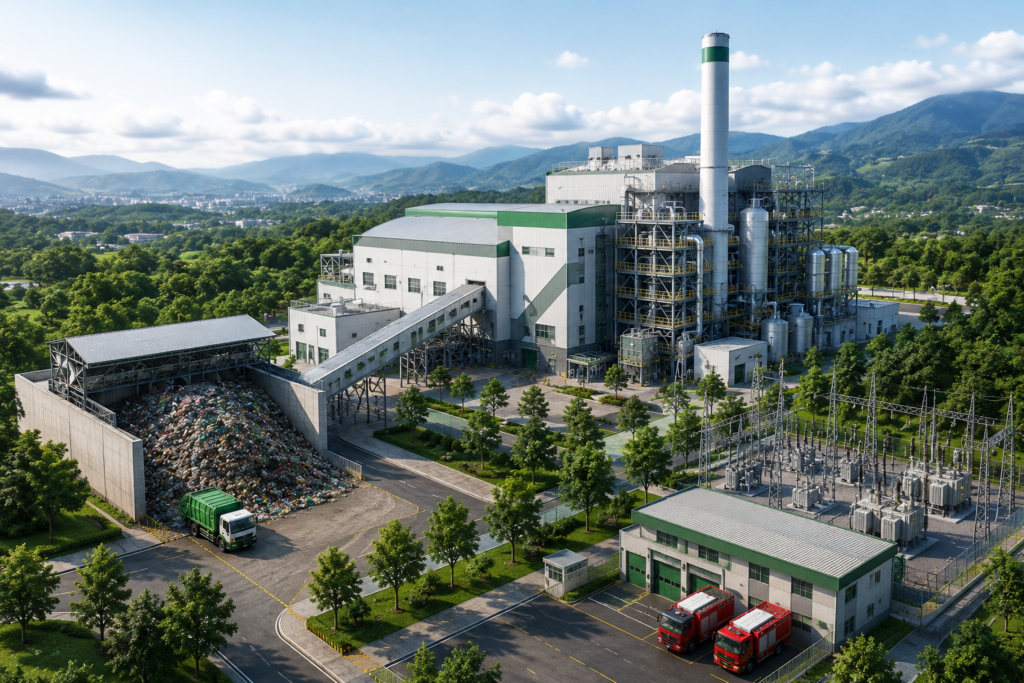
The project has also become a subject of discussion on social media, where impressive images and videos depicting a modern WTE plant in Davao have circulated widely. However, authorities and project records indicate that the facility shown in those materials has not yet been built.
The proposed project is real, but the highly polished plant images circulating online should not be mistaken for actual construction footage. Some of the visuals appear to be computer-generated or artificial intelligence-created representations of what the future facility could look like.
The distinction is important as Davao City continues to work through the environmental and technical requirements needed before the project can move toward actual construction.
The Department of Environment and Natural Resources–Environmental Management Bureau in Region XI (DENR-EMB XI) scheduled a public scoping activity for the proposed project on April 15, 2026. The planned facility is located in Sitio Pungot, Barangay Biao Escuela, Tugbok District.
The environmental approval process underscores that the project remains in the development stage rather than being an operational or fully constructed power plant.
Despite the uncertainty surrounding the images online, Davao’s WTE initiative has been under consideration for years.
- Crypto, AI and Betting Firms Emerge as New U.S. Political Kingmakers
- Davao City’s ₱10-Billion Waste-to-Energy Project Moves Closer to Reality
- CLE RESULTS August 2026: Criminology Licensure Examination

- Alfred Tecsond Nagkuwento ng Umano’y Karanasan sa PNP General Bilang Kliyente

- ABS-CBN Holds Quiet Stockholders’ Meeting as P6-Billion Recapitalization Looms

- US Sanctions ICC President Tomoko Akane and Senior Lawyer in Latest Move Against Court

Japan and the Philippines signed an Exchange of Notes on March 20, 2018, providing grant assistance of ¥5.013 billion for the development and construction of waste-to-energy facilities in Davao City. Depending on the exchange rate used, the amount was equivalent to roughly ₱2 billion to ₱2.5 billion at the time.
The project is designed to process approximately 600 tons of municipal solid waste per day and recover energy from the waste. Earlier planning documents associated with the Japan International Cooperation Agency (JICA) projected around 9.7 megawatts (MW) of electricity available for sale, while other project presentations placed gross generation at approximately 11 MW.
The figures, however, should not be interpreted as the final capacity or financial structure of the facility, which could change as the project progresses through planning, environmental review and procurement.
More importantly, the proposed facility should not be viewed simply as another power-generation project.
At its core, WTE is a waste-management system designed to recover energy from residual waste that would otherwise have to be disposed of in landfills or other facilities. Its success therefore depends not only on electricity production but also on reliable waste collection, proper segregation, environmental safeguards and long-term financial sustainability.
This is where the economics of the project become critical.
Japanese grant assistance does not necessarily mean that Davao City will receive an entire WTE facility without additional public expenditure. Earlier financing discussions contemplated additional Philippine government support to complement Japanese assistance and cover the remaining costs of developing the facility.
The project could therefore involve substantial public resources, making transparency and financial accountability essential throughout its implementation.
Another major consideration is the tipping fee the amount charged or paid for every ton of waste delivered to the facility for treatment.
Earlier project proposals cited a tipping fee of about ₱600 per ton, although other financial scenarios considered higher amounts depending on capital requirements, operating expenses, government support and electricity revenues.
These historical figures should not be treated as the final amount that Davao City will eventually pay.
Nevertheless, the eventual tipping fee could become one of the most important factors determining whether the project provides a financially sustainable waste-management solution or creates a costly long-term obligation for taxpayers.
There is also a fundamental policy challenge.
Under Republic Act No. 9003, or the Ecological Solid Waste Management Act, local governments are expected to prioritize waste reduction, segregation, recycling and composting. A WTE facility must therefore complement not undermine these efforts.
The objective should not be to generate more garbage simply to keep a WTE plant operating.
Instead, recyclable and compostable materials should be recovered whenever economically and environmentally appropriate, while WTE technology should focus on residual waste that remains after proper segregation and recovery.
The experience of Davao City could consequently become important not only for Davao but also for other cities considering similar facilities.
For local governments in Northern Mindanao, particularly Cagayan de Oro and Misamis Oriental, the Davao project could provide valuable lessons before committing to their own WTE investments.
Rather than immediately pursuing another large-scale facility, policymakers could examine whether a regional approach would be more economically viable.
A WTE facility serving Cagayan de Oro and participating local government units in Misamis Oriental could potentially achieve the volume of residual waste needed to support a major investment. But such a proposal would require detailed analysis of waste volumes, transportation distances, tipping fees, electricity revenues, financing costs, operating expenses and environmental safeguards.
Any future WTE project should also be subjected to strong safeguards.
These should include transparent and competitive procurement, independent emissions monitoring, mandatory waste segregation before treatment, full disclosure of waste-volume and tipping-fee commitments, and an independent comparison of WTE against alternatives such as sanitary landfills, recycling, composting and other waste-management technologies.
For the construction and engineering industries, the project could represent significant opportunities if it advances to implementation. A facility of this scale could create demand for engineering services, construction workers, specialized equipment, technology providers, contractors and local suppliers.
But economic opportunities should not overshadow the project’s fundamental purpose: solving the city’s waste problem safely, efficiently and sustainably.
The contrast between the AI-generated images circulating online and the actual status of the project offers an important lesson. Modern-looking visuals can easily create the impression that a major infrastructure project is already under construction when, in reality, it may still be undergoing planning and regulatory review.
Davao’s WTE facility may not yet exist physically, but the project itself is far from fictional.
It represents years of planning, international cooperation and public investment aimed at addressing one of the city’s most persistent environmental challenges.
The real test now is whether Davao can transform the long-discussed proposal into a financially viable, environmentally responsible and publicly accountable facility.
For Cagayan de Oro, Misamis Oriental and other cities watching closely, the goal should not simply be to replicate Davao’s proposed plant.
The greater opportunity is to learn from Davao’s experience what works, what causes delays, how much government support is required and, ultimately, how much taxpayers and communities will have to pay.
The AI-generated WTE plants circulating online may be fictional representations of the future.
But Davao City’s waste-to-energy project is real.
What remains to be proven is whether that real project can deliver a sustainable solution for the city’s waste and a responsible return on the public investment behind it.
- Zyan Cabrera A.K.A Jerriel Cryazee Sex Scandal
- Zyan Cabrera
- Zoonotic disease
- Young Filipino Baseball Stars Shock Powerful Japan With Historic Championship Victory Together

- You want to become a Contributor of Aptikons
- Yemen Faces Imminent Famine, Millions on Brink as Aid Dries Up
- Yamal Shatters Mbappé Record as Barcelona Cruise Past Mallorca 3–0

- Xi Jinping | President, Biography, Education & Issues