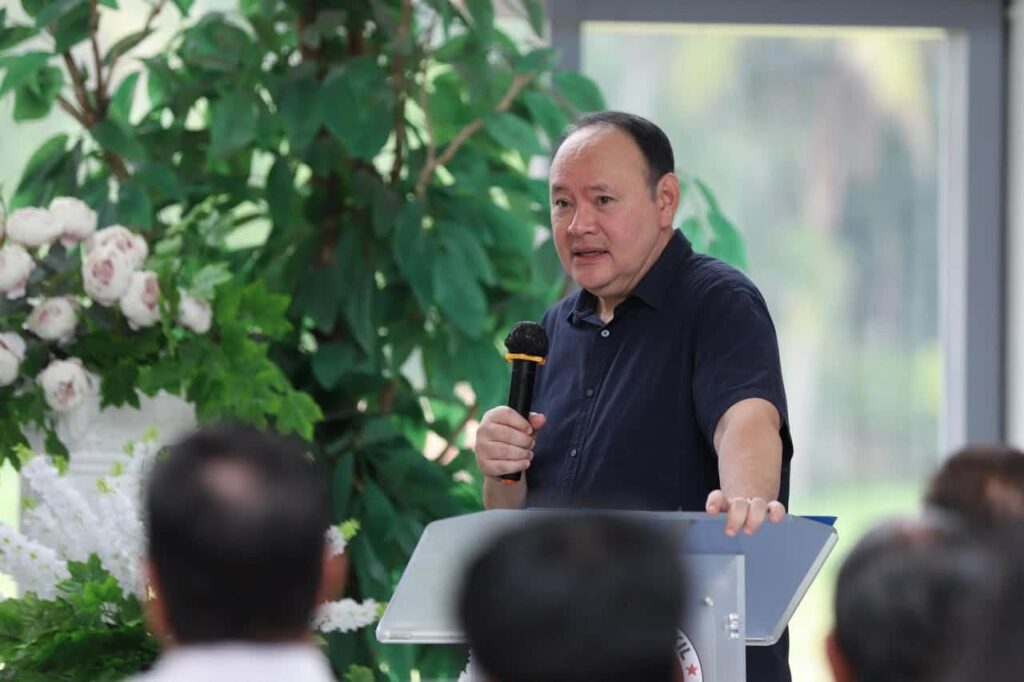
The Department of National Defense (DND) has strongly rejected the Chinese Embassy’s accusations against Defense Secretary Gilberto Teodoro Jr., escalating a diplomatic dispute over the arrest of Chinese nationals during a law enforcement operation at the Sanjia Steel Plant in Misamis Oriental.
The Chinese Embassy, through its spokesperson Ji Lingpeng, described Teodoro’s remarks as “completely unfounded” and accused the Philippine defense chief of distorting facts surrounding the raid. The embassy claimed that the operation was discriminatory and allegedly intended to frame Chinese nationals, pointing out that Filipino workers at the facility were released following the operation.
- Alfred Tecsond Nagkuwento ng Umano’y Karanasan sa PNP General Bilang Kliyente
- US Sanctions ICC President Tomoko Akane and Senior Lawyer in Latest Move Against Court
- Jonvic Remulla Urges Congress to Tighten Firearms Law, Revisit ‘Robin Padilla Law’ After School Shooting
- Col. Raymund Dante Lachica Challenges Ramil Madriaga’s Claims in Sara Duterte Impeachment Hearing

- Colonel Raymund Dante Lachica Faces Scrutiny Over ₱125M Confidential Funds
- Roblox, Terrorist Influence and Rising Youth Violence Alarm the Philippines

Ji further alleged that three Chinese workers were required to wear protective equipment and pose for photographs during the raid. The accusation added another layer to an already tense exchange between Beijing and Manila, with both sides presenting sharply different accounts of what transpired during the operation.
The Department of National Defense, however, rejected the Chinese Embassy’s characterization of the incident. DND spokesperson Arsenio Andolong described Beijing’s statement as a “classic example of evasiveness and a badge of deception,” arguing that the embassy failed to directly respond to Teodoro’s allegation that Chinese diplomats had illegally intervened in a Philippine law enforcement operation involving the Sanjia Steel Plant.
“Instead, it is full of questions and rhetoric. This is, in legal practice, an implied admission of culpability,” Andolong said, strongly defending the Philippine government’s position. He added that the DND would not be intimidated by what he described as misinformation coming from the Chinese side.
“We will not be oppressed,” Andolong declared, signaling the Philippine defense establishment’s determination to stand by its allegations and defend the authority of Philippine law enforcement agencies operating within the country.
The dispute comes amid continuing tensions between Manila and Beijing, particularly over issues involving Philippine sovereignty, national security, and China’s activities in the West Philippine Sea. Teodoro has emerged as one of the Philippine government’s most outspoken critics of China, repeatedly challenging Beijing’s claims and actions in areas that Manila considers part of its sovereign territory and maritime jurisdiction.
Teodoro has also accused China of engaging in propaganda and disinformation campaigns related to the West Philippine Sea. His position is consistent with the Philippine government’s reliance on the 2016 arbitral ruling, which rejected the legal basis of China’s sweeping claims over much of the South China Sea and affirmed maritime entitlements under international law.
Beijing, for its part, has consistently rejected the arbitration ruling and has maintained its own claims in the disputed waters. The disagreement has remained one of the most sensitive issues in Philippine foreign and national security policy, with both countries frequently exchanging statements over maritime activities, diplomatic conduct, and the treatment of their respective nationals.
The latest controversy also highlights the increasingly contentious relationship between Teodoro and the Chinese government. China has previously imposed sanctions on the defense secretary, including a ban preventing him and members of his family from entering mainland China, Hong Kong, and Macao.
Against this backdrop, the dispute over the Sanjia Steel Plant raid has quickly developed beyond a simple disagreement over a law enforcement operation. The conflicting statements from Manila and Beijing reflect broader concerns about sovereignty, foreign interference, and the role of Chinese nationals and diplomatic personnel in sensitive activities within the Philippines.
For the Philippine defense establishment, the central issue is whether foreign diplomatic representatives improperly interfered in a legitimate Philippine law enforcement operation. For Beijing, however, the incident is being portrayed as an unfair and discriminatory action against Chinese nationals.
The opposing narratives have further intensified scrutiny of the incident, as authorities and the public seek clarity regarding what occurred during the raid, the circumstances surrounding the arrest of the Chinese nationals, and the alleged involvement of Chinese diplomats.
The DND’s response makes clear that Manila is unwilling to allow the controversy to be framed solely through Beijing’s account. By directly challenging the Chinese Embassy’s statement, the Philippine defense department has sought to reinforce the principle that law enforcement operations conducted within Philippine territory remain subject to Philippine authorities and laws.
The exchange also underscores the broader diplomatic challenge facing the Philippines as it balances its economic and diplomatic relations with China with its commitment to protecting national sovereignty and enforcing domestic laws.
As both sides continue to defend their respective positions, the Sanjia Steel Plant incident is likely to remain a subject of political and diplomatic scrutiny. The controversy demonstrates how a single law enforcement operation can become intertwined with much larger questions involving foreign influence, national security, diplomatic conduct, and the Philippines’ increasingly assertive position toward China.
For Manila, the message from the DND is unequivocal: allegations of foreign interference in Philippine law enforcement will not be ignored, and the government intends to defend its authority against what it considers attempts to distort the facts or undermine Philippine sovereignty.
China Accuses Teodoro of Provoking Tensions as Sanjia Steel Plant Raid Deepens Manila-Beijing Dispute
The diplomatic dispute between the Philippines and China has intensified following the arrest of 69 Chinese nationals during a joint law enforcement operation at a Chinese-run steel facility in Misamis Oriental, with Beijing accusing Defense Secretary Gilberto Teodoro Jr. of deliberately provoking tensions between the two countries.
The Chinese Embassy questioned Teodoro’s participation in the operation, which involved the Armed Forces of the Philippines (AFP), the Presidential Anti-Organized Crime Commission (PAOCC), and the National Bureau of Investigation (NBI). The operation resulted in the arrest of dozens of Chinese nationals and the subsequent shutdown of the facility amid allegations of immigration, labor, environmental, and public safety violations.
In a strongly worded statement, the Chinese Embassy accused Teodoro of using the incident to pursue what it described as a political agenda against China. Beijing alleged that the defense secretary was attempting to worsen relations between Manila and Beijing rather than resolve the issues surrounding the steel facility through established legal and diplomatic channels.
“Teodoro has recently spared no effort to stage anti-China activities,” the embassy said, accusing him of seeking to destabilize relations between the Philippines and China and push Manila toward confrontation with Beijing.
The embassy further alleged that Teodoro’s actions were intended to create continued tensions and conflicts between the two countries. It characterized his actions as part of what it described as an “ulterior political agenda,” reflecting Beijing’s growing criticism of the Philippine defense chief, who has repeatedly taken a firm position on issues involving China and Philippine national security.
The accusations came after Teodoro criticized the Chinese Embassy for allegedly intervening in the case involving the arrested workers. The defense secretary accused Chinese diplomatic officials of attempting to cover up issues surrounding the individuals detained during the operation and questioned their involvement in a Philippine law enforcement matter.
Teodoro has maintained that Philippine authorities have the right and responsibility to investigate alleged violations occurring within Philippine territory, particularly when such violations may have implications for national security, public safety, immigration, labor regulations, and environmental protection.
The controversy has also expanded beyond the steel facility itself, with Teodoro raising the issue of more than 100 undocumented Filipinos allegedly arrested in China. He described the reported arrests as an act of “extortion and blackmail,” further escalating the war of words between Manila and Beijing.
The Philippine government shut down the Chinese-run steel facility after authorities allegedly discovered radioactive materials in imported scrap metal, including uranium and thorium. The discovery prompted heightened concerns over the possible health, environmental, and national security implications of the facility’s operations.
Authorities also cited alleged immigration and labor violations, as well as environmental concerns, in connection with the facility. These included allegations involving untreated wastewater and toxic emissions, raising questions about whether the plant had complied with Philippine environmental and occupational safety regulations.
Teodoro also pointed to allegations of substandard steel production, adding another concern to the growing list of issues surrounding the facility. If established, such violations could have broader implications for workers, surrounding communities, consumers, and the country’s industrial sector.
The allegations involving radioactive materials have made the incident particularly sensitive because of the potential risks associated with improper handling, storage, or disposal of radioactive substances. While authorities continue to investigate the circumstances surrounding the reported discovery, the issue has placed the steel facility under intense government scrutiny.
The arrest of 69 Chinese nationals has likewise raised questions about immigration compliance and the presence of foreign workers in the country. Philippine authorities are expected to determine whether those arrested possessed the appropriate documentation and permits to work and reside in the Philippines.
The Chinese Embassy, however, has questioned the manner in which the operation was conducted and Teodoro’s involvement in it. Beijing’s criticism reflects its broader concern over what it sees as increasingly hostile actions by Philippine officials toward Chinese nationals and Chinese-operated businesses in the country.
For Manila, the issue is being presented primarily as a matter of law enforcement, national security, and regulatory compliance. Philippine officials have emphasized that foreign-owned or foreign-operated businesses remain subject to Philippine laws and regulations, regardless of the nationality of their owners, employees, or investors.
The dispute nevertheless comes at a particularly delicate time in Philippine-China relations. Manila and Beijing continue to face disagreements over the West Philippine Sea, maritime activities, territorial claims, and the treatment of their respective nationals. The latest confrontation adds another issue to an already complicated relationship.
Teodoro has been among the most outspoken Philippine officials in challenging China on national security concerns. His statements have frequently drawn strong responses from Beijing, particularly when they involve China’s activities in areas claimed by the Philippines or allegations of Chinese interference in Philippine affairs.
China has previously sanctioned Teodoro, barring him and his family from entering mainland China, Hong Kong, and Macao. The latest accusations from the Chinese Embassy therefore add to an already strained relationship between the defense secretary and Beijing.
The Sanjia steel plant controversy is now developing into a broader diplomatic and political dispute, with both sides defending sharply different interpretations of the events. While Beijing accuses Teodoro of deliberately worsening bilateral relations, Philippine authorities continue to emphasize their responsibility to investigate alleged violations and protect the country’s laws and national interests.
At the center of the controversy are several unanswered questions: What exactly led authorities to conduct the joint operation? How were the 69 Chinese nationals involved with the facility? Were radioactive materials actually present in the imported scrap metal, and if so, how were they handled? Were immigration, labor, environmental, and safety regulations violated? And did Chinese diplomatic officials improperly intervene in the Philippine investigation?
The answers to these questions could determine not only the legal consequences for those involved but also the broader political impact of the incident.
As investigations continue, the Philippine government faces the challenge of addressing legitimate concerns over public safety and regulatory violations while preventing the dispute from further damaging diplomatic relations with China. Beijing, meanwhile, continues to reject what it considers anti-China actions and has called on Manila to avoid steps that could deepen confrontation.
The incident underscores the increasingly complex relationship between the Philippines and China, where economic ties and diplomatic engagement exist alongside serious disagreements over sovereignty, national security, and foreign influence.
For now, the Sanjia steel plant remains at the center of a growing controversy that has moved far beyond the walls of an industrial facility. What began as a law enforcement operation has evolved into another major test of Philippine sovereignty, diplomatic relations, and the government’s ability to enforce its laws while navigating an increasingly tense relationship with one of its most powerful regional neighbors.
Steel Facility Workers Allege Harassment During NBI-PAOCC Raid
Employees of a steel facility in Misamis Oriental have alleged that they were harassed and maltreated during a separate raid conducted by personnel from the National Bureau of Investigation (NBI) and the Presidential Anti-Organized Crime Commission (PAOCC), adding another layer of controversy to the government operation.
According to one female employee, the situation quickly turned tense when armed personnel arrived at the facility and began searching employees and their belongings. She said the personnel were carrying long firearms and ordered workers to remain silent and leave their respective offices as the operation got underway.
The employee also alleged that workers were instructed to shut down the facility’s closed-circuit television (CCTV) system, raising concerns about the circumstances surrounding the raid and the lack of access to the facility’s security recordings during the operation.
“I thought they were terrorists. It was a surprise when they came. We were just working in our offices then they (NBI) came with their long guns pointing at us,” the employee said, describing the incident as frightening and unexpected.
The account provides a glimpse into the experience of workers who were inside the facility when authorities carried out the operation. The allegations of intimidation and maltreatment are expected to draw further attention as authorities continue to investigate the circumstances surrounding the raid and the activities being conducted at the steel facility.
The employee further said that workers were subjected to scanning and testing for toxic substances. According to her account, the employees who underwent the tests were found negative for toxic substances.
The operation ultimately resulted in the arrest of both Chinese and Filipino workers, while several Filipino employees were reportedly rescued amid allegations concerning the condition and safety of the facility. Authorities have raised concerns over claims that some of the steel products produced at the facility were substandard and potentially hazardous to human health and the environment.
The allegations have added to an already contentious situation involving the steel plant, Chinese nationals, Philippine law enforcement agencies, and government officials. The operation has also become part of a wider political and diplomatic dispute involving Philippine officials and Beijing.
Defense Secretary Gilberto Teodoro Jr., who has been outspoken in criticizing China’s actions in the West Philippine Sea, has faced strong opposition from Beijing over his statements and policies. China has previously imposed sanctions on Teodoro and barred him, along with members of his family, from entering mainland China, Hong Kong, and Macao.
The latest allegations from employees come as questions continue to surround the conduct of law enforcement personnel during the raid, the treatment of workers, and the broader allegations involving the steel facility. While authorities have emphasized the importance of enforcing Philippine laws and protecting public safety, the employees’ accounts have raised concerns about whether proper procedures were followed during the operation.
The allegations of harassment and maltreatment remain claims that require appropriate investigation and verification. A complete understanding of the incident will depend on evidence, official reports, CCTV recordings if available, and statements from both law enforcement personnel and employees who were present during the operation.
As the investigation continues, the steel facility raid is likely to remain under close public scrutiny. Beyond the arrests and allegations surrounding the facility’s products, the incident has raised broader questions about worker safety, law enforcement procedures, environmental protection, and the treatment of employees during high-profile operations.
The controversy also highlights the sensitive environment surrounding operations involving Chinese nationals in the Philippines, particularly as Manila and Beijing continue to face disagreements over national security and the West Philippine Sea. With conflicting accounts emerging from workers, authorities, and Chinese officials, the investigation will be crucial in determining what happened inside the facility and whether any violations occurred during the raid.
- US Sanctions ICC President Tomoko Akane and Senior Lawyer in Latest Move Against Court
- DND Fires Back at Chinese Embassy Over Sanjia Steel Plant Raid

- United States Scientists Revisit Covid Origins After Private Messages Raise Fresh Questions
- Enrico Gloria Delivers Historic Mandarin Graduation Speech at Prestigious Tsinghua University Ceremony
- Sheikh Hamad bin Khalifa Remembered for Historic Gaza Visit Supporting Palestinians