Devastating double-earthquake disaster has plunged Venezuela into mourning after two powerful earthquakes measuring 7.2 and 7.5 magnitude struck near the capital Caracas, leaving at least 164 people dead and nearly 1,000 injured. The back-to-back tremors, among the strongest ever recorded in the country, triggered widespread destruction, collapsing buildings, crippling critical infrastructure, and trapping countless residents beneath rubble as rescue teams race against time to find survivors. Authorities have declared a state of emergency while international aid begins pouring in amid fears that the death toll could rise dramatically in the coming days.
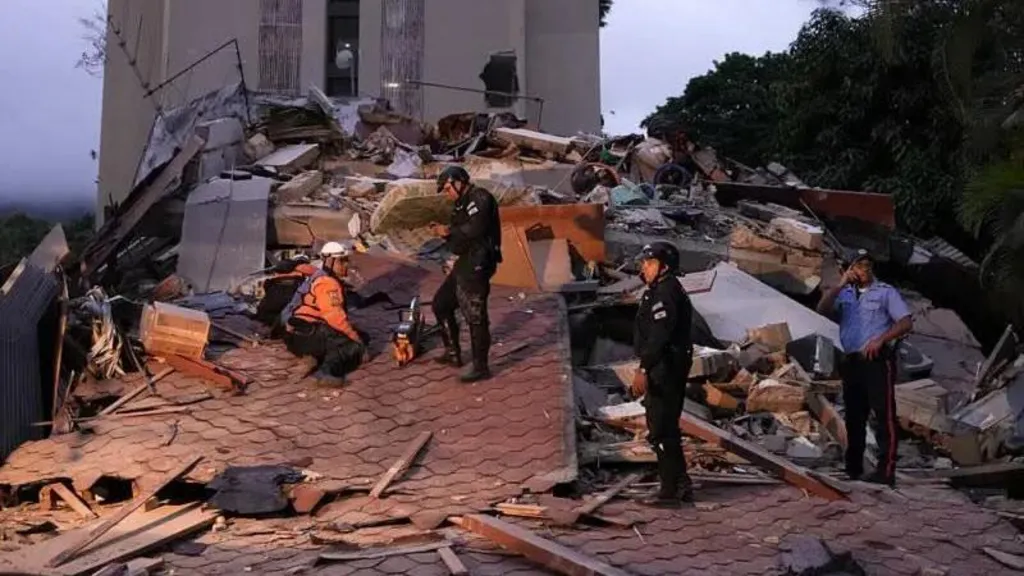
VENEZUELA — In a matter of seconds, the ground beneath northern Venezuela shook with a force not seen in more than a century. Two powerful earthquakes struck in quick succession near the capital city of Caracas, leaving behind a growing toll of death, destruction, and uncertainty. As of official reports, at least 164 people have lost their lives, and nearly 1,000 more have been injured but experts warn that these numbers may only be the beginning of a much larger tragedy.
According to the United States Geological Survey (USGS), the sequence began with a magnitude 7.2 quake, followed just moments later by an even stronger magnitude 7.5 tremor. Both occurred at shallow depths the second at only 10 kilometers below the surface a factor that amplifies the energy released and multiplies the potential for damage. Geologically, this event is no surprise: Venezuela sits at the boundary of two tectonic plates, where built-up pressure is released in sudden, violent movements. But the scale of this event is historic. USGS records confirm that the second quake is the strongest to strike the country since 1900, surpassing any seismic activity experienced in generations.
From the earliest moments, the USGS issued a stark assessment: “High casualties and extensive damage are probable and the disaster is likely widespread.” The agency’s modeling offered a sobering outlook a 44% chance that the final death toll could exceed 10,000, and a 30% chance it might climb above 100,000. These figures are not precise predictions; they are statistical estimates drawn from past earthquakes of similar size, depth, and location. They also account for critical human factors: the number of people living in the affected zone, the time of day, and perhaps most importantly, the condition of the buildings and infrastructure.
READ MORE ARTICLES:
- Earthquakes in Venezuela knock Internet down to 59% Capacity, Recovery Underway
- 3 Patay, 5 Sugatan sa Pamamaril sa San Jose National High School sa Tacloban City
- From First Lady at 19 to Presidential Hopeful: Keiko Fujimori’s Fourth Bid for Peru
- Thai Princess Bajrakitiyabha Dies at Age 47 After More Than Three Years in Coma
- Anti-Bullying Act of 2013 (Republic Act No. 10627): Is It Truly Effective or Just Policy on Paper?
- 7.8-Magnitude Quake Strikes Off Sarangani; Tsunami Warning Issued, Evacuations Ordered
The timing made the impact even more severe. The earthquakes struck on a national holiday, meaning more people were at home rather than in transit or workplaces a detail that can shift casualty figures dramatically. Witnesses described chaos: streets filled with rushing residents, clouds of dust rising from damaged structures, and power lines snapping and exploding. Schoolteacher Alan Chung recalled stepping out of a restaurant only to see smoke and debris everywhere. Journalist Nicole Kolste, living on the seventh floor of a building in Los Palos Grandes, said, “It was so strong that I thought the building was going to fall on top of me.”
What makes this disaster uniquely challenging for Venezuela is its long-standing economic and infrastructure crisis. For years, the country has faced shortages of resources, decaying public services, and limited maintenance of buildings, roads, and utilities. As Caracas-based journalist Luis Hernandez explained, assessing the true scale of damage is already difficult, and the crisis itself makes it harder: “Due to the economic crisis in the country, it is very difficult for us to assess.” Power outages and internet failures have cut off communication across wide areas, slowing the flow of information and delaying rescue efforts.
The physical damage is visible in verified footage and official updates. La Guaira, the coastal city north of Caracas, has been identified as the hardest-hit region; a 10-story hotel there has been reduced to rubble. In Caracas itself, neighborhoods such as Altamira and Los Palos Grandes — which also suffered heavily during the last major quake in 1967 are once again at the center of destruction. That 1967 event killed 200 people, but today’s population is far larger, and many structures have not been built or retrofitted to modern seismic safety standards. Beyond the capital, damage has been reported across several states: Trujillo, Yaracuy, Carabobo, Aragua, and Miranda. Even the main international airport in Maiquetía has been closed after suffering severe structural damage, with images showing debris falling from terminal ceilings.
Adding to the urgency, more than 30 aftershocks have been recorded so far, keeping survivors and rescue teams on edge and raising the risk of further collapses.
In the immediate aftermath, Interim President Delcy Rodríguez declared a state of emergency and mobilized all available resources to search for survivors trapped under rubble. The response has also become a test of regional and international cooperation — and a turning point in Venezuela’s complex political relations.
Support has been pledged from across the Americas and beyond: the United States, the Dominican Republic, El Salvador, Mexico, and Qatar have all offered assistance. Most notably, the disaster arrives just months after a major shift in relations between Venezuela and the United States. Earlier this year, the Trump administration moved against former President Nicolás Maduro, eventually shifting its support to Rodríguez. Now, this tragedy serves as the first real-world test of that new dynamic.
President Donald Trump publicly stated that the U.S. stands ready to act: “The two major earthquakes that just hit the great people of Venezuela are both massive in scale and have left a devastating number of deaths. The U.S. stands ready, willing and able to help!” Secretary of State Marco Rubio confirmed that search-and-rescue teams, medical supplies, and humanitarian aid are being deployed immediately.
Inside Venezuela, the response crosses political lines. Opposition leader María Corina Machado offered words of comfort and unity: “My heart, my infinite embrace, and my prayers are with every Venezuelan home in these hours of anguish.” For a nation long divided by politics, the earthquake has become a shared moment of suffering and perhaps, an opportunity to set aside differences in the face of a common threat.
As rescue teams work through the rubble, and as aftershocks continue to rattle the region, the full extent of this catastrophe remains unclear. The numbers we see today 164 dead, nearly 1,000 injured — are likely to rise as more areas are reached and more information emerges. The USGS projections remind us that the worst may not yet be over.
This disaster is a reminder that nature does not distinguish between political systems, economic conditions, or geopolitical alliances. It exposes the fragility of human-built environments, and the critical importance of preparedness, construction standards, and functional infrastructure. For Venezuela, the challenge is twofold to save lives and provide relief in the short term, and then to rebuild in a way that makes communities safer and more resilient for the future.
In the streets of Caracas and La Guaira, the sound of calling voices from beneath debris mixes with the roar of heavy machinery and the footsteps of volunteers. For now, the focus is on survival. But in the months and years to come, this moment will be remembered not only as a tragedy, but as a turning point one that could shape Venezuela’s recovery, its international relationships, and its readiness to face whatever nature may bring next.
Double Tremors: How Two Powerful Quakes Struck Venezuela in Less Than a Minute
Shaking Felt Hundreds of Kilometers Away, Damage Concentrated Near Caracas and La Guaira. On the evening of 24 June, Venezuela was struck by an unprecedented seismic event: two major earthquakes hit within just 60 seconds, sending shockwaves across the northern part of the country and as far as neighboring Colombia. Data from the US Geological Survey (USGS) and the Global Disaster Alert and Coordination System (GDACS) confirms the first quake measured magnitude 7.2, striking at 18:04 local time, followed immediately by an even stronger magnitude 7.5 tremor at 18:05. Both occurred at shallow depths, maximizing the force of shaking on the surface.
The Pattern of Shaking
The maps above illustrate how the intensity spread across the region:
- First quake (7.2): Produced Strong to Very Strong shaking centered directly north of Caracas, with the most severe impact concentrated in the coastal zone around La Guaira, the gateway to Venezuela’s main airport. Moderate and light shaking extended across much of central and northern Venezuela.
- Second quake (7.5): Expanded and deepened the zone of heavy shaking. The Severe intensity core remained near La Guaira, while Strong and Very Strong levels spread further inland, covering more of the capital city and surrounding states.
Because both events happened so close together, the ground did not have time to settle between them. For residents, it felt like one continuous, violent jolt that lasted far longer than a typical earthquake.
Impact Beyond Borders
The energy released was so great that it was felt far outside Venezuelan territory. In Colombia, hundreds of kilometers away in the capital Bogotá, people reported feeling the tremors. As a precaution, many office buildings and residential blocks were evacuated, and authorities checked for structural damage even though the intensity there was much lower.
Within Venezuela, the overlap of the two quakes created a cumulative effect: buildings already weakened by the first shock were then hit again by the stronger second one. This explains why destruction was so concentrated in areas like Altamira, Los Palos Grandes, and La Guaira — neighborhoods already vulnerable from years of underinvestment in infrastructure.
Why This Was So Destructive
Three factors made this sequence particularly dangerous:
- Shallow depth: The second quake struck only 10 km below the surface, meaning energy reached towns and cities with little loss of power. The second and stronger quake started only 10 kilometers below the ground. This is very shallow. When an earthquake happens this close to the surface, nearly all its energy travels straight up to towns and cities. Very little strength is lost along the way, so the shaking feels much stronger and causes more damage to buildings and roads.
- Rapid succession: Less than one minute separated the two events, giving no time for people to take cover or for structures to stabilize. The two quakes were separated by less than one minute. Normally, there may be minutes or hours between major shocks, giving people time to run outside or take cover. Here, there was no time to react. Buildings already weakened by the first shake were immediately hit again by the second, making collapses much more likely.
- Location: The epicenters sat right along the boundary of two tectonic plates, where pressure builds up and releases in sudden bursts. The quakes struck right where two huge sections of the Earth’s crust called tectonic plates. These plates slowly push against each other, but friction locks them in place. Over time, huge pressure builds up. When that pressure finally breaks free, it releases suddenly as a powerful earthquake. This makes the area naturally prone to strong tremors.
As confirmed by the USGS, the second 7.5-magnitude quake is the strongest recorded in Venezuela since 1900 — a milestone that underscores just how rare and powerful this event was.
With at least 164 lives lost and nearly 1,000 injured, and the USGS estimating a significant risk of far higher casualties as rescue teams reach isolated areas, the disaster is unfolding as a major national crisis. The timing on a national holiday meant more families were at home, increasing exposure, while pre-existing economic difficulties have slowed damage assessments due to power and internet failures.
Internationally, the response has become a landmark moment. Just months after a shift in leadership dynamics, Venezuela is receiving aid from the United States, Mexico, the Dominican Republic, El Salvador, and Qatar. For the first time in years, the crisis is bringing governments together across political lines, with rescue teams working to locate survivors trapped under rubble. These twin earthquakes are more than a natural disaster they are a reminder of the Earth’s power and the vulnerability of communities built in active seismic zones. The maps tell a clear story: the heaviest damage lies closest to the coast, but the reach of the shaking extended across borders. As Venezuela counts its losses and begins the long process of recovery, the event will also serve as a critical lesson for future building codes, emergency planning, and regional cooperation.