A massive Facebook outage sent shockwaves across multiple continents on Friday as millions of users in the world and other parts of Asia suddenly lost access to the social media giant’s services. The disruption, which later appeared to affect users in the United States and Europe, left personal accounts, business pages, and online communities inaccessible, raising concerns over the growing dependence of billions of people on Meta’s digital infrastructure. Despite the widespread impact, Meta had yet to release an official statement explaining the cause of the outage.
USA — Millions of Facebook users across the Philippines and several Asian countries experienced widespread disruptions after the social media giant’s platform suddenly became inaccessible on multiple devices and services.
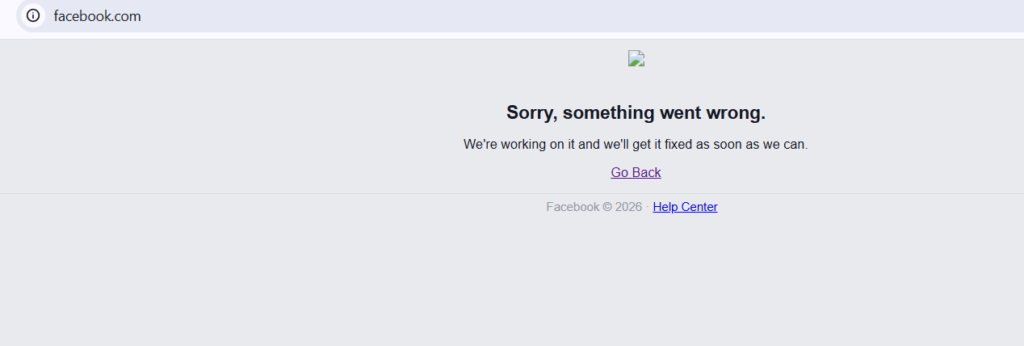
Users attempting to access Facebook through Facebook Lite, the standard Facebook mobile application, and desktop browsers were met with an error message stating:
“Sorry, something went wrong. We’re working on it and we’ll get it fixed as soon as we can.”
The outage left countless users unable to access their accounts, communicate with contacts, manage business pages, or conduct online transactions that rely heavily on Facebook’s ecosystem.
As of this writing, Meta Platforms Inc., the parent company of Facebook, has yet to issue an official advisory explaining the cause of the disruption or providing a timeline for restoration.
READ MORE ARTICLES:
- CNN Analyst Points to Record Inflation Disapproval After Trump’s Controversial Remarks
- Flesh-Eating Fly Infestation Confirmed, New World Screwworm Detected 30 Miles From Border; Quarantine and Sterile Fly Release Planned
- Iran Unblocks Most Underground Missile Sites, Poised for More Long-Range Strikes; Experts Flag Limits of US Bombing Strategy
- JUSTICE & TRUTH: The Long Road to Unlocking the Epstein Files
- Take It Down Act – A Major Step Forward in Protecting Digital Privacy and Dignity
Widespread Impact Across Asia
Reports of the outage quickly spread on other social media platforms as users from the Philippines, Thailand, Vietnam, Indonesia, Malaysia, and other parts of Asia complained about being unable to load Facebook services.
Many users initially believed the issue was isolated to their internet connection or devices. However, the growing number of reports from different countries suggested a larger platform-wide problem.
The outage affected both personal and professional users. Businesses that depend on Facebook for customer engagement, online sales, advertising, and communication found themselves unable to reach clients and customers.
For many small and medium-sized enterprises, Facebook serves as their primary online storefront. The disruption therefore caused immediate concerns regarding lost sales opportunities, delayed transactions, and interrupted customer service operations.
Businesses and Communities Disrupted
The impact extended beyond ordinary social networking.
Numerous entrepreneurs reported difficulties accessing business pages, responding to inquiries, and processing orders. Community organizations, schools, local government units, and content creators who use Facebook as their main communication channel were similarly affected.
Many users expressed frustration as important messages, announcements, and updates became temporarily inaccessible.
For overseas Filipino workers (OFWs), Facebook remains one of the most widely used platforms for communicating with family members back home. The outage therefore disrupted a vital communication tool relied upon by millions worldwide.
The sudden loss of Facebook connectivity has caused major disruptions across multiple sectors, affecting millions of users who rely on the platform for communication, entertainment, and business operations. The outage, which impacted access to Facebook’s main services including the mobile app, Facebook Lite, and desktop website, resulted in widespread frustration as users were unable to log in or load content.
One of the most immediate effects of the disruption was the loss of personal communication channels. Many individuals who depend on Facebook Messenger and Facebook profiles to stay connected with family and friends, especially those working or living abroad, suddenly found themselves cut off. Overseas Filipino Workers (OFWs), in particular, were heavily affected, as Facebook serves as one of the primary and most affordable ways to maintain contact with loved ones back home. Video calls, messages, and group chats were temporarily inaccessible, leaving users searching for alternative platforms.
The outage also had a significant impact on live streaming and content creation. Thousands of content creators, influencers, and small media pages who rely on Facebook Live for broadcasting events, updates, and entertainment content were unable to continue their scheduled streams. This interruption not only affected audience engagement but also led to potential financial losses for those who earn through digital monetization, sponsorships, and virtual events.
Businesses that depend on Facebook as a primary marketing and sales platform were likewise disrupted. Small and medium-sized enterprises, which use Facebook Pages and Messenger to communicate with customers, process orders, and promote products, experienced delays and confusion. Online sellers, in particular, faced difficulties responding to inquiries and confirming transactions, highlighting the platform’s central role in modern digital commerce.
Media organizations also felt the effects of the outage. Many news outlets use Facebook as a distribution channel to share breaking news, reach audiences instantly, and engage with readers. With the platform temporarily unavailable, their ability to disseminate information in real time was significantly reduced. This raised concerns about the heavy dependence of modern journalism on a single social media platform for audience reach.
On a broader scale, the incident once again exposed the vulnerability of global digital communication systems that rely heavily on a few major tech platforms. When Facebook experiences downtime, the ripple effect extends far beyond casual social media use, disrupting business operations, media distribution, and even emergency communication channels in some cases.
As connectivity was gradually restored, users resumed normal activity, but the outage served as a reminder of how deeply integrated Facebook has become in everyday life. From personal communication and entertainment to business transactions and global networking, the platform plays a critical role in maintaining modern digital connectivity—and when it fails, the impact is felt worldwide.
Speculation Surrounding Messenger Changes
The outage has also sparked speculation among users following recent discussions regarding Meta’s plans to further separate or modify Messenger services within its ecosystem.
Some users questioned whether the disruption could be connected to Meta’s previously announced platform changes and restructuring efforts involving Messenger integration.
However, there is currently no evidence linking the outage to any Messenger-related updates or policy changes.
Technology analysts caution against drawing conclusions until Meta releases an official statement explaining the incident.
Reports Emerging from the United States and Europe
Reports emerging from the United States and several European countries have confirmed that the recent Facebook disruption was not limited to Asia, as initially believed. Users from multiple regions experienced widespread difficulty accessing Facebook services, raising concerns that the incident may have involved a broader, global-scale technical failure.
At first, the outage appeared to primarily affect users in parts of Asia, where individuals reported being unable to load the Facebook app, Facebook Lite, and desktop versions of the platform. However, within a short period, similar complaints began surfacing from users in the United States and various European countries, indicating that the disruption had extended far beyond its initial scope.
Online outage monitoring platforms recorded a sharp and sudden spike in user-submitted reports. Thousands of individuals flagged issues such as failure to log in, blank feeds, missing posts, and complete inaccessibility of Facebook’s core services. The volume of complaints across different time zones suggested that the problem was not isolated, but rather affecting multiple segments of Facebook’s global network simultaneously.
In the United States, users reported intermittent connectivity problems, with some able to access the platform briefly before encountering errors. Others experienced complete outages, with pages failing to load entirely. Similar patterns were observed in Europe, where users from countries such as the United Kingdom, Germany, France, and Spain reported disruptions ranging from slow loading times to full service interruptions.
The growing number of reports across multiple continents has led analysts and users alike to speculate that the disruption may have been linked to Facebook’s global infrastructure rather than a localized server issue. Given the scale of the platform’s operations, even minor technical faults in centralized systems can trigger widespread consequences across regions.
Experts note that platforms like Facebook rely on highly interconnected data centers, content delivery networks, and authentication systems. A failure in any of these components—whether due to configuration errors, server overload, or internal system updates—can cascade quickly, leading to global service instability. While the exact cause of the recent outage has not been officially confirmed, the pattern of disruptions strongly suggests a large-scale technical malfunction rather than isolated regional downtime.
The incident also highlighted the growing dependence of billions of users worldwide on a single social media ecosystem. Facebook, which is widely used for personal communication, business operations, news distribution, and digital marketing, plays a critical role in everyday online activity. When the platform experiences downtime, the impact is immediately felt across personal, professional, and institutional levels.
For many users, especially those who rely on Facebook Messenger for international communication, the outage created a temporary breakdown in connectivity with friends, families, and business contacts abroad. Businesses that depend on Facebook Pages and advertising systems also reported interruptions in customer engagement and campaign performance, further emphasizing the platform’s global economic significance.
As service gradually stabilized in some regions, users began regaining access, though intermittent issues persisted for others. Despite the restoration of partial functionality, the incident has renewed discussions about the risks of overreliance on centralized social media platforms and the importance of diversified digital communication systems.
Authorities and digital analysts continue to monitor the situation closely, while users await a detailed explanation from Meta, Facebook’s parent company, regarding the root cause of the disruption.
One of the World’s Largest Platforms
The outage highlights the enormous influence Facebook continues to hold in global digital communications.
According to recent company figures, Facebook has more than 3.06 billion monthly active users worldwide, making it one of the largest social media platforms in history.
The platform is not only a social networking service but also a crucial tool for commerce, education, government communication, news dissemination, and community engagement.
Public figures, businesses, media organizations, and government agencies rely heavily on Facebook to reach audiences and distribute information.
The platform’s influence is reflected in its massive user base. Portuguese football superstar Cristiano Ronaldo currently holds one of the most-followed accounts on Facebook, with more than 172 million followers.
Growing Dependence on Social Media Infrastructure
The disruption once again demonstrates how dependent modern societies have become on major technology platforms.
A temporary outage can affect communication, business operations, customer service, marketing campaigns, emergency information dissemination, and personal connections between families and friends.
Experts note that while Facebook outages are relatively rare, their impact is often felt immediately because of the platform’s vast reach and integration into everyday life.
For many users, Facebook serves as more than a social network—it functions as a marketplace, news source, messaging platform, business directory, and community hub.
Awaiting Meta’s Explanation
As users continue to monitor the situation, attention is now focused on Meta’s response.
Industry observers expect the company to provide technical details once engineers determine the root cause of the outage.
Until then, millions of users across the Philippines, Asia, Europe, and North America remain affected by one of the most significant Facebook service disruptions in this days.
Whether the outage was caused by server issues, infrastructure failures, software updates, or network-related problems remains unclear.
For now, users can only wait as Meta works to restore normal operations and provide answers regarding the unexpected disruption that temporarily disconnected a substantial portion of the world’s largest social media network.