Tens of thousands of migrants who crossed into Spain’s North African territory of Ceuta have voluntarily returned to Morocco after a massive border crossing triggered chaos, claimed at least 57 lives, and sparked a humanitarian crisis that drew sharp condemnation from Spanish and European Union leaders. The unprecedented influx overwhelmed local authorities, prompted Spain to deploy additional security forces, and reignited debate over migration policies and border security across Europe.
CEUTA, Spain — Tens of thousands of migrants who crossed into Spain’s North African territory of Ceuta voluntarily returned to Morocco on Friday, following an extraordinary surge that overwhelmed local authorities, triggered a humanitarian emergency, and reignited debate over migration policies across Europe. The unprecedented influx, which unfolded over just two days, placed immense pressure on one of Europe’s most strategically important border regions and prompted swift responses from the Spanish government and European Union leaders.
Spanish officials reported that approximately 50,000 migrants entered Ceuta from neighboring Morocco beginning Thursday, marking one of the largest mass crossings ever recorded at the Spanish enclave. By Friday evening, the Spanish Interior Ministry announced that around 48,300 of those migrants had already returned voluntarily to Morocco, while hundreds more continued making their way back across the border as authorities worked to restore order.
The figures released by the Spanish government differed from those provided by Ceuta President Juan Jesús Vivas, who estimated that as many as 60,000 migrants had entered the territory an astonishing number equivalent to roughly 70 percent of Ceuta’s population. Regardless of the exact figure, the sudden influx transformed the city into the center of a rapidly unfolding humanitarian crisis.
The Moroccan Interior Ministry did not immediately respond to requests for comment regarding the migrant figures released by Spanish authorities, leaving unanswered questions about the circumstances that allowed such a massive movement of people across one of Europe’s most heavily monitored external borders.
The journey into Ceuta proved deadly for many attempting to reach Spanish territory. According to reports, at least 57 migrants lost their lives during the crossings. Many drowned while swimming several miles through the dangerous waters separating Morocco from Ceuta, while others died in a stampede near a breakwater barrier close to a border checkpoint as thousands attempted to enter the enclave simultaneously.
Witnesses described scenes of desperation as migrants risked everything in hopes of reaching European soil. Many swam through rough seas for hours, while others confronted security forces attempting to stop the crossings. Authorities reportedly used water cannons, tear gas, and warning shots in an effort to disperse crowds and prevent additional unauthorized entries. Despite these measures, thousands succeeded in reaching the territory before officials gradually regained control.
The scale of the crisis forced Spain to deploy additional police officers and members of its armed forces to Ceuta to restore public order and reinforce border security. Ceuta, located along the Strait of Gibraltar at the entrance to the Mediterranean Sea, has remained under Spanish sovereignty since 1580 and serves as one of only two European Union land borders with Africa.
- Mark Zuckerberg Summoned as Facebook Faces Possible Suspension in Philippines

- August–September 2026 Nurses Licensure Exam Results Released; 28,652 Pass
- Over 230,000 Fake Recruitment Posts Removed by Meta, TikTok Since 2022
- Roblox Corp. Unveils Comprehensive Safety Overhaul for Young Users 5 to 15 Age
- Lorna Kapunan | Education, Professional Career & Issue
- NLE G-K August–September 2026 Nurse Licensure Exam Passers





On the Moroccan side of the frontier, security forces also clashed with groups of migrants as authorities sought to regain control of the border area and prevent further crossings. The confrontations highlighted growing tensions surrounding irregular migration routes connecting North Africa and Europe.
Spanish Prime Minister Pedro Sánchez traveled to Ceuta on Friday to personally assess the situation and express support for local authorities and security personnel responding to the emergency. During his visit, Sánchez strongly condemned what he described as a violation of Spain’s territorial integrity and emphasized that the country’s borders must be respected.
The prime minister also blamed criminal human-smuggling organizations for exploiting vulnerable individuals by encouraging dangerous migration attempts. He stated that smugglers deceive countless young people with false promises of reaching Europe while ultimately placing their lives at grave risk.
“They deceive so many young people and ultimately lead many of them to their deaths,” Sánchez said, referring to those who perish either at sea or during dangerous attempts to cross heavily fortified borders.
European Commission President Ursula von der Leyen also expressed deep concern over the developments, describing the images emerging from Ceuta as unacceptable and calling for stronger enforcement of European migration policies.
“We cannot allow anyone to come to our Union without abiding by our rules,” von der Leyen said in an online statement. “Dangerous crossings must stop immediately. Smuggling networks must be dismantled. And returns must be swift, as our rules allow.”
Her remarks underscored the European Union’s continued commitment to strengthening border security while combating human-smuggling networks that profit from irregular migration.
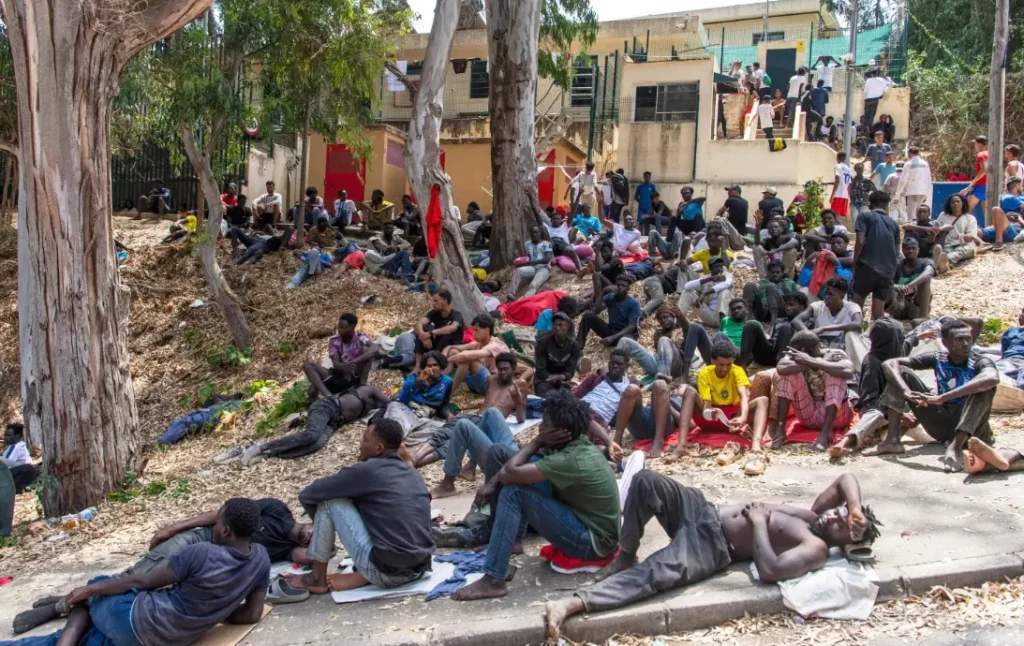
The humanitarian consequences of the crisis quickly became evident throughout Ceuta. Thousands of migrants, including large numbers of unaccompanied children, were left stranded with limited access to shelter, food, and medical assistance. Parks, sidewalks, and public spaces became temporary resting places as exhausted migrants waited for assistance or prepared to return to Morocco.
Rachid Sbihi, who heads a local workers’ association representing officers of Spain’s Civil Guard, described the situation as nothing short of a humanitarian emergency.
“It is a serious humanitarian crisis,” Sbihi said, explaining that thousands of migrants were sleeping outdoors while many others wandered the streets without clear destinations or support. “It’s chaotic.”
The sudden arrival overwhelmed emergency services, humanitarian organizations, and local authorities, all of whom struggled to provide basic assistance amid the sheer number of arrivals.
Beyond Spain, the events in Ceuta sent shockwaves across Europe. Governments in Italy and France announced plans to strengthen controls on individuals arriving from Spain amid concerns that migrants could continue traveling deeper into the European continent after reaching Spanish territory.
The developments have once again placed migration at the forefront of political debate within the European Union, where member states continue to grapple with balancing humanitarian responsibilities, border security, and coordinated immigration policies. The tragedy in Ceuta has also renewed calls for stronger international cooperation to combat human-smuggling networks while addressing the underlying economic hardship, conflict, and instability that continue to drive thousands of people to undertake life-threatening journeys in search of safety and opportunity.
Although the majority of migrants voluntarily returned to Morocco within a day of crossing, the events in Ceuta serve as a stark reminder of the immense human cost associated with irregular migration. With dozens of lives lost, thousands displaced, and political tensions once again rising across Europe, the crisis underscores the continuing challenge of managing migration while protecting human dignity and preventing further loss of life.
Dozens Killed as Ceuta Border Crisis Exposes Human Cost of Irregular Migration
The humanitarian crisis unfolding in Spain’s North African enclave of Ceuta turned increasingly tragic as officials confirmed that at least 57 migrants lost their lives during the massive border crossing, highlighting the deadly risks faced by thousands seeking a better future in Europe.
According to Rachid Sbihi, head of a local workers’ association representing Spain’s Civil Guard officers, several victims drowned while attempting the dangerous sea crossing from Morocco to Ceuta. Others were killed in a stampede as large crowds rushed toward the breakwater fence at Tarajal Beach, an urban shoreline located near one of the main border checkpoints between Morocco and the Spanish territory.
In the aftermath of the chaos, the waters surrounding the border fence painted a haunting picture of the desperate journey. Buoys, shoes, backpacks, clothing, and other personal belongings floated in the sea or lay scattered along the shoreline, serving as silent reminders of the perilous attempts made by thousands of migrants hoping to reach European soil.
For many of those who survived, the dream of finding safety and economic opportunity quickly gave way to disappointment. Large numbers of young Moroccan migrants who had crossed into Ceuta voluntarily began returning home after realizing the city could not provide the opportunities they had hoped to find amid the unfolding crisis.
Among them was 21-year-old Abdulah Buji from the Moroccan city of Tetouan, who said his decision to leave home was driven by the lack of decent employment opportunities.
“There is nothing at home,” Buji said. “I’d have to work 12-hour shifts for a meager wage. That’s why I came here. But I haven’t found any opportunities here either, so I have to go back.”
His story reflected the reality faced by many young migrants who viewed Europe as a chance to escape poverty and unemployment, only to encounter uncertainty, overcrowding, and increasingly strict border enforcement.
As thousands attempted to reach Ceuta, Moroccan security forces intensified efforts to stop additional crossings. Human rights organizations in Morocco reported that police deployed water cannons and fired warning shots into the air in an effort to disperse crowds gathering along the coastline and discourage further attempts to enter Spanish territory.
Despite the dramatic scenes at the border, Moroccan Ambassador to Spain Karima Benyaich emphasized that the developments did not reflect her country’s migration policy.
“We have always prioritized legal, orderly and safe migration for all,” Benyaich said, while declining to comment on what specifically triggered the sudden mass movement of migrants toward Ceuta.
Ceuta, situated on Africa’s northern coast but governed by Spain, has long served as one of Europe’s most sensitive migration entry points. Many migrants attempt to reach the enclave by swimming from the Moroccan town of Fnideq, a hazardous journey of approximately five kilometers across open water. Others depart from the nearby town of Belyounech, where the distance is shorter but the crossing remains dangerous due to strong currents and heightened border security.
Spanish authorities believe the unprecedented surge may have been fueled by misinformation surrounding a recent ruling by Spain’s Supreme Court. The court determined that migrants arriving in Spanish territory by sea could not be immediately deported under the same procedures applied to those who cross by land or scale border fences.
Prime Minister Pedro Sánchez argued that criminal human smuggling networks deliberately distorted the court’s decision, misleading thousands of vulnerable migrants into believing they would automatically be allowed to remain in Spain if they reached Ceuta by sea.
According to Sánchez, the false interpretation of the ruling spread rapidly through trafficking networks, encouraging desperate individuals to undertake dangerous journeys across the Mediterranean coastline.
“The interpretation of the Supreme Court’s ruling spread like wildfire over the past few hours through the networks of human trafficking organizations,” Sánchez said, adding that smugglers exploited vulnerable people by giving them false hope while exposing them to life-threatening risks.
The events in Ceuta have once again highlighted the complex challenges facing Europe as governments seek to balance humanitarian obligations with border security. While authorities continue investigating the circumstances surrounding the mass crossing, the deaths of dozens of migrants underscore the devastating consequences of misinformation, human trafficking, and desperate migration routes that continue to claim lives along Europe’s borders.
Pressure Mounts on Spain’s African Enclaves as Migration Crisis Spreads to Melilla
The migration crisis that overwhelmed Spain’s North African territory of Ceuta has expanded to the neighboring Spanish enclave of Melilla, raising fresh concerns over regional security, humanitarian conditions, and the growing pressure on Europe’s external borders. As authorities worked to restore order in Ceuta following one of the largest mass border crossings in recent history, thousands of migrants shifted their attention toward Melilla, triggering new clashes with security forces and heightening fears that the crisis could spread further across the region.
Reports from northern Morocco indicated that groups of migrants attempted to cross into Melilla, Spain’s second autonomous territory on the African continent, as border tensions continued to escalate. The attempted crossings came amid heightened security measures and growing political concern over the unprecedented surge in irregular migration that has placed enormous strain on Spanish authorities.
The situation was particularly volatile in the Moroccan border town of Bni Nsar, where widespread unrest erupted as migrants confronted Moroccan security forces in an effort to reach Melilla. According to local media reports and human rights organizations, demonstrators threw rocks at police officers and set several police vehicles on fire during the confrontations, creating scenes of chaos and violence along one of the region’s most closely monitored border areas.
Security forces responded by dispersing crowds and restoring order, while authorities reported multiple injuries among police officers during the clashes. Dozens of individuals attempting to cross into Melilla were arrested as Moroccan authorities intensified efforts to prevent additional unauthorized entries into Spanish territory.
The unrest in Bni Nsar reflects the mounting frustration among migrants who continue to seek entry into Europe despite increasingly strict border controls and heightened security operations. Many are fleeing poverty, unemployment, and limited economic opportunities, hoping to build better lives across the Mediterranean. However, their journeys have become increasingly dangerous as governments strengthen border enforcement and criminal smuggling networks continue exploiting vulnerable people with false promises of safe passage.
Melilla, like Ceuta, occupies a unique geopolitical position. Although located on the northern coast of Africa and surrounded by Moroccan territory, it remains a self-governing Spanish city and forms part of the European Union’s external border. Together, Ceuta and Melilla represent Europe’s only land frontiers with Africa, making them key gateways for migrants attempting to reach the continent.
For decades, both territories have been the focus of political and diplomatic sensitivity. While Spain maintains full sovereignty over Ceuta and Melilla, many Moroccans continue to regard the two cities as occupied territories, a longstanding dispute that has periodically strained relations between Rabat and Madrid. Although the current migration crisis has largely centered on humanitarian and security concerns, the renewed pressure on both enclaves has once again highlighted the broader geopolitical complexities surrounding their status.
Spanish authorities remain on high alert as they continue reinforcing security around both territories to prevent additional mass crossings. The government has deployed additional police officers and military personnel while coordinating closely with Moroccan authorities to restore stability along the shared border.
The developments in Melilla demonstrate that the challenges facing Spain extend beyond a single border crossing. Officials fear that unless the underlying causes of irregular migration including poverty, misinformation spread by human trafficking networks, and regional instability are effectively addressed, similar crises could continue to unfold along Europe’s southern frontier.
As Europe grapples with renewed migration pressures, the events in Ceuta and Melilla have reignited debate over border security, asylum policies, and international cooperation. The violence witnessed in Bni Nsar, coupled with the humanitarian emergency in Ceuta, underscores the urgent need for coordinated solutions that both protect national borders and safeguard the lives and dignity of those risking everything in search of a better future.
Ceuta Migrant Crisis Sparks Political Clash Across Europe as Spain Defends Immigration Policy
Spain’s handling of migration has come under intense political scrutiny after the unprecedented influx of tens of thousands of migrants into the North African enclave of Ceuta ignited a humanitarian emergency, intensified border security measures across Europe, and fueled a fierce debate over immigration policy.
The crisis, which saw approximately 50,000 migrants cross into Spanish territory from neighboring Morocco within a matter of hours, quickly evolved beyond a border emergency into a political flashpoint, with leaders across Europe weighing in on Spain’s immigration strategy and its broader implications for the European Union.
Prime Minister Pedro Sánchez firmly rejected claims that his government’s migration reforms were responsible for the surge, insisting that the events in Ceuta were unrelated to Spain’s recent efforts to regularize undocumented migrants already living in the country.
Earlier this year, Sánchez’s Socialist-led government introduced legislation aimed at granting residency and work permits to hundreds of thousands of migrants who had been living in Spain without legal authorization. The government argued that the measure would help address labor shortages, strengthen the economy, and respond to the country’s aging population by integrating long-term residents into the workforce.
Officials emphasized that the policy applied only to migrants who had entered Spain before January 1 of this year. Individuals arriving after that date, including those involved in the recent Ceuta crossings, were explicitly excluded from the legalization program.
Despite these distinctions, political opponents seized on the border crisis as evidence that the government’s immigration policies had encouraged irregular migration.
Among the most outspoken critics was conservative Madrid regional president Isabel Díaz Ayuso, who accused Sánchez of weakening Spain’s borders and exposing the country to uncontrolled migration.
“Sánchez allows Spain to be invaded through Ceuta,” Ayuso wrote on the social media platform X, reflecting growing criticism from opposition parties that have long argued for stricter immigration controls.
The political controversy quickly expanded beyond Spain’s borders as governments across Europe assessed the implications of the massive migrant influx.
The United States also voiced support for Spain and other European nations affected by irregular migration. In a statement posted on X, the U.S. State Department expressed solidarity with “the people of Spain, and all Europeans, against this egregious violation of their sovereignty and human rights.”
The department further described the border surge as “the direct result of the Spanish Government’s deliberate efforts to enable and facilitate mass illegal migration into Europe,” adding another international dimension to the already heated debate.
Prime Minister Sánchez strongly rejected those accusations, maintaining that Spain’s immigration reforms had been misrepresented and had no connection to the sudden events in Ceuta.
“The crisis in Ceuta has nothing to do with the regularization of migrants adopted by the Government of Spain, as is being falsely claimed by some,” the Spanish government said in an official statement released late Thursday.
Spanish officials argued that the extraordinary border crossings were instead fueled by misinformation spread through criminal human smuggling networks, which allegedly distorted a recent ruling by Spain’s Supreme Court concerning migrants arriving by sea. According to the government, traffickers exploited the ruling to convince vulnerable people that reaching Spanish territory would automatically guarantee them legal protection.
As the situation unfolded, neighboring European countries moved swiftly to tighten border controls.
Italy temporarily suspended the practical application of its open-border travel arrangements with Spain under the Schengen system by reinstating passport checks for travelers arriving by air and sea. While Italy’s Interior Ministry described the move as effectively closing its borders with Spain, legal experts clarified that the decision represented a temporary reintroduction of border controls rather than a suspension of Spain’s membership in the Schengen Area.
The Schengen Agreement normally allows travelers to move freely between participating European countries without routine passport inspections, making Italy’s decision a significant response to concerns over secondary migration.
France also announced enhanced security measures along its border with Spain. French Interior Minister Laurent Nunez confirmed that authorities would strengthen border inspections to monitor movements from Spain more closely, reflecting broader concerns among European governments that migrants entering Ceuta could eventually travel deeper into the continent.
The developments have once again exposed deep divisions within Europe over migration policy. While some governments continue to advocate for stronger border enforcement and faster deportation procedures, others argue that long-term solutions must address labor shortages, humanitarian responsibilities, and the root causes driving migration from Africa and other regions.
For Spain, the events in Ceuta have become both a humanitarian challenge and a political test. As authorities continue restoring order and coordinating the voluntary return of thousands of migrants to Morocco, the government faces mounting pressure to reassure both domestic critics and European partners that its immigration policies remain firmly aligned with border security.
The Ceuta crisis has underscored the fragile balance between protecting national borders, respecting humanitarian obligations, and maintaining unity within the European Union. With political tensions rising and migration once again dominating public debate, the events are likely to shape immigration discussions across Europe for months to come. / APNews