The Court of Appeals (CA) has ordered China Banking Corporation (Chinabank) to pay nearly P70 million, exclusive of legal interest, to a longtime depositor couple after affirming the bank’s liability for a missing trust fund investment and millions of pesos in unauthorized withdrawals. The appellate court ruled that Chinabank failed to exercise the extraordinary diligence expected of banks, holding it directly responsible for fraudulent acts committed by one of its officers in the performance of her official duties.
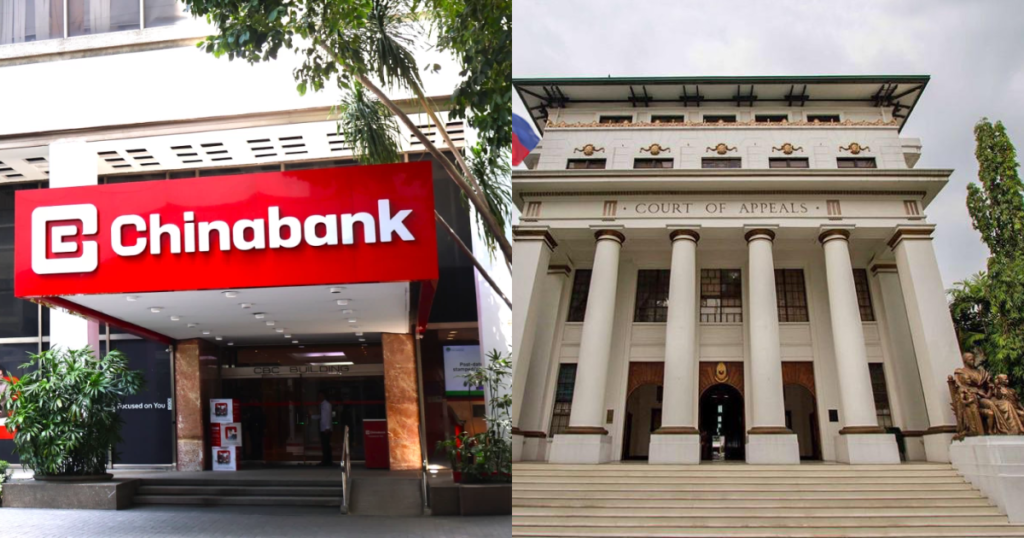
MANILA, Philippines The Court of Appeals (CA) has affirmed a lower court ruling ordering China Banking Corporation (Chinabank) to pay nearly P70 million, excluding legal interest, to a longtime depositor couple after a missing trust fund investment and millions of pesos in unauthorized withdrawals were traced to failures in the bank’s internal safeguards.
In a decision that underscores the extraordinary level of diligence required of financial institutions, the CA’s Thirteenth Division upheld the ruling of the Manila Regional Trial Court (RTC) in favor of spouses Remigio and Elvira Godoy, who successfully proved that the bank failed to protect their deposits and prevent fraudulent transactions carried out under the apparent authority of one of its officers.
The appellate court dismissed Chinabank’s appeal and sustained the trial court’s findings that the bank breached its contractual obligations to the couple, emphasizing that banks occupy a position of public trust and are legally required to exercise the highest degree of care in handling clients’ money.
Court records showed that the Godoy spouses had been loyal depositors of Chinabank for years when personnel from the bank’s Blumentritt branch in Manila encouraged them to transfer funds from a time deposit into the bank’s Trust Fund product, promising higher investment returns.
Trusting the recommendation of bank officials, the couple issued checks to then Assistant Branch Manager Maria Victoria Ang, who later provided them with a Fund Balance Advice reflecting an investment amounting to P29.396 million. The document led the spouses to believe that their money had been successfully placed in the trust investment.
- Enrique Razon Reigns as Philippines’ Richest Billionaire for Third Consecutive Year

- Marcos Appoints Ronald Chua as New Sandiganbayan Justice; Randolph Pascasio Named to Court of Appeals
- Rafael Consing, Maharlika Loan Fuels Celsius Foreclosure Case Over Kalinga Mine
- ICC Defends Independence Following Sara Duterte’s Marcos Puppet Allegations in The Hague
- No to Pax Silica’ in the Philippines as Critics Raise Concerns Over Sovereignty, Environment, and Economic Benefits
- Sara Duterte Witness Says OVP Used Gym Bags for ₱500 Million






However, when the investment reached maturity and the couple sought to renew or roll over the trust fund, they received a shocking response from bank personnel. They were informed that no trust account bearing their investment existed in the bank’s records.
The revelation prompted a deeper investigation into their accounts, eventually uncovering an even more alarming discovery. More than P38.763 million had allegedly been withdrawn and transferred from their accounts through transactions that they neither authorized nor approved. The funds had reportedly been sent to unknown recipients without the couple’s knowledge.
Believing they had become victims of negligence and fraud, the Godoys filed a civil case against Chinabank seeking the recovery of their missing funds, as well as damages arising from the financial and emotional distress they suffered.
The Manila RTC ruled in favor of the spouses, finding the bank liable for the losses. Chinabank later elevated the case to the Court of Appeals, arguing that it should not be held responsible because Assistant Branch Manager Maria Victoria Ang was not named as a defendant in the lawsuit. The bank likewise questioned the RTC’s findings regarding breach of contract and unauthorized fund transfers.
The Court of Appeals, however, found the bank’s arguments unpersuasive.
In the July 17 decision penned by Associate Justice Ferdinand Baylon, the appellate court stressed that the losses suffered by the Godoy spouses were primarily caused by Chinabank’s own negligence in supervising its personnel and ensuring that adequate verification procedures were in place before allowing significant financial transactions to proceed.
The court ruled that banks cannot evade responsibility for fraudulent acts committed by their employees when those acts are performed under the authority and responsibilities entrusted to them by the institution itself.
“The proximate cause of appellees’ losses was appellant’s own negligence in failing to implement adequate verification procedures and safeguards to ensure the legitimacy of the questioned transactions. This liability is not merely vicarious. The negligent and fraudulent acts of appellant’s officers and employees, committed in the discharge of their functions, are attributable to the bank itself,” the Court of Appeals stated in its ruling.
The appellate court further rejected Chinabank’s contention that it could not be held liable simply because Ang had not been included as a defendant in the case.
According to the court, the legal and contractual relationship existed directly between the bank and its depositors—not between the depositors and an individual employee. As such, the bank remained accountable for transactions carried out by personnel acting within the apparent scope of their authority.
The court explained that Chinabank itself created the circumstances that enabled the fraudulent acts by allowing Ang to transact directly with depositors while presenting her as a bank officer authorized to handle customer investments.
“By cloaking Ang with apparent authority and permitting her to deal directly with depositors, appellant created the very conditions that enabled the fraud. Thus, appellant cannot disclaim responsibility for the consequences of Ang’s acts, which were committed under the mantle of authority that it itself conferred upon her,” the appellate court declared.
The decision also highlighted the bank’s failure to produce essential documents that could have demonstrated the legitimacy of the disputed transactions.
Despite claiming that the transfers had been properly executed, Chinabank failed to present transfer instructions, deposit slips, debit memoranda, or any written authorization bearing the signatures of the Godoy spouses.
The Court of Appeals noted that because the bank had exclusive custody of these records, it bore the responsibility of presenting them before the court.
Its failure to produce such evidence further weakened its defense.
“Having exclusive custody and control of the documents necessary to establish the authenticity and authorization of the questioned transactions, appellant cannot now rely on the absence of proof when its own omission prevented the presentation of the best evidence available,” the court emphasized.
Under the affirmed judgment, Chinabank has been ordered to pay the Godoy spouses P29.396 million representing the missing trust fund investment and P38.763 million corresponding to the unauthorized withdrawals and transfers from their accounts.
The bank was likewise directed to pay P1.5 million in moral damages, exemplary damages, and attorney’s fees.
In addition to the monetary awards, the court imposed 6 percent annual legal interest, computed from the spouses’ extrajudicial demand dated May 3, 2017, with all accrued interest continuing to earn 6 percent annually until the judgment is fully satisfied.
The ruling reinforces long-standing legal principles recognizing banks as institutions vested with public confidence. Philippine jurisprudence consistently requires banks to exercise extraordinary diligence in protecting depositors’ money, maintaining accurate financial records, and ensuring that employees strictly comply with internal controls and banking regulations.
Legal observers note that the decision serves as another significant reminder that financial institutions may be held directly liable when weak internal controls, inadequate supervision, or failures in verification procedures enable fraud or unauthorized transactions. The judgment likewise strengthens the protection afforded to depositors, affirming that banks cannot escape accountability by shifting blame solely to individual employees when those employees acted under the authority granted by the institution itself.