It Would Take a Filipino Minimum Wage Earner Nearly 247 Million Years to Earn $1 Trillion
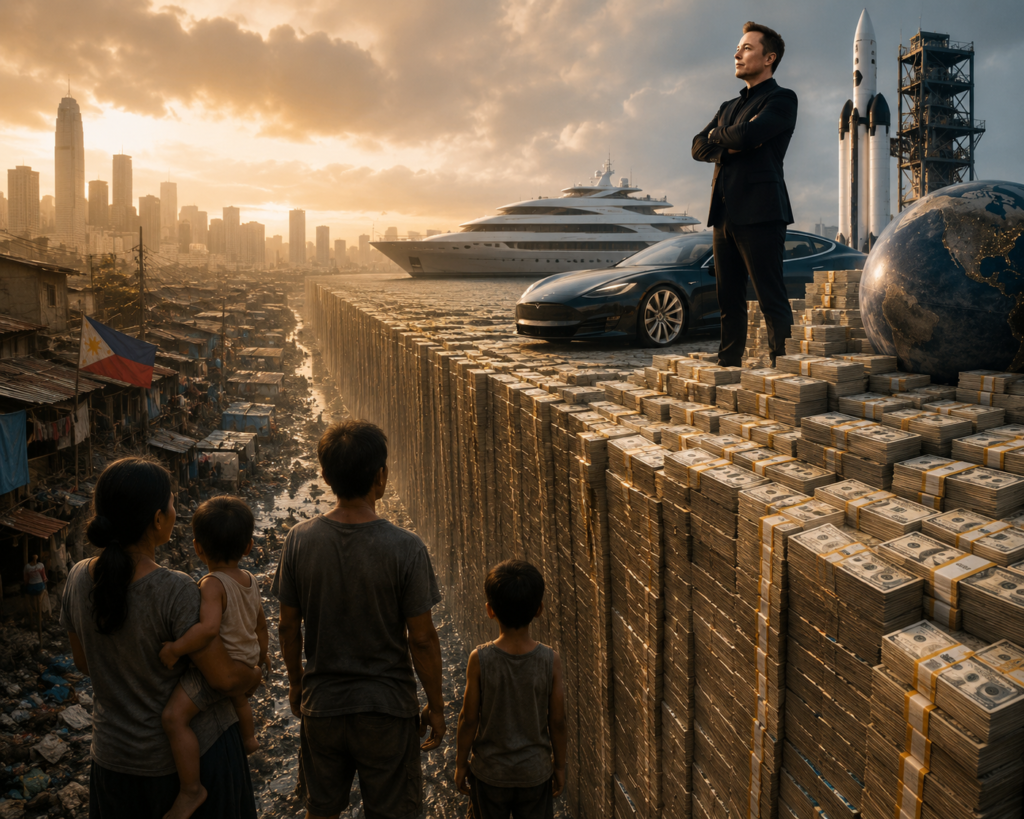
As discussions continue around Elon Musk’s reported rise as the world’s first trillionaire, many Filipinos may wonder just how enormous a trillion-dollar fortune really is.
The answer is almost beyond imagination. Based on current exchange rates and the highest minimum wage in the Philippines, a Filipino worker would need approximately 246.9 million years to accumulate $1 trillion—and that is under the impossible assumption that every peso earned is saved and not a single centavo is spent.
Converting One Trillion Dollars into Philippine Pesos. Using an estimated exchange rate of ₱58.00 per US dollar, a fortune worth $1 trillion would be equivalent to:
₱58 trillion
This staggering figure is written numerically as:
₱58,000,000,000,000 To put that into perspective, the amount is several times larger than the annual national budget of the Philippines and exceeds the economic output of many countries around the world.
The Highest Minimum Wage in the Philippines
According to the National Wages and Productivity Commission (NWPC), the highest daily minimum wage in the country is found in the National Capital Region (NCR), where non-agricultural workers receive ₱695 per day.
Assuming a worker is employed six days a week, they would work approximately 312 days per year. Adding the mandatory 13th-month pay, equivalent to about 26 additional days of wages, results in a total of 338 paid days annually.
At ₱695 per day, the worker’s total yearly income would amount to:
₱234,910 per year, to determine how long it would take for a minimum wage earner to save ₱58 trillion, the total amount is divided by the worker’s annual income:
₱58,000,000,000,000 ÷ ₱234,910 = 246,903,069 years
The result is astonishing. A Filipino minimum wage earner would need approximately 246.9 million years to accumulate a trillion dollars’ worth of wealth.
READ MORE ARTICLES:
- Elon Musk becomes world’s first trillionaire as SpaceX IPO Reshapes Global Wealth, New Age of Extreme Wealth or A Warning for Humanity?
- Donald Trump Rushes Iran Deal as Tehran Pushes Back: Diplomatic Drama Exposes Deep Mistrust Behind “Historic” Agreement
- Millions Affected as Facebook Suffers Major Outage Across the world
- CNN Analyst Points to Record Inflation Disapproval After Trump’s Controversial Remarks
Longer Than the Age of Dinosaurs: The Staggering Reality of a Trillion-Dollar Fortune
The size of a trillion-dollar fortune is difficult for most people to imagine. One way to understand it is by comparing it to the age of dinosaurs.
Based on calculations using the highest minimum wage in the Philippines, a worker earning ₱695 per day would need nearly 247 million years to save enough money to reach $1 trillion, assuming every peso earned was saved and nothing was spent.
For comparison, dinosaurs first appeared on Earth around 230 million years ago. This means a Filipino minimum wage earner would need to work and save for a period longer than the entire time that has passed since dinosaurs first walked the planet.
The comparison shows just how enormous a trillion-dollar fortune really is. While ordinary workers spend years saving for education, housing, food, and daily necessities, a trillion dollars represents a level of wealth that is almost impossible to comprehend. It is an amount so large that it exceeds the lifetime earnings of countless generations of workers.
As discussions continue about the rise of the world’s first trillionaire, the numbers highlight the growing gap between the wealthiest individuals and ordinary people. For many, the comparison serves as a reminder of the extraordinary scale of modern wealth and the economic challenges faced by workers around the world.
Most people can easily understand the difference between one thousand and one million. However, the jump from a billion to a trillion is far greater than many realize.
One trillion dollars is not merely a thousand billion dollars on paper—it represents a level of wealth so vast that it becomes difficult to relate to everyday life and human experience.
For the average Filipino worker struggling with rising food prices, transportation costs, rent, and household expenses, a trillion-dollar fortune belongs to an entirely different economic universe.
The calculation serves as a powerful reminder of the immense scale of global wealth concentration. While technological innovators and business leaders continue to build fortunes measured in hundreds of billions or even trillions of dollars, the average worker’s earnings remain measured in thousands of pesos per week.
Whether viewed as a symbol of entrepreneurial success or as evidence of growing economic inequality, one fact remains undeniable:
If a Filipino minimum wage earner started saving every peso today, it would take nearly 247 million years to reach a fortune worth $1 trillion.
That is a length of time so vast that it stretches beyond recorded human history and deep into the age of the dinosaurs.
Elon Musk’s Trillion-Dollar Fortune Is Equivalent to the Entire Economy of Some Nations
The emergence of Elon Musk as the world’s first trillionaire has sparked fascination across the globe. While the figure of $1 trillion is difficult for most people to comprehend, economists offer a simple way to understand its scale: compare it to the annual economic output of entire countries.
In economic terms, a trillion dollars is not merely a large fortune—it is the equivalent of the Gross Domestic Product (GDP) of a medium-sized developed nation. Economists often refer to countries that generate at least $1 trillion in annual economic output as members of the exclusive “Trillion Dollar Club.”
Wealth Equal to an Entire Nation
A fortune worth $1 trillion is roughly equivalent to the total value of all goods and services produced in a year by some of the world’s most developed economies.
Countries whose annual GDP is close to the trillion-dollar mark include:
- Saudi Arabia, with an economy valued at approximately $1.1 trillion.
- The Netherlands, generating around $1.05 trillion annually.
- Turkey, with an economy worth about $1.02 trillion.
- Switzerland, whose GDP fluctuates between $900 billion and $1 trillion.
This means that a single trillion-dollar fortune represents the same amount of economic activity generated by tens of millions of people, thousands of businesses, and entire national industries over the course of a year.
For many observers, this comparison places Musk’s wealth into a perspective that simple numbers cannot.
Twice the Size of the Philippine Economy
The comparison becomes even more striking when viewed from a Philippine perspective.
According to recent international economic estimates, the Philippines generates approximately $512 billion in GDP annually. This means that $1 trillion is nearly double the entire economic output of the country.
In practical terms, the combined annual production of more than 115 million Filipinos is only about half of a trillion dollars.
To reach the trillion-dollar threshold, the economies of both the Philippines and Malaysia would need to be combined. Together, their annual economic output would roughly equal $1 trillion.
The comparison highlights the extraordinary concentration of wealth represented by a trillion-dollar fortune.
While a trillion dollars is enough to rival the economies of many countries, it remains only a fraction of the economic power generated by the world’s largest nations.
The United States, the world’s largest economy, produces approximately $32.4 trillion worth of goods and services every year. At that scale, $1 trillion represents only a small portion of the country’s annual output—equivalent to roughly eleven days of economic activity.
China, the world’s second-largest economy, generates approximately $20.8 trillion annually, while Germany produces around $5.4 trillion.
These figures demonstrate the vast differences that exist not only between individuals and ordinary workers but also between nations themselves.
The rise of the world’s first trillionaire marks a historic milestone in modern economics. Never before has a single individual accumulated wealth comparable to the annual economic output of an entire nation.
Supporters argue that such fortunes are the result of innovation, entrepreneurship, and technological breakthroughs that create value on a global scale. Critics, however, view the trillion-dollar milestone as evidence of widening wealth inequality and growing concentrations of economic power.
Regardless of where one stands in the debate, the numbers are staggering.
A trillion dollars is not merely a billionaire becoming richer. It is wealth measured on the same scale as countries, governments, and national economies.
For most people, it is a number too large to visualize. But when compared to nations such as Saudi Arabia, the Netherlands, Turkey, Switzerland, or even nearly two years of the Philippines’ entire economic output, its true magnitude becomes impossible to ignore.
The age of the trillionaire has arrived, and it is reshaping how the world understands wealth itself.
Elon Musk’s $1.1 Trillion Fortune Equals Nearly 67 Times the Wealth of the Richest Filipino
The reported rise of Elon Musk to a net worth of approximately $1.1 trillion in 2026 has placed his wealth on a scale that is difficult to imagine. Following the successful public offering of companies such as SpaceX, Musk became the first person in history to reach the trillion-dollar milestone.
To better understand the size of his fortune, it can be compared to the wealth of the richest individuals in the Philippines.
According to the latest Forbes rankings, the wealthiest Filipino is business tycoon Enrique Razon Jr., whose estimated net worth stands at about $16.5 billion. While Razon remains one of the most successful businessmen in Southeast Asia, his fortune is only a fraction of Musk’s wealth.
A comparison shows that Elon Musk’s estimated $1.1 trillion net worth is equivalent to nearly 67 times the wealth of Enrique Razon Jr.
Even more striking is the fact that the combined wealth of the Philippines’ richest billionaires still falls far short of Musk’s fortune. The total wealth of the country’s 15 richest billionaires is estimated at around $53 billion, while the combined wealth of the 50 richest Filipinos is approximately $86 billion.
Despite combining the fortunes of the nation’s wealthiest families and business leaders, Elon Musk would still be around 13 times richer than all of them combined.
The comparison becomes even more astonishing when viewed from the perspective of an ordinary Filipino worker.
Using the highest minimum wage rate in Metro Manila of ₱695 per day, a worker earns approximately ₱234,910 per year, including the mandatory 13th-month pay.
At an exchange rate of ₱58 to one US dollar, Musk’s $1.1 trillion fortune would be worth about ₱63.8 trillion.
Based on this amount, a minimum wage earner would need to work continuously for more than 271 million years to accumulate the same wealth, assuming every peso earned was saved and not a single peso was spent.
To put that into perspective, dinosaurs first appeared on Earth roughly 230 million years ago. In other words, a Filipino worker would need to save for a period longer than the age of the dinosaurs just to match Musk’s current fortune.
The figures highlight the extraordinary scale of modern wealth and the vast gap between the world’s richest individuals and ordinary workers. Whether viewed as a symbol of innovation and entrepreneurship or as evidence of growing economic inequality, Elon Musk’s trillion-dollar milestone has become one of the most remarkable financial achievements in modern history.
Elon Musk’s ₱63.8 Trillion Fortune Is Larger Than Most Filipinos Can Imagine
The rise of Elon Musk to a net worth of approximately $1.1 trillion has created a historic moment in global finance. At an exchange rate of ₱58 to one US dollar, his fortune is equivalent to an astonishing ₱63.8 trillion. While the number itself is difficult to comprehend, its true scale becomes clearer when compared with the economy, government finances, and salaries in the Philippines.
To many Filipinos, a million pesos is already a life-changing amount of money. A billion pesos is enough to build businesses, buy vast properties, and secure generations of wealth. A trillion pesos, however, belongs to an entirely different universe. Musk’s estimated wealth is not just a trillion pesos—it is more than sixty-three trillion pesos, a figure so massive that it rivals the resources of entire nations.
The enormity of this fortune becomes evident when compared with the Philippine economy. According to international economic estimates, the Philippines generates roughly $512 billion worth of goods and services every year. This represents the combined efforts of millions of workers, farmers, fishermen, teachers, nurses, engineers, office employees, factory workers, entrepreneurs, and corporations spread across more than 7,000 islands. Yet Musk’s fortune is worth more than twice the country’s annual economic output. In simple terms, if every Filipino worked continuously and every peso generated by the country’s economy were handed over without spending anything on food, housing, transportation, healthcare, or education, it would still take more than two years to equal the wealth of one man.
The comparison becomes even more remarkable when viewed against the Philippine government’s national budget. The government’s annual budget funds public schools, hospitals, infrastructure projects, social welfare programs, national defense, law enforcement, and the salaries of millions of public servants. For 2026, the national budget stands at approximately ₱6.793 trillion. Musk’s fortune of ₱63.8 trillion could theoretically finance the entire Philippine government for nearly a decade. Imagine every public school operating, every government hospital functioning, every road project continuing, and every government employee receiving compensation for almost ten years using an amount equivalent to one person’s estimated wealth.
The scale becomes even harder to grasp when compared with individual earnings. The President of the Philippines, one of the highest-paid government officials in the country, earns approximately ₱5.5 million annually, including bonuses and benefits. At that rate, it would take more than 11.6 million years of continuous service to accumulate wealth equal to Musk’s fortune. That period is far longer than the entire history of human civilization. In fact, it stretches back to a time when early human ancestors had not yet appeared on Earth.
These comparisons highlight a reality that economists and financial analysts have increasingly discussed in recent years: the concentration of wealth at the very top of the global economy has reached levels previously unimaginable. A trillion-dollar fortune is no longer simply a personal achievement or a financial milestone. It represents economic power on a scale comparable to governments and nations. It is wealth measured not in terms of houses, cars, or luxury goods, but in terms of entire economies, national budgets, and the lifetime earnings of millions of people.
Supporters argue that fortunes of this magnitude reflect extraordinary innovation, entrepreneurship, and risk-taking. Musk’s companies have transformed industries ranging from electric vehicles and renewable energy to space exploration, satellite communications, and artificial intelligence. Critics, however, point to the widening gap between the world’s wealthiest individuals and ordinary workers, raising questions about inequality, economic opportunity, and the distribution of resources in modern society.
Regardless of one’s perspective, the numbers speak for themselves. A fortune worth ₱63.8 trillion is not merely large—it is almost beyond human comprehension. It is greater than the annual output of many countries, enough to fund governments for years, and so vast that even the highest-paid public officials would need millions of years to earn an equivalent amount. As the world enters the age of the trillionaire, Elon Musk’s wealth serves as a striking reminder of how dramatically wealth and economic power can be concentrated in the modern era.
Elon Musk’s $1.1 Trillion Fortune Could Cover Metro Manila, Reach Beyond Space, and Stretch to the Moon 13 Times
The announcement that Elon Musk’s net worth has surpassed $1.1 trillion has left many people struggling to understand just how large such a fortune truly is. Numbers at this scale are almost impossible for the human mind to visualize. A million dollars sounds enormous. A billion dollars seems unimaginable. But a trillion dollars exists in an entirely different universe of wealth.
To better understand the magnitude of Musk’s fortune, imagine converting every dollar of his estimated $1.1 trillion wealth into Philippine currency. Using an exchange rate of approximately ₱58 per US dollar, his fortune would be worth about ₱63.8 trillion. Now imagine that entire amount transformed into physical ₱1,000 bills.
The result would be a staggering 63.8 billion individual banknotes.
If those ₱1,000 bills were laid flat on the ground side by side like a giant carpet, they would occupy an area of approximately 67,373 hectares. That figure is difficult to picture until it is compared with something familiar. The entire National Capital Region, commonly known as Metro Manila, covers roughly 61,950 hectares. In other words, Elon Musk’s fortune, converted entirely into ₱1,000 bills, could blanket the whole of Metro Manila—from the northern cities of Valenzuela and Caloocan to the southern communities of Muntinlupa and Alabang—with enough money left over to extend into neighboring areas of Rizal and Cavite.
The comparison illustrates a level of wealth so vast that it could physically cover one of the most densely populated metropolitan regions in Southeast Asia.
Yet the scale becomes even more astonishing when viewed from another perspective.
Imagine stacking every one of those ₱1,000 bills on top of one another to create a single tower of money reaching toward the sky. Such a tower would rise approximately 7,018 kilometers above the Earth’s surface. For comparison, the International Space Station orbits our planet at an altitude of only about 400 kilometers. Musk’s tower of money would soar far beyond the station’s orbit and extend deeper into space than many satellites.
The tower would even exceed the Earth’s radius, which measures about 6,371 kilometers from its center to the surface. In practical terms, the pile of cash would not merely touch space—it would reach thousands of kilometers beyond it.
Perhaps the most incredible comparison comes when imagining those same ₱1,000 bills arranged end to end in a single continuous line. Such a chain of banknotes would stretch approximately 10.2 million kilometers in length.
To appreciate this distance, consider that the average distance between the Earth and the Moon is approximately 384,400 kilometers. Musk’s line of money would be long enough to travel from Earth to the Moon and back again not once, not twice, but thirteen consecutive times.
A person could theoretically begin laying out the bills from Earth, reach the Moon, return home, and repeat the journey over and over again before running out of banknotes.
These comparisons reveal why trillion-dollar fortunes are so difficult to comprehend. At this level, wealth can no longer be measured through ordinary experiences such as salaries, houses, vehicles, or even large corporations. It begins to rival the scale of cities, countries, and astronomical distances.
For the average worker, earning enough money to buy a home, support a family, or save for retirement can take decades of hard work. By contrast, a fortune worth $1.1 trillion represents wealth on a scale that transcends normal human experience. It is large enough to cover major cities, build towers that extend into space, and create lines of money stretching millions of kilometers across the solar system.
Whether viewed as a symbol of entrepreneurial success, technological innovation, or the growing concentration of wealth in modern society, one thing is undeniable: Elon Musk’s fortune is so immense that traditional numbers fail to capture its true size. Only comparisons involving entire cities, outer space, and journeys to the Moon begin to reveal just how extraordinary a trillion-dollar fortune really is.