Tensions between the Philippines and China are escalating as a diplomatic row over reported remarks by Chinese Ambassador Jing Quan intensifies growing concerns over Beijing’s actions in the West Philippine Sea, with Philippine officials and lawmakers defending the country’s sovereignty amid continuing maritime disputes, competing territorial claims, and rising calls for accountability.
MANILA — Tensions between China and the Philippines are intensifying as disputes over the West Philippine Sea, competing maritime claims, and increasingly confrontational diplomatic statements continue to strain relations between the two countries. The latest controversy involving Chinese Ambassador to the Philippines Jing Quan has drawn criticism from Filipino lawmakers and government officials, renewing concerns about regional security, national sovereignty, and diplomatic efforts to prevent further escalation in the South China Sea.
The diplomatic dispute gained attention following remarks attributed to Jing on October 15, 2026, in which he reportedly said that China could easily win if it chose to use force. The statement, according to the supplied account, drew strong reactions from Philippine officials, who argued that threatening language has no place in diplomatic relations between neighboring countries. The controversy has added another layer of tension to an already complicated relationship shaped by years of disagreements over maritime boundaries, access to fishing grounds, and the presence of Chinese vessels in waters claimed by the Philippines.
The Philippine Department of Foreign Affairs, Defense Secretary Gilberto Teodoro Jr., and several senators, including JV Ejercito and Senate Tito Sotto, were among those cited as criticizing the reported remarks. Their reactions reflect broader concerns within the Philippine government about protecting the country’s sovereignty and ensuring that disagreements are addressed through international law and peaceful diplomatic engagement. Some lawmakers have also called for certain Chinese Embassy officials to be declared persona non grata, a designation that expresses a host country’s objection to a foreign representative’s presence. According to the supplied account, Jing said he would be prepared to leave the Philippines if President Ferdinand Marcos Jr. ordered him to do so.
READ OTHER ARTICLES:
- China-Philippines Tensions Escalate Over West Philippine Sea Dispute
- Hurricane Simon Batters Mexico as Floods Swallow Coastal Communities
- Russia Denies Plague as Lab Worker Dies, World Demands Answers
- Francis Leo Marcos Arrested Again Over Three Cyberlibel Cases
- Housing Fury Erupts Across Spain as Protesters Clash With Police
The Chinese Embassy, meanwhile, has accused some Philippine officials of spreading misinformation and fueling public hostility toward China. Among those reportedly targeted by these accusations is Philippine Coast Guard spokesperson Rear Admiral Jay Tarriela, who has frequently addressed maritime incidents and China’s activities in disputed waters. The competing accusations highlight how the maritime dispute has expanded beyond encounters at sea into a broader struggle over public messaging, diplomatic credibility, and the interpretation of events in the region.
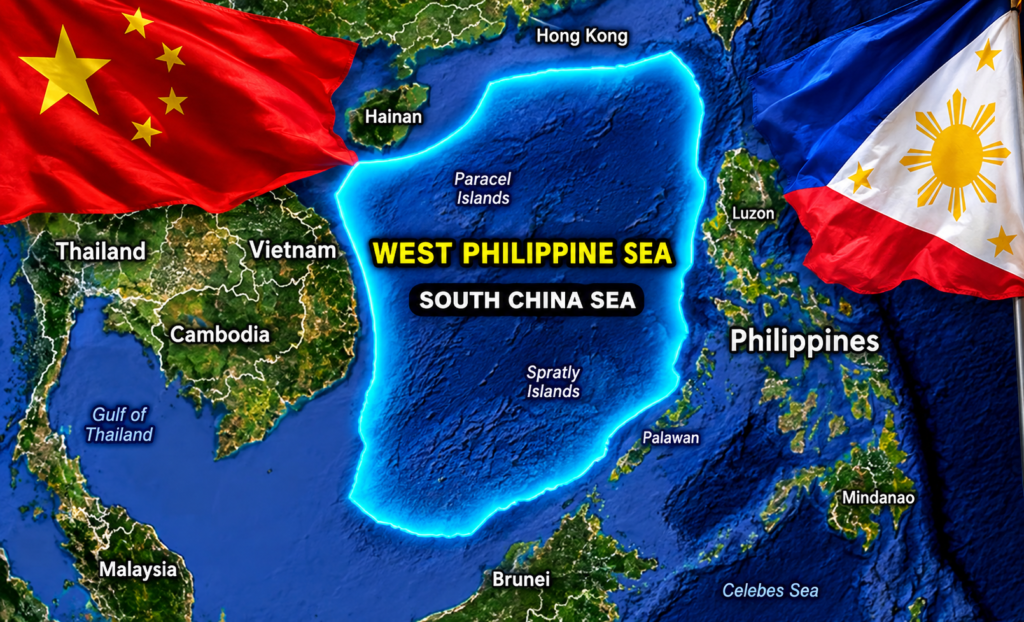
At the heart of the disagreement is the West Philippine Sea, the name used by the Philippines for maritime areas in the western part of its archipelago, including areas within its exclusive economic zone in the South China Sea. Philippine officials have repeatedly objected to the presence and activities of Chinese coast guard and other government vessels in waters where Manila asserts maritime rights under international law. China, which claims extensive areas of the South China Sea, rejects key aspects of the Philippine position and maintains that its own territorial and maritime claims should be respected.
Encounters involving Chinese and Philippine vessels have become a major source of friction. Philippine authorities have reported incidents involving dangerous maneuvers, collisions, the use of water cannons, and physical confrontations in disputed waters. Manila has also raised concerns about incidents affecting personnel involved in maritime resupply operations, while reports of injuries and confrontations have intensified public scrutiny of the dispute. Each incident risks deepening mistrust between the two governments, particularly when the parties offer conflicting accounts of what happened and who was responsible.
For Filipino fishing communities, the dispute has consequences that extend well beyond diplomatic statements and military strategy. Access to traditional fishing grounds, including waters around Scarborough Shoal, locally known as Bajo de Masinloc, remains a major concern for fishermen whose livelihoods depend on marine resources. Philippine officials and fishing advocates have objected to actions they say intimidate Filipino fishermen or prevent them from operating in areas where they claim the right to fish. Such restrictions can lead to reduced incomes, higher operating costs, and uncertainty for families that depend on their daily catches to survive.
The dispute also involves Ayungin Shoal, known internationally as Second Thomas Shoal, where the Philippines maintains a small military presence aboard the grounded naval vessel BRP Sierra Madre. Resupply missions to Filipino personnel stationed there have repeatedly become flashpoints between Philippine and Chinese vessels. Manila maintains that its operations support personnel at a Philippine military outpost, while Beijing claims the shoal and objects to Philippine activities there. These competing positions have made resupply operations a recurring test of both countries’ willingness to avoid dangerous confrontations.
The legal dispute became a defining issue after an arbitral tribunal issued its 2016 award in the case brought by the Philippines under the United Nations Convention on the Law of the Sea, commonly known as UNCLOS. The tribunal rejected the legal basis for China’s claims to historic rights over resources within the so-called nine-dash line to the extent that those claims exceeded the maritime entitlements permitted under the convention. It also addressed the legal status of maritime features and the Philippines’ rights in parts of the South China Sea. The award did not determine sovereignty over disputed land features or establish a comprehensive maritime boundary between the two countries.
The Philippines regards the 2016 award as a binding and authoritative clarification of its maritime rights under international law. China, however, rejected the arbitration proceedings and has consistently refused to recognize or accept the award, arguing that the tribunal lacked jurisdiction over what Beijing considers questions of sovereignty and maritime delimitation. China maintains that the dispute should be handled through direct negotiations between the countries concerned rather than through arbitration initiated without its consent.
Beijing has also cited its 2006 declaration under Article 298 of UNCLOS, through which it excluded certain categories of disputes from compulsory procedures that could lead to binding decisions. These exclusions cover specified disputes involving maritime delimitation, historic bays or titles, military activities, and certain law enforcement activities. China argues that the Philippine case involved matters excluded from compulsory arbitration. The tribunal, however, concluded that it had jurisdiction over the submissions it decided, treating the case as one concerning the interpretation and application of UNCLOS rather than a determination of sovereignty over land territory.
Another central point of disagreement is China’s reliance on historical claims to the South China Sea. Beijing argues that its historical activities and claims support its position in the disputed waters, while the Philippines maintains that maritime entitlements must be assessed under modern international law, including UNCLOS. The 2016 tribunal found that there was no legal basis for China’s historic-rights claims to resources within the nine-dash line insofar as those claims exceeded the maritime entitlements allowed under the convention. China has nevertheless continued to reject that conclusion, leaving the legal disagreement unresolved in practical terms despite the award.
The South China Sea dispute is particularly sensitive because of the waterway’s strategic and economic importance. It is a major route for international shipping and trade, while its fisheries and potential energy resources are important to countries across Southeast Asia. China’s extensive maritime claims overlap with claims or maritime entitlements asserted by the Philippines and other coastal states. As a result, confrontations involving individual vessels can have implications beyond the countries directly involved, drawing the attention of regional governments and countries with security and economic interests in maintaining open sea lanes.
For Manila, responding to Chinese maritime activity has involved a combination of diplomatic protests, public disclosure of incidents, coast guard operations, and security cooperation with international partners. Philippine officials argue that documenting encounters and releasing evidence can help clarify what happens at sea and strengthen international understanding of the country’s position. The government has also pursued closer defense cooperation with allies and other partners, describing these relationships as part of its effort to protect national security and uphold its rights under international law.
China, by contrast, has repeatedly criticized what it describes as Philippine provocations and outside interference in the South China Sea. Chinese officials argue that Manila’s actions, including maritime missions and cooperation with countries outside the region, contribute to instability and complicate bilateral negotiations. Beijing has also called for disputes to be managed through dialogue and has objected to actions it views as challenges to its sovereignty claims. These opposing narratives have made it difficult for the two governments to establish a shared understanding of the incidents that continue to undermine their relations.
The debate over whether Chinese diplomatic officials should be declared persona non grata illustrates the political pressure surrounding the dispute. Such a move would send a significant diplomatic signal, although it would not, by itself, resolve the underlying disagreements over maritime rights or sovereignty. Philippine lawmakers advocating the measure have expressed concern about statements they consider threatening or inappropriate, while the Chinese ambassador’s reported response has drawn further attention to the diplomatic fallout. Any decision by Manila would need to be weighed against the government’s broader objectives, including maintaining communication channels and preventing further deterioration in bilateral relations.
Despite the increasingly sharp exchanges, diplomacy remains an important means of reducing the risk of confrontation. Direct communication between the Philippine and Chinese governments, clear operational procedures for vessels at sea, and meaningful discussions on maritime conduct could help reduce the likelihood that an encounter escalates into a more serious crisis. Regional diplomatic initiatives, including negotiations toward a code of conduct for the South China Sea, also remain relevant to efforts to manage tensions. However, progress depends on the willingness of participating countries to reach and implement practical agreements.
The fundamental challenge is that the two governments continue to disagree not only over specific incidents but also over the legal and political principles governing the disputed waters. The Philippines insists that its maritime rights must be respected under UNCLOS and the 2016 arbitral award, while China maintains claims that the Philippines and the tribunal have rejected. These incompatible positions have sustained a cycle of maritime confrontations, diplomatic protests, and public accusations that threatens to erode trust between the neighboring countries.
As the dispute continues, its consequences will be felt by more than government officials and military personnel. Filipino fishermen remain concerned about access to traditional fishing grounds, coastal communities face uncertainty over their livelihoods, and the wider region has a strong interest in preventing an incident at sea from developing into a broader security crisis. The latest diplomatic controversy has underscored how quickly rhetoric can intensify an already sensitive dispute, making restraint and reliable communication essential.
For the Philippines and China, the central question is whether continued confrontation will overshadow opportunities for practical cooperation and peaceful dispute management. Manila’s position rests on defending its sovereignty and maritime entitlements through international law, while Beijing continues to reject the arbitration outcome and insist on its own claims. Unless the two governments can reduce tensions at sea and manage their differences through sustained dialogue, the West Philippine Sea is likely to remain one of the most serious and persistent sources of friction between the two countries.
READ OTHER ARTICLES:
- Every 40 Seconds, a Life Lost: The Quiet Crisis Behind the Philippines’ Suicide Numbers
- LAC Sessions Now Count as Teaching Hours, Says Angara
- DICT Secretary Henry Aguda Resigns
- BiPSU Warns Students After Incident, Citing Strict Handbook Safety Rules
- Macalintal Eyes Supreme Court Challenge Over BSKE Postponement
China Faces Territorial Disputes With Numerous Asian Neighbors
China’s territorial disputes across Asia continue to fuel diplomatic tensions, military confrontations, and growing concerns over regional security. Competing claims over islands, maritime boundaries, and land borders have put Beijing at odds with several neighboring countries. From the disputed waters of the South China Sea to the mountainous frontier between China and India, these disagreements involve national sovereignty, access to natural resources, strategic military positions, and control over some of the world’s most important trade routes.
The Philippines is among the countries at the center of these tensions, particularly in the South China Sea, where overlapping maritime claims have repeatedly triggered confrontations between Chinese and Philippine vessels. However, the Philippines is not the only country facing territorial disagreements with Beijing. Other Asian nations, including Vietnam, Malaysia, Brunei, Indonesia, India, Japan, and Bhutan, also have disputes with China, although the nature, intensity, and legal circumstances of each case vary.
China’s expansive maritime claims, often associated with its nine-dash line map, have been a major source of friction in the South China Sea. The map encompasses waters and maritime features claimed in whole or in part by several Southeast Asian countries, raising questions about maritime rights, fishing grounds, energy exploration, and freedom of navigation. These disputes have become increasingly significant because the region serves as a vital corridor for international shipping, with enormous volumes of commercial goods passing through its waters every year.
Vietnam is one of China’s most persistent rivals in the South China Sea, with both countries claiming the Paracel Islands and parts of the Spratly Islands. Their disagreements have a long and sometimes violent history. Chinese forces seized control of the Paracel Islands following a naval battle with South Vietnamese forces in 1974, while a deadly confrontation near Johnson South Reef in the Spratly Islands in 1988 killed Vietnamese personnel. Tensions have continued over competing maritime claims, offshore energy exploration, fishing rights, and the construction of facilities on disputed features. For Hanoi, the issue involves not only access to potentially valuable resources but also the defense of national sovereignty in waters that are strategically important to its economy and security.
The Malaysia and Brunei also have maritime interests that overlap with China’s claims in parts of the South China Sea. Malaysia claims several features in the Spratly Islands and asserts maritime rights within its exclusive economic zone, where it seeks to protect fishing grounds and offshore oil and natural gas operations. Brunei, meanwhile, has maritime claims in the southern part of the South China Sea, although it has generally pursued a more restrained diplomatic approach than some of its neighbors. Both countries have a strong interest in ensuring that their maritime rights are respected under international law, particularly the United Nations Convention on the Law of the Sea, which establishes rules governing territorial seas, exclusive economic zones, and continental shelves.
Indonesia has also experienced repeated tensions with China in the North Natuna Sea, an area within Indonesia’s exclusive economic zone. Jakarta does not claim the disputed Spratly Islands and maintains that it has no traditional territorial sovereignty dispute with Beijing over those islands. Nevertheless, Chinese vessels, including fishing boats and coast guard ships, have entered waters where Indonesia exercises sovereign rights over natural resources. Indonesian authorities have responded by deploying maritime security forces, escorting fishing vessels, and reinforcing their presence around the Natuna Islands. The disagreement highlights a broader conflict over how China interprets its historic maritime claims and how neighboring countries defend their internationally recognized maritime entitlements.
Beyond Southeast Asia, India remains one of China’s most significant strategic rivals because of their unresolved land boundary dispute. The two countries share a long frontier across the Himalayas, where the boundary has not been fully agreed upon and both governments maintain competing territorial claims. Major areas of disagreement include Aksai Chin, administered by China but claimed by India, and Arunachal Pradesh, administered by India but claimed in large part by China. The disputed frontier has experienced repeated military standoffs, including a deadly clash in the Galwan Valley in June 2020 that killed 20 Indian soldiers and at least four Chinese soldiers, according to official announcements from the two governments. The confrontation sharply worsened relations and prompted both sides to increase military deployments, build infrastructure, and strengthen logistical support in remote border areas.
Although China and India have reached agreements aimed at reducing tensions and have pursued negotiations to manage their border disagreements, the underlying territorial dispute remains unresolved. The issue is particularly sensitive because both countries possess nuclear weapons, maintain large armed forces, and view the Himalayan frontier as central to their national security. Roads, bridges, airfields, and other military-related infrastructure have become increasingly important as both sides seek to improve access to contested areas. Their rivalry also extends beyond the border, influencing regional diplomacy, economic policy, and competition for strategic influence across Asia.
Japan faces a separate but equally significant dispute with China over the Senkaku Islands, known in China as the Diaoyu Islands, in the East China Sea. Japan administers the islands, while China claims sovereignty over them. Chinese coast guard vessels regularly operate near the islands, prompting Japan to monitor their movements and respond to what it considers incursions into its territorial waters. The dispute has implications for maritime security, fishing rights, and access to potentially valuable seabed resources. Its strategic importance is heightened by the islands’ location near major shipping lanes and areas where the interests of China, Japan, Taiwan, and the United States intersect. Despite periodic diplomatic efforts to prevent incidents, the disagreement remains a persistent source of tension between Beijing and Tokyo.
Taiwan represents one of the most sensitive sovereignty issues involving China. Beijing considers Taiwan part of its territory and has not renounced the use of force to achieve unification. Taiwan, however, is self-governed and has its own elected leadership, military, and political institutions. The two sides have been governed separately since the Chinese Civil War ended in 1949, and their political future remains deeply contested. China has increased military pressure around the island through air and naval operations, while Taiwan continues to strengthen its defenses and maintain unofficial relations with countries that support a peaceful resolution of cross-strait differences. Any military confrontation over Taiwan could have consequences far beyond the island, threatening regional stability, global supply chains, and international trade.
In the eastern Himalayas, Bhutan also faces unresolved territorial disagreements with China. The two countries have no formal diplomatic relations and have held multiple rounds of negotiations aimed at settling their boundary dispute. Areas of concern include territory in western Bhutan, particularly around Doklam, where the interests of Bhutan, China, and India intersect. Doklam gained international attention in 2017 when Indian and Chinese troops faced off following Chinese road construction in the disputed area. The confrontation underscored the region’s strategic importance, as it lies near a narrow corridor connecting India’s northeastern states to the rest of the country. Bhutan’s territorial concerns are therefore closely linked to broader security calculations involving its much larger neighbors.
China has also faced questions and allegations concerning parts of its border with Nepal. Reports in previous years have raised concerns about boundary markers and construction near certain frontier areas, although allegations of Chinese encroachment have been disputed and require careful examination against official surveys and bilateral records. Nepal and China maintain diplomatic and economic relations, and their border has generally been managed through agreements and cooperation. Nevertheless, the mountainous terrain, limited access to some border areas, and strategic importance of cross-border infrastructure make accurate boundary monitoring important to both countries.
The broader pattern of disputes involving China reflects a complex combination of historical claims, national security priorities, economic interests, and changing regional power dynamics. Beijing has repeatedly defended its territorial positions by referring to historical records, sovereignty, and national unity. Neighboring governments, however, argue that historical claims cannot automatically override modern international law or their own sovereignty and maritime rights. The disagreement is particularly pronounced in the South China Sea, where an arbitral tribunal established under the United Nations Convention on the Law of the Sea issued a landmark ruling in 2016. The tribunal rejected China’s claimed historic rights within the nine-dash line to the extent that they exceeded the maritime entitlements permitted under the convention. China rejected the ruling, while the Philippines and several other governments have cited it in defending their maritime rights.
Natural resources remain an important factor in many of these disputes. Offshore areas may contain oil and natural gas reserves, while coastal waters support fishing industries that provide food, jobs, and income for millions of people. Control over islands and reefs can also affect maritime surveillance, military access, and the ability to monitor important shipping routes. In land disputes, strategic mountain passes, access roads, and elevated positions can provide military advantages, making even remote areas politically and militarily significant.
At the same time, it would be misleading to describe every country involved in these disputes as an outright enemy of China. Many maintain extensive trade relations with Beijing, cooperate with it on regional issues, and seek diplomatic solutions even while opposing its territorial claims. Malaysia and Indonesia, for example, have generally sought to balance the protection of their maritime interests with the preservation of economic ties with China. India and Japan, meanwhile, have deepened security cooperation with other countries as they respond to their own strategic concerns. The Philippines has also combined diplomatic engagement with efforts to strengthen maritime surveillance and defense cooperation with international partners.
The number of countries described as having territorial disputes with China depends on how those disputes are counted, including whether overlapping maritime claims, unresolved land boundaries, and Taiwan’s separate political status are treated as distinct cases. Therefore, the claim that China has active territorial disputes with approximately 17 Asian countries should not be regarded as a universally accepted or definitive figure. The disputes vary considerably in scope, legal status, and intensity, and some involve allegations or unresolved questions rather than formally acknowledged conflicts.
Nevertheless, the range of disagreements demonstrates how territorial questions continue to shape Asia’s security landscape. As China expands its economic and military capabilities, neighboring countries face the challenge of defending their territorial and maritime interests without allowing local confrontations to escalate into wider conflicts. The future of regional stability will depend in part on whether the governments involved can strengthen communication, respect international law, manage encounters between military and coast guard vessels, and pursue negotiations that reduce the risk of miscalculation.
For the Philippines and other countries with overlapping claims, the central issue is not simply competition with China but the protection of sovereignty, lawful maritime rights, economic livelihoods, and regional peace. These disputes will likely remain a major concern for years to come, particularly as governments compete for access to strategic waters and natural resources. Whether these tensions lead to greater confrontation or meaningful diplomatic progress will depend on the choices made by Beijing and its neighbors, as well as their willingness to resolve disagreements through peaceful and legally grounded means.
READ OTHER ARTICLES:
- Robert E. Hall and Michael Woodford Win Nobel Prize in Economics
- US Supreme Court Gives FCC More Time in Political Ad-Rate Dispute
- Xi-Trump Summit Leaves U.S.-China Tensions Unresolved
- Donald Trump Administration Prepares Sweeping Sanctions Against ICC
- Donald Trump Expands Drug Pricing Deal, Projecting $27.6 Billion 50 State Savings
China’s South China Sea Ambitions Raise Philippine Security Concerns
China’s growing presence in the South China Sea continues to raise serious concerns in the Philippines, where disputes over maritime territory, access to natural resources, military security, and international trade have become increasingly important national issues. At the center of these tensions is the West Philippine Sea, the name used by the Philippine government for the maritime areas in the South China Sea that fall within the country’s exclusive economic zone and other relevant maritime entitlements. For Manila, the dispute is not simply about competing territorial claims or isolated reefs in the ocean. It concerns the country’s sovereign rights, the livelihoods of Filipino fishing communities, access to potential energy resources, and the security of one of the most strategically important waterways in the world.
China’s interest in the disputed waters is driven by a combination of economic, military, and geopolitical considerations. Among the most significant is the potential availability of oil and natural gas beneath the seabed. Areas such as Reed Bank, also known as Recto Bank in the Philippines, have long been regarded as potentially important sources of offshore energy. For a country with enormous energy demands, maintaining access to reliable supplies of fuel is a major economic priority. China’s vast industrial sector, extensive manufacturing operations, and large population require enormous quantities of energy to sustain economic activity. Greater access to offshore resources could help strengthen its energy security, reduce some dependence on imported supplies, and support its long-term industrial development.
For the Philippines, the potential resources in these waters are equally significant. The country continues to face challenges in securing affordable and dependable energy supplies, making the development of domestic natural gas and oil resources an important national concern. The possibility of exploring and developing energy deposits in disputed areas has nevertheless been complicated by competing claims and tensions between Manila and Beijing. The inability to fully develop potentially valuable resources represents an economic concern for the Philippines, particularly as electricity demand increases and the country seeks to diversify its energy sources. However, the actual size, commercial viability, and accessibility of offshore reserves must be established through further exploration and technical assessments rather than assumed from preliminary estimates.
Beyond energy, the South China Sea is a major source of food and income for millions of people across the region. Its waters support commercially important fish populations, coral reef ecosystems, and marine habitats that sustain coastal communities. Filipino fishermen who depend on these resources have repeatedly faced difficulties accessing traditional fishing grounds amid confrontations with Chinese coast guard vessels and other maritime forces. Areas such as Scarborough Shoal, known locally as Bajo de Masinloc, and Ayungin Shoal, internationally known as Second Thomas Shoal, have become prominent flashpoints in the wider dispute.
Control over fishing grounds can carry substantial economic and food-security implications. China has a large seafood industry and significant domestic demand for fish, while the Philippines also depends heavily on marine resources for food, employment, and local economic activity. Competition over access to fishing grounds can therefore intensify tensions, particularly when the activities of large commercial fleets affect smaller fishing communities. Nevertheless, the problem should not be reduced to the assumption that China is seeking a permanent, unrestricted supply of Filipino fish. Overfishing, habitat destruction, pollution, and climate change are broader regional challenges that require effective conservation policies and cooperation among coastal states. Protecting the marine environment is essential to ensuring that the South China Sea remains productive for future generations.
The strategic military value of the disputed waters is another major factor behind the continuing rivalry. The South China Sea provides access to important maritime approaches linking China with the Pacific Ocean and other major shipping routes. From Beijing’s perspective, a stronger military and coast guard presence in the area can help protect its maritime interests, monitor foreign naval movements, and strengthen its position in regional security disputes. For neighboring countries, however, the expansion of Chinese military infrastructure and the increasing presence of Chinese government vessels raise concerns about freedom of navigation, regional stability, and the possibility of coercion against smaller states.
China’s construction and militarization of artificial islands in parts of the Spratly Islands have added to these concerns. Facilities capable of supporting aircraft, surveillance systems, communications equipment, and military logistics can extend a country’s ability to monitor and operate across a wide maritime area. Such capabilities have implications for the Philippines, whose western coastline faces the disputed waters, as well as for the United States and other countries that maintain security partnerships with Manila. In a potential regional crisis, including a conflict involving Taiwan, the South China Sea could become an important operating area for military forces seeking to protect shipping lanes, support allies, or restrict the movements of opposing forces.
The Philippines has consequently strengthened security cooperation with the United States and expanded engagement with other regional partners. Philippine officials argue that these partnerships help improve the country’s maritime surveillance, defense capabilities, and ability to respond to incidents at sea. China, meanwhile, has repeatedly criticized what it describes as external interference and efforts to contain its rise. These competing security perspectives contribute to a cycle of military activity, diplomatic protests, and heightened tensions. The challenge for the Philippines is to protect its maritime rights and national security without allowing individual confrontations to escalate into a wider conflict that could damage the region’s economies and endanger civilians.
The economic importance of the South China Sea extends far beyond the countries directly involved in the territorial disputes. The waterway is a major corridor for international commerce, connecting manufacturing centers in East Asia with markets and energy suppliers in Southeast Asia, the Middle East, Europe, and other parts of the world. Large quantities of petroleum, liquefied natural gas, manufactured products, food, and industrial materials pass through the region aboard commercial vessels. Any prolonged disruption caused by armed conflict, coercive restrictions, or a serious maritime crisis could increase shipping costs, delay deliveries, raise insurance premiums, and place additional pressure on global supply chains.
Estimates of the value of annual trade passing through the South China Sea vary depending on the year, the goods included, and the methodology used. Regardless of the precise figure, its importance to international commerce is beyond dispute. China has a substantial interest in maintaining access to these shipping routes because its economy depends heavily on international trade and imported energy. At the same time, the Philippines, Japan, South Korea, Taiwan, Vietnam, and numerous other economies depend on the reliable movement of goods through the same maritime corridor. This shared dependence makes the protection of freedom of navigation a common international interest rather than an issue affecting only the countries involved in the territorial dispute.
If China were able to exercise overwhelming control over important maritime routes, other countries would naturally worry about the potential use of that position to exert political or economic pressure. Such concerns do not mean that China could automatically dictate every vessel’s movement or shut down international shipping at will. International maritime law, the presence of other naval powers, commercial interests, and the economic consequences of disrupting trade would all shape what any country could realistically do. Nevertheless, the possibility that maritime access could become a tool of strategic pressure explains why the South China Sea has attracted sustained international attention.
For the Philippines, these maritime challenges have increasingly intersected with concerns about espionage, organized crime, fraudulent identities, illegal online gambling operations, and the protection of critical infrastructure. Philippine authorities and lawmakers have investigated cases involving Chinese nationals and criminal networks suspected of conducting activities that could threaten public safety or national security. These investigations have drawn attention to the potential misuse of commercial enterprises, immigration procedures, and financial systems to conceal illegal operations. They have also raised questions about whether certain individuals or organizations have attempted to exploit weaknesses in the country’s regulatory and security systems.
One of the most prominent areas of concern has been the former Philippine Offshore Gaming Operators, commonly known as POGOs. These businesses originally operated under a regulatory framework that permitted certain online gambling activities serving customers outside the Philippines. Over time, some operations became associated with allegations of human trafficking, illegal detention, online fraud, money laundering, and other criminal activities. Law enforcement raids uncovered cases involving foreign workers who were allegedly forced to participate in scam operations, while investigations revealed weaknesses in the monitoring of businesses operating within the country.
The issue became a major subject of Senate hearings, including investigations led by Senator Risa Hontiveros. Lawmakers examined whether some gambling-related enterprises had been used as cover for organized criminal activities and whether foreign nationals had obtained improper access to Philippine identities or government documentation. Allegations that certain individuals or networks may have engaged in espionage have also contributed to public anxiety. However, the existence of criminal operations involving Chinese nationals does not, by itself, establish that every POGO was an intelligence operation or that all those involved were acting on behalf of the Chinese government. Determining whether espionage occurred requires specific evidence, reliable intelligence, and appropriate legal proceedings.
The case of former Bamban, Tarlac, mayor Alice Guo became a central part of this national controversy. Philippine authorities investigated questions surrounding her identity, citizenship, business connections, and alleged links to illegal online gambling operations. Investigators identified her as Guo Hua Ping, a Chinese national, according to official findings and case records. The controversy raised serious questions about the safeguards used to verify citizenship, register voters, issue government documents, and qualify candidates for public office. It also intensified concerns about the possibility that individuals with questionable backgrounds could obtain positions of public trust.
The broader implications of the case extend beyond one local official. Public institutions depend on reliable identity verification, transparent records, and effective oversight to prevent fraud and abuse. If citizenship documents or official registrations are obtained through deception, the consequences can affect elections, property transactions, business ownership, and the credibility of government institutions. At the same time, allegations concerning national security or foreign intelligence connections must be distinguished from charges that have been formally filed, findings established by courts, and suspicions that remain under investigation. Maintaining that distinction is essential to ensuring that accountability is based on evidence rather than political speculation.
Authorities have also investigated cases involving suspected surveillance activities and the alleged misuse of technology. Drones, communications equipment, and devices capable of collecting information about mobile networks can have legitimate civilian applications, but they can also raise security concerns when used near military installations, government offices, or other sensitive facilities without proper authorization. Reports of arrests involving Chinese nationals accused of suspicious surveillance have therefore prompted calls for stronger monitoring and improved coordination among law enforcement agencies.
Such incidents demonstrate why national security investigations must be technically sound and carefully documented. The presence of a drone near a sensitive site does not automatically prove espionage, just as possession of specialized communications equipment does not independently establish hostile intent. Investigators must determine who operated the equipment, what information was collected, whether relevant laws were violated, and whether the activity was connected to a wider operation. Evidence-based investigations are necessary both to identify genuine threats and to protect individuals from unsupported accusations.
Another major concern involves fraudulent Philippine identity documents. Authorities have investigated alleged schemes involving falsified birth certificates, passports, identification cards, and other records that could enable foreign nationals to misrepresent their citizenship or legal status. If such documents are used to acquire property unlawfully, evade immigration rules, participate in elections, or obtain access to restricted industries, the consequences can extend well beyond ordinary document fraud. These cases highlight the importance of strengthening civil registration, improving document verification, and ensuring that agencies responsible for issuing official records can detect suspicious applications.
The protection of critical infrastructure has also become part of the national security debate. The Philippines depends on reliable electricity transmission, telecommunications, transportation, ports, water systems, and digital networks to sustain economic activity and public services. Foreign investment and international contractors can contribute valuable expertise and financing, but access to strategically important facilities must be governed by effective security standards, transparent ownership disclosures, and appropriate regulatory oversight. Concerns about foreign involvement in essential industries should therefore be addressed through verifiable evidence, careful risk assessments, and enforceable safeguards rather than nationality alone.
The electricity transmission network has attracted particular attention because of its importance to national operations. Investigations and public discussions involving contractors, corporate ownership, and foreign participation have raised questions about the security implications of control over strategically significant infrastructure. Yet allegations involving individual contractors or investors must be established through official records and credible investigations. A foreign national’s business relationship with an infrastructure company does not automatically demonstrate control over the national power supply or prove that the person was engaged in espionage. What matters is whether the individual had actual access, what authority that access provided, and whether any security violations occurred.
Illegal drug trafficking represents another serious challenge facing the Philippines. Methamphetamine, commonly known locally as shabu, remains a major concern for law enforcement agencies because of its social consequences, links to organized crime, and role in illicit financial networks. Philippine authorities have conducted raids, seized illegal substances, and investigated individuals suspected of participating in drug manufacturing and distribution. Some investigations have involved Chinese nationals or networks with international connections, reflecting the cross-border nature of the illegal drug trade.
The manufacture of synthetic drugs can involve precursor chemicals obtained through international supply chains, making cooperation among customs authorities, police agencies, financial investigators, and foreign governments essential. Chinese companies and suppliers have faced scrutiny in international investigations involving chemicals that may be diverted for illicit drug production, while criminal organizations can exploit complex transactions, false declarations, and intermediaries to conceal their activities. However, the origin of a chemical shipment does not automatically establish the involvement of a national government, and the nationality of a suspect does not prove that an entire country is responsible for a criminal network. Effective investigations must identify the actual suppliers, financiers, manufacturers, distributors, and beneficiaries involved.
The possibility that organized criminal networks may seek protection through corrupt relationships with public officials is another concern that deserves serious attention. Criminal organizations can use bribery, political influence, intimidation, and financial incentives to weaken enforcement or obstruct investigations. When evidence establishes such connections, authorities must pursue accountability regardless of the individuals or businesses involved. Protecting the integrity of public institutions requires transparent procurement, strong anti-money-laundering controls, independent investigations, and consistent enforcement of the law.
Beijing has rejected various accusations made against China and has often characterized some Philippine claims as politically motivated or designed to damage bilateral relations. Such denials should be considered alongside independently verifiable evidence, official records, court decisions, and findings from credible investigations. Neither blanket acceptance of every allegation nor blanket dismissal of every concern provides a sound basis for national policy. The appropriate response is to evaluate each case on its own merits and ensure that conclusions are supported by evidence.
The maritime dispute itself also requires a clear understanding of international law. In 2016, an arbitral tribunal constituted under the United Nations Convention on the Law of the Sea ruled in the Philippines’ favor on several important issues in its case against China. The tribunal concluded that there was no legal basis for China’s claims to historic rights to resources within the so-called nine-dash line to the extent that those claims exceeded the maritime entitlements permitted under the convention. It also found that certain Chinese actions had violated the Philippines’ sovereign rights within its exclusive economic zone. China rejected the arbitration and maintains its own position on the dispute, but the award remains legally binding on the parties under the convention’s arbitration framework.
The ruling did not decide sovereignty over every disputed island or establish that every feature in the South China Sea belongs to the Philippines. Instead, it addressed specific questions concerning maritime entitlements, historic rights, and conduct at sea. Understanding this distinction is important because the dispute involves several separate legal questions, including sovereignty over land features, the maritime zones those features can generate, and the rights of coastal states under international law. Clear explanations of these issues can help the public distinguish legal findings from political claims.
Ultimately, the competition between China and the Philippines in the West Philippine Sea is about much more than the control of isolated reefs or potential oil and gas deposits. It involves access to food and energy, the security of vital sea lanes, the balance of military power in the Indo-Pacific, and the ability of a smaller country to defend its lawful maritime rights in the face of a much larger neighbor. The parallel concerns involving espionage allegations, fraudulent identities, illegal businesses, and drug trafficking underscore the importance of strong institutions and reliable law enforcement, although each issue must be investigated independently and supported by credible evidence.
For the Philippines, the most effective response requires a combination of capable maritime forces, sustained diplomatic engagement, stronger intelligence and cybersecurity systems, transparent investigations, and deeper cooperation with regional partners. Government agencies must protect sensitive infrastructure, improve immigration and identity-verification procedures, and pursue criminal networks without compromising due process or civil liberties. Public communication must also be accurate, distinguishing established facts from allegations and avoiding language that unfairly attributes the actions of individuals to an entire population.
China’s growing power ensures that the South China Sea will remain a major strategic issue for years to come. Yet the long-term interests of the Philippines and the wider region depend on more than military strength or competing national ambitions. They also depend on respect for international law, responsible management of shared marine resources, open shipping routes, and the peaceful resolution of disputes. Protecting the West Philippine Sea is therefore not only a matter of defending territory; it is a matter of safeguarding the country’s economic future, food security, public institutions, and the rights of future generations of Filipinos.
READ OTHER ARTICLES:
- Has the “Godfather of AI” Geoffrey Hinton Come to Regret Creating Artificial Intelligence?
- Iran and Britain: How Another Cycle of Confrontation Leaves Ordinary People Paying the Price
- AITSA Cabuyao Violations
- KOMENTARYO: “PISA Score Umangat, Pero Literacy Crisis Lumala — DepEd, Nasaan ang Solusyon?”
- Sara Impeachment o Tunay na Reporma? Ang Mas Malaking Tanong na Kinakaharap ng Pilipinas
West Philippine Sea: Strategic Waters, Rich Resources, and Philippine Sovereignty
The West Philippine Sea remains one of the Philippines’ most important maritime areas, carrying enormous significance for national security, food security, economic development, environmental protection, and the country’s rights under international law. Beyond its vast blue waters and scattered islands, shoals, and reefs, the area represents the livelihood of thousands of Filipino fishing families, a potential source of energy for future generations, and a continuing test of the Philippines’ ability to defend its maritime rights amid competing territorial claims and geopolitical tensions.
The name West Philippine Sea refers to the portions of the South China Sea that the Philippine government officially designates as part of its western maritime domain. Former President Benigno Aquino III formalized the name through Administrative Order No. 29, signed on September 5, 2012. The order established the Philippine government’s official use of the designation for specific maritime areas along the country’s western side. It also directed the use of the name in government maps, documents, and communications. The term does not refer to the entire South China Sea, which is the internationally used geographical name for the broader body of water bordered by several Southeast Asian countries and China. Instead, the West Philippine Sea identifies particular maritime areas associated with the Philippines’ western coast and maritime entitlements.
The names used for these waters can differ depending on the country, language, and geographical context. In Filipino, the term may be translated as Kanlurang Dagat ng Pilipinas, while Luzon Sea refers to a particular body of water included in the geographical areas identified under Administrative Order No. 29. Vietnam also uses the name East Sea, or Biển Đông, for the South China Sea. These different designations reflect national naming practices and geographical perspectives, but a name alone does not determine sovereignty over an island or establish a country’s maritime rights under international law.
Among the most significant features associated with the West Philippine Sea are Bajo de Masinloc, also known internationally as Scarborough Shoal, and the Kalayaan Island Group, which forms part of the Spratly Islands. Other important features include Pag-asa Island, Ayungin Shoal, and Recto Bank, also known as Reed Bank. These locations have different geographical and legal characteristics, making it important to distinguish islands from reefs, shoals, and submerged features when discussing territorial claims and maritime entitlements. Some are especially important to Filipino fishing communities, while others have strategic value because of their location, surrounding marine resources, and potential energy deposits.
The economic importance of the West Philippine Sea extends far beyond its geographical boundaries. Its waters support commercial fishing, small-scale fishing communities, marine biodiversity, and potentially valuable energy resources. For many Filipino families, fishing is not simply a source of income but a way of life passed down through generations. The fish caught in these waters help supply markets and consumers across the country, contributing to food availability and the livelihoods of people who depend on the fishing industry. Tuna, galunggong, lapu-lapu, and other marine species are among the resources associated with the region’s productive fishing grounds.
The health of the area’s coral reefs is equally important. Coral ecosystems provide shelter, breeding grounds, and feeding areas for numerous marine species. When these habitats remain healthy, they help sustain fish populations and strengthen the natural systems on which coastal communities depend. Seagrass beds, seaweed resources, giant clams, and other marine organisms also contribute to the ecological value of the region. Protecting these resources is essential not only for biodiversity but also for the long-term survival of fishing communities and the stability of the country’s seafood supply.
However, the abundance of marine life cannot be taken for granted. Destructive fishing practices, pollution, habitat loss, and damage to coral reefs can reduce fish populations and weaken the ecosystems that support them. Activities associated with maritime disputes can create additional environmental pressures, particularly when they involve extensive construction, dredging, or the destruction of sensitive habitats. Environmental protection therefore remains an essential part of the Philippines’ broader interest in the West Philippine Sea. Defending maritime rights and protecting the marine environment are closely connected because both influence the country’s ability to benefit from these waters over the long term.
Energy resources are another major reason the West Philippine Sea attracts national and international attention. Recto Bank, in particular, has long been discussed for its potential oil and natural gas deposits. These resources could become important to the Philippines as it seeks reliable and affordable energy supplies while facing uncertainty over domestic natural gas production and its dependence on imported fuels. The Malampaya gas field has played a significant role in supplying natural gas to power plants in Luzon, making the search for additional domestic energy sources an important economic and strategic priority.
Nevertheless, estimates of oil and gas reserves in the West Philippine Sea vary, and the amount of commercially recoverable resources remains uncertain. Claims that Recto Bank alone could meet the country’s energy needs for more than a century should not be treated as established fact without reliable geological assessments and independently verified reserve estimates. Exploration, development, and production would also require substantial investment, appropriate technology, environmental safeguards, and a stable legal and security framework. Even so, the area’s potential energy resources make it an important consideration in the Philippines’ long-term planning for energy security.
The West Philippine Sea also has considerable strategic importance because of its location along the country’s western approaches. The Philippines is an archipelago whose security depends partly on the ability to monitor and protect its surrounding waters, maintain access to fishing grounds, and safeguard maritime transportation routes. Developments in the West Philippine Sea can therefore affect the work of the Philippine Coast Guard, the Armed Forces of the Philippines, maritime agencies, and other institutions responsible for protecting national interests. The region’s strategic significance is further heightened by the presence of competing maritime claims and the growing involvement of regional and international powers.
For Filipino fishermen, however, the issue is often more immediate than geopolitics. Their daily concerns include whether they can reach traditional fishing grounds safely, whether they will encounter dangerous confrontations at sea, and whether their catch will be sufficient to support their families. Encounters involving water cannons, dangerous maneuvering, or obstruction by vessels can threaten both personal safety and economic security. When fishermen are prevented from reaching productive waters, the consequences may extend to their household income, local fish supplies, and the prices consumers pay in markets.
These concerns explain why the West Philippine Sea has become a major national issue. The ability of Filipino fishermen to work safely, the protection of marine resources, and the enforcement of Philippine maritime rights are interconnected responsibilities. Government responses may involve diplomatic protests, maritime patrols, public information efforts, international cooperation, and measures to improve the safety and resilience of coastal communities. At the same time, managing tensions requires careful judgment because incidents at sea can carry wider diplomatic and security consequences.
The Philippines bases its maritime rights primarily on international law, particularly the United Nations Convention on the Law of the Sea, commonly known as UNCLOS. Under this convention, a coastal state may establish an exclusive economic zone extending up to 200 nautical miles from its baselines, subject to the convention’s provisions and any relevant overlapping claims. Within its exclusive economic zone, a coastal state has sovereign rights to explore, exploit, conserve, and manage natural resources in the water, seabed, and subsoil. It also has jurisdiction over specified activities, including certain marine scientific research and the protection of the marine environment.
An exclusive economic zone is not the same as territorial sovereignty over all geographical features within it. A state has sovereign rights over resources within its EEZ, but those rights do not automatically mean that every island, reef, or shoal in the area becomes its territory. The legal status of individual maritime features depends on their geographical and physical characteristics, applicable international law, and the circumstances of competing claims. This distinction is particularly important in the West Philippine Sea, where the status of islands and reefs and the maritime zones they may generate have been subjects of prolonged disagreement.
The Philippines also draws on historical maps and documentary records when explaining its position. One frequently cited historical document is the 1734 Murillo Velarde map, an important early map of the Philippine Islands produced during Spanish rule. The map is often discussed in connection with historical geographical knowledge of features in the surrounding waters. However, historical maps must be interpreted in their proper historical and legal context. A map can provide evidence of geographical awareness and historical usage, but it does not, by itself, settle modern questions of sovereignty or replace the rules of international maritime law.
A central legal development in the dispute came on July 12, 2016, when an arbitral tribunal constituted under UNCLOS issued its award in the Philippines’ case against China. The proceedings were administered by the Permanent Court of Arbitration in The Hague. The tribunal concluded that China’s claims to historic rights within the nine-dash line were incompatible with UNCLOS to the extent that they exceeded the maritime entitlements permitted under the convention. It also clarified the legal status of several maritime features and addressed questions concerning fishing rights, interference with Philippine petroleum exploration, and environmental damage.
The award was a major development in the Philippines’ effort to clarify its rights under international law. Among other findings, the tribunal concluded that certain traditional fishing activities at Scarborough Shoal were protected and that China had unlawfully interfered with the Philippines’ exercise of sovereign rights in parts of its exclusive economic zone. It also found that China’s large-scale land reclamation and construction activities had caused severe harm to the marine environment in certain areas. The tribunal did not, however, decide sovereignty over land territory or delimit a maritime boundary between the two countries.
China rejected the arbitration and continues to dispute the award. Nevertheless, the 2016 decision is final and binding on the parties under UNCLOS, although enforcement remains a practical challenge. The ruling did not resolve every aspect of the wider South China Sea dispute, but it established important legal findings concerning maritime entitlements and the limits of historic-rights claims under the convention. The Philippines continues to invoke the award in diplomatic discussions and international engagements, while other governments have expressed support for adherence to international law and peaceful dispute settlement.
The wider international response matters because the West Philippine Sea is connected to regional stability, freedom of navigation, lawful maritime commerce, and the credibility of the international legal system. Countries such as the United States, Japan, and Australia have emphasized the importance of international law and peaceful conduct in the South China Sea. Cooperation among the Philippines and its partners has included diplomatic coordination, security cooperation, maritime capacity-building, and efforts to improve information sharing. Such partnerships can strengthen the Philippines’ ability to monitor its maritime domain, although they do not eliminate the need for diplomacy, careful crisis management, and sustained investment in national capabilities.
At home, protecting the West Philippine Sea requires more than patrols and official statements. It also demands stronger support for fishing communities, improved maritime surveillance, scientific research, environmental protection, and transparent public communication. Fishermen need access to safety equipment, reliable information, emergency assistance, and programs that help them recover when confrontations or environmental damage disrupt their work. Researchers need opportunities to study fish stocks, coral reefs, and potential energy resources. Government agencies must also coordinate effectively to ensure that decisions are grounded in reliable information and consistent with Philippine law and international obligations.
Education plays an important role as well. Understanding the West Philippine Sea requires citizens to distinguish geographical names from legal rights, historical evidence from modern legal decisions, and sovereign rights over resources from sovereignty over land territory. These distinctions are important because misinformation can weaken public understanding of a complicated national issue. Clear and responsible reporting can help Filipinos recognize the legal basis of the country’s position without overstating what any single historical document, court decision, or resource estimate proves.
Ultimately, the West Philippine Sea is about more than disputed waters on a map. It concerns the rights of a coastal nation, the safety of its fishermen, the future of its energy supply, the health of its marine ecosystems, and the security of generations yet to come. Its resources could contribute to the country’s development if they are explored responsibly and managed sustainably, while its strategic location will continue to influence Philippine foreign policy and regional relations.
The challenge facing the Philippines is to protect its lawful maritime rights while avoiding unnecessary escalation, strengthening its institutions, and ensuring that the benefits of the sea reach the Filipino people. International law provides an important foundation, but its practical value depends on consistent diplomacy, effective maritime capabilities, environmental stewardship, and public accountability. For the millions of Filipinos whose lives are connected directly or indirectly to the ocean, safeguarding the West Philippine Sea is not merely a matter of national pride. It is a long-term responsibility involving livelihood, food security, economic opportunity, environmental survival, and the country’s place in a region where maritime rights and international rules continue to face serious tests.
- China-Philippines Tensions Escalate Over West Philippine Sea Dispute

- A Prayer of Surrender, Strength, and Divine Protection
- PRC PLE Results October 2026 Physician Licensure Exam List of Passers
- #NEWSROUNDUP Lalaki, Patay sa Loob ng Lodging House sa Lanao del Sur Matapos Umano’y Pitong Beses na Makipagtalik sa Nobya
- Hurricane Simon Batters Mexico as Floods Swallow Coastal Communities
- Asawa ni Nikko Natividad, Isinugod sa ER Dahil sa Ectopic Pregnancy