Spain’s housing crisis erupted into the streets Saturday as thousands of furious protesters marched across major cities, with clashes between demonstrators and police exposing the growing desperation over soaring rents and evictions. The unrest intensified after Prime Minister Pedro Sánchez’s government suffered a decisive parliamentary defeat on emergency housing measures, leaving tenants demanding immediate protection as home prices and rents continue to climb.
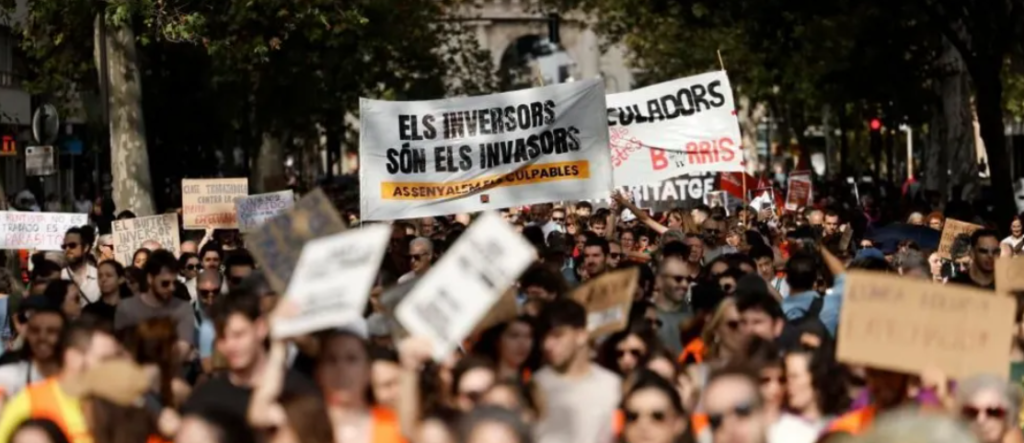
VALENCIA,SPAIN –Thousands of people took to the streets across Spain on Saturday to demand stronger protection for tenants as the country’s housing crisis continued to deepen following the government’s failure to pass emergency housing measures in parliament. Protests were reported in several major cities, including Madrid, Valencia and Barcelona. Images circulating on social media showed clashes between protesters and police near the Palau de les Arts Reina Sofía in Valencia, where a real estate summit was taking place.
Spanish media reported that some protesters removed barriers and threw objects toward police officers stationed near the area. Police responded with rubber bullets as tensions escalated around the demonstration. Organizers said around 50 marches were planned in cities across Spain, reflecting growing anger over rising rents, limited housing supply and the increasing difficulty many ordinary families face in finding affordable homes.
In Valencia, a spokesperson for the Valencia Tenants’ Union said there was widespread anger among people taking part in the demonstration. “The anger in the streets is enormous,” the spokesperson said, as protesters gathered to demand stronger measures to protect renters from rapidly increasing housing costs and eviction. The protests came just one day after the government of Prime Minister Pedro Sánchez suffered a major defeat in Congress when lawmakers rejected two emergency housing decrees introduced by his left-wing coalition government.
READ OTHER ARTICLES:
- The Timeless Bond and Contemporary Crossroads of Philippines–China Relations
- Italy’s Fideuram Bank Loses €95 Million in AI Voice Scam
- CHINA: Commemorating the Spirit of the Long March, 90 Years of Resilience and Triumph
- Many Delegates Walk Out as PM Netanyahu Addresses UN General Assembly
- North Korea nuclear tests may have triggered earthquakes near Mount Mantap
- Catriona Gray Still Reigns as the Gold Standard of Beauty Queens
The measures were presented as an attempt to respond to growing public pressure over housing affordability. The issue became particularly emotional after an 87-year-old woman was evicted from her home after being unable to afford a substantial increase in her rent. The case of Maricarmen Abascal became a symbol of the wider housing crisis. Public anger over her eviction contributed to demonstrations across Spain, with protesters demanding lower rents, stronger protections against evictions and restrictions on investment funds purchasing residential properties.
The Spanish government has referred to some of these investment companies as “vulture funds,” reflecting criticism from housing activists who argue that large investment groups can contribute to increasing pressure on the housing market. Despite the government’s efforts to respond to the protests, its proposed emergency legislation failed to secure enough support in Congress.
The first decree was rejected by 178 lawmakers against 172, while the second was defeated by 184 votes to 166. The results highlighted the difficulties facing Sánchez’s minority government, which does not control a majority of seats in parliament. Sánchez’s governing coalition consists of his Socialist Party and its junior coalition partner, the Sumar alliance. Because the government lacks a parliamentary majority, it needs support from smaller political parties to pass major legislation.
Before the votes, the conservative People’s Party and the far-right Vox had already indicated that they would oppose the measures. The government therefore needed support from smaller nationalist and pro-independence parties, including those representing interests in Catalonia and the Basque Country.
However, Together for Catalonia, known as JxCat, indicated before the parliamentary session that it would also oppose both measures. Without enough votes from these smaller parties, the government was unable to push the legislation through Congress. The proposed measures had been prepared quickly as the government attempted to calm growing anger over the housing situation.
One of the decrees would have suspended evictions involving vulnerable tenants until 2030. It also included a two-year extension for certain rental agreements scheduled to expire before 2028, higher taxes on tourist apartments and tighter restrictions on residential property purchases by large investment funds.
The second decree included automatic renewal of rental contracts, a demand that has been strongly supported by several left-wing political groups and tenant organizations. For housing activists, however, the measures did not go far enough. The Madrid Tenants’ Union said Friday evening that although the government’s proposals were insufficient, their rejection by parliament could further worsen a housing crisis that is already putting serious financial pressure on working-class households.
The group also called for a general strike over the housing crisis, showing how the issue has expanded beyond individual rent disputes and become a broader social and economic concern. Madrid was expected to host the largest demonstration on Saturday. Protesters had already been camping for several days at Puerta del Sol, one of the capital’s most important public squares.
Before the demonstration, a protester identified as David told Spanish public broadcaster RTVE that the participants were not gathering for entertainment or comfort but because they believed strongly in their cause.
The demonstrations reflect a growing debate in Spain over how housing should be regulated and how much protection renters should receive when rents rise sharply.
The problem is being intensified by a shortage of available homes. The Bank of Spain estimates that the country is short by roughly 700,000 homes when comparing housing demand with the number of new homes being built.
That shortage has contributed to higher housing costs, particularly in major cities where demand is strong and available rental properties are limited.
Official data from Spain’s national statistics institute, INE, showed that house prices increased by 12.2% over the previous year in the second quarter of 2026.
Rental costs have also increased. Real estate company Idealista reported that rental expenses across Spain rose by 8.5% in 2025. In Madrid, the increase reached 9.7%.
Barcelona and Madrid remain among the most expensive cities in Spain for renters. According to Idealista, the average rental price reached €23.80 per square meter in Barcelona and €22.70 per square meter in Madrid.
For many residents, the numbers translate into a difficult everyday reality: more of their monthly income must be used simply to keep a roof over their heads.
The housing shortage is particularly challenging for low-income households, young people and vulnerable renters who have fewer financial resources when landlords raise rents or when rental agreements come to an end.
The case of Abascal demonstrated how quickly an individual housing dispute can become a national political issue. Following intense public reaction to her eviction, Urbagestión, the company that owned her apartment, negotiated an arrangement that allowed her to return home at a lower rent.
But the agreement did not end the demonstrations. Tenant organizations continued to argue that the problem was much larger than one person’s situation. Their demands focus on structural changes to the rental market, including greater security for tenants, lower housing costs and limits on practices they believe make residential property increasingly difficult for ordinary residents to afford.
The failed votes in Congress have also created additional political uncertainty for Sánchez’s government.
The defeat has fueled speculation about whether the prime minister could eventually call an early general election, although the next election had originally been expected in the following summer.
For now, the immediate issue remains Spain’s housing crisis and the growing pressure from people who say existing policies have not provided enough protection from rising rents and housing insecurity.
As thousands of protesters marched through Spanish cities, the demonstrations showed that housing has become one of the country’s most visible public concerns. The failure of the emergency legislation in Congress has added another layer to the dispute, leaving the government facing continued pressure from tenant groups while it attempts to find enough parliamentary support for future housing measures.
Spain’s Government Faces Growing Pressure After Housing Measures Collapse
Spain’s government suffered a major parliamentary defeat on Friday, October 2, after lawmakers rejected two emergency housing measures designed to address the country’s worsening housing crisis. The defeat came as thousands of people were already protesting across the country, demanding stronger protection for renters and action against rising housing costs.
The measures were pushed by Prime Minister Pedro Sánchez’s coalition government as public anger continued to grow following the eviction of 87-year-old Maricarmen Abascal from her home in Madrid. Her eviction, which was widely reported on television, became a symbol of the struggles faced by vulnerable renters and helped trigger a new wave of housing protests across Spain.
But Sánchez’s government does not have enough seats in Congress to pass major legislation on its own. His Socialist Party governs in coalition with Sumar, but the government depends on support from other political groups to secure enough votes in the 350-seat lower house.
That political weakness became clear during Friday’s votes.
The Catalan pro-independence party Junts, which had been considered important to the government’s parliamentary calculations, announced that it would vote against the housing decrees. Its opposition, combined with votes against the measures from the conservative Popular Party and Vox, was enough to defeat both proposals.
The first decree was rejected by 178 votes to 172, while the second failed by 184 votes to 166. The results meant that the government’s emergency housing package could not proceed through parliamentary ratification.
The government had argued that the measures were necessary to give vulnerable tenants greater protection and respond to the country’s housing shortage.
Among the proposals were stronger protections against the eviction of vulnerable people, measures targeting property speculation, incentives connected to rental housing, and changes to rental contracts. Another measure would have allowed rental agreements to automatically continue when they reached their expiration date under certain conditions.
Supporters of the measures said they were needed because many families and young people were struggling to afford housing. Sánchez personally appealed to lawmakers before the vote, urging them to think about ordinary people facing rising rents and difficulty finding a home.
Junts, however, argued that the government’s approach could have the opposite effect. Its representatives said the measures could encourage property owners to remove homes from the rental market, potentially reducing the supply of available housing and putting further pressure on prices.
This disagreement highlights one of the biggest debates surrounding Spain’s housing crisis. The government and tenant organizations have focused on protecting renters, while opponents of the decrees have argued that policies affecting landlords and investors could discourage owners from offering properties for rent.
The parliamentary defeat immediately increased pressure on Sánchez’s government.
Outside Congress in Madrid, protesters demanded stronger action on housing as lawmakers debated the measures. Housing organizations have also maintained protest camps, including one in the central Puerta del Sol, while demonstrations have taken place in different parts of Spain.
For many protesters, the issue is no longer simply about one eviction. They see the case of Maricarmen as an example of a much larger problem involving expensive rents, limited housing supply, and the difficulty faced by ordinary people trying to remain in their homes.
The political consequences could also be significant.
Spanish media have reported speculation that Sánchez could consider bringing forward the next general election. However, an early election had not been confirmed at the time of the parliamentary defeat, and Sánchez’s government had not formally announced such a decision.
The defeat also demonstrates how difficult it is for a minority government to pass major legislation when it cannot rely on a stable parliamentary majority.
At the same time, the situation has raised questions about the role of Spain’s King Felipe VI.
Despite being the country’s head of state, the King does not have the constitutional power to simply overturn a parliamentary vote because he disagrees with it. Spain operates as a constitutional monarchy, meaning that the King’s powers are defined and limited by the Constitution.
Under Article 56 of Spain’s Constitution, the King is the head of state and serves as a symbol of the country’s unity and continuity. The Constitution also describes him as having a role in ensuring and moderating the regular functioning of institutions.
However, his formal powers are exercised within constitutional procedures rather than through personal political intervention.
For example, Article 62 gives the King the formal authority to sanction and promulgate laws, dissolve the Cortes Generales, and call elections in circumstances established by the Constitution. Article 91 states that laws approved by Parliament are to be sanctioned by the King within 15 days and then promulgated and ordered to be published.
This means the King is not an alternative political authority that can replace Congress when lawmakers reject a bill.
If Prime Minister Sánchez decides to seek an early dissolution of Parliament, the Constitution provides a specific procedure. Under Article 115, the Prime Minister may propose the dissolution of the Congress, the Senate, or both chambers after deliberation by the Council of Ministers. The dissolution is then formally decreed by the King, with the decree setting the election date.
In simple terms, the King has an important formal role in the process, but he does not personally decide whether Spain should have an early election. The initiative comes from the government under the constitutional rules.
The King’s role is therefore different from that of a president in a presidential system. He does not run the government or decide which political program should become law. Day-to-day political decisions remain with the elected government and Parliament.
The housing crisis has now placed those institutions under increasing pressure.
For renters, the failed measures mean that several proposed protections will not take effect through those rejected decrees. For the government, the defeat demonstrates the difficulty of securing parliamentary support for its response to the housing crisis. For opposition parties, the vote reflects their disagreement with the government’s approach and their arguments about the possible impact of regulation on the rental market.
Meanwhile, protests continue to keep the housing issue in the public spotlight.
Spain’s housing problem is unlikely to disappear simply because the parliamentary measures failed. The dispute has exposed a much deeper conflict over rents, property ownership, investment, evictions, and the responsibility of government to make housing more affordable.
As protesters continue demanding action and political parties remain divided over how the crisis should be addressed, the failed vote has turned Spain’s housing problem into an even larger political challenge for Sánchez’s minority government.
Spain Housing Measures Collapse as Political Divisions Deepen
Spain’s Parliament has rejected two emergency housing decrees proposed by Prime Minister Pedro Sánchez’s government, exposing deep political divisions over how the country should address its worsening housing crisis. The measures were defeated after opposition from the conservative Popular Party, Vox, the Catalan party Junts and, in the first vote, UPN, leaving the government without the parliamentary support needed to keep the measures in force.
The first decree was rejected by 178 votes to 172, while the second was defeated by 184 votes to 166. The measures had been introduced as an emergency response to rising housing costs, evictions, and growing public pressure over the difficulty many people face in finding or keeping an affordable home.
At the center of the dispute was a basic question: How can Spain protect renters without creating new problems for landlords, investors, and the supply of homes available for rent?
Sánchez’s minority coalition government argued that stronger protections were needed for vulnerable tenants. The proposed measures included protections against certain evictions, extensions of some rental contracts, restrictions on certain property purchases by large investment funds, and other measures intended to improve housing affordability and rental stability.
But opposition parties said the government’s approach could create problems of its own.
Junts, the Catalan pro-independence party whose votes were important to the government’s efforts to pass the measures, became one of the most important opponents of the decrees. The party argued that several provisions could reduce the number of homes available on the rental market instead of increasing supply.
Junts also criticized what it considered insufficient differentiation between large property companies and small landlords. The party argued that small property owners should not necessarily be treated in the same way as large companies that own many properties.
This distinction is important because many small landlords depend on rental income from one or a few properties. According to Junts, imposing the same restrictions on small owners and large property investors could place additional pressure on people who rely on rental income.
The party also argued that some of the government’s measures could encourage property owners to withdraw homes from the rental market. If fewer homes are available for rent, Junts said, competition among renters could increase and prices could rise.
Junts therefore called for the proposals to be changed and renegotiated rather than simply approved in their existing form. The party maintained that the government’s measures did not adequately address the housing shortage and could have effects opposite to those intended by the government.
The conservative Popular Party and Vox also opposed the government’s housing package, although their arguments came from a different political perspective.
The opposition parties have criticized measures that increase protections for tenants and restrict certain actions by property owners. They have argued that stronger restrictions could interfere with property rights and discourage owners from placing homes on the rental market.
Critics of the government’s approach have also raised concerns about what they describe as situations in which tenants remain in properties without paying rent for extended periods. They argue that property owners need stronger protections against serious cases of non-payment and unlawful occupation.
The opposition has also argued that Spain’s housing problem cannot be solved mainly through rent restrictions and temporary protections. Instead, they have emphasized the need to increase the number of homes available, reduce barriers to construction, and create conditions that encourage investment in new housing.
In simple terms, the disagreement comes down to two different approaches.
The government and tenant groups have emphasized stronger protection for people who are struggling to afford housing, while opponents have placed greater emphasis on increasing housing supply and protecting property owners from measures they believe could discourage them from renting out their homes.
Neither side accepted the other’s approach as sufficient to solve the crisis. That disagreement became especially important because Sánchez’s government does not have a stable majority in Congress. His Socialist Party governs with Sumar, but the coalition needs support from other parties to pass important legislation.
Junts had previously been an important parliamentary partner for Sánchez’s government on some issues. But this time, the party refused to support the housing decrees, effectively removing a crucial source of votes.
The Popular Party and Vox had already positioned themselves against the measures. Their votes, combined with those of Junts and other opposition lawmakers, were enough to defeat the government’s proposals.
The result was a major setback for Sánchez’s government. The first decree contained measures including temporary protections for vulnerable tenants facing eviction, extensions for certain rental contracts, limits on some property acquisitions by large investment funds, and tax-related measures connected to housing. The second decree focused on strengthening the stability of ordinary rental contracts, including automatic renewal provisions under certain circumstances.
Because Congress rejected the decrees, those emergency measures could not continue through parliamentary approval. The first decree, which had only recently entered into force, was effectively overturned after the vote.
The defeat came as housing protests were already taking place in Spain. Thousands of people have been demanding stronger action over rising rents, evictions, and the shortage of affordable homes. The housing crisis has become particularly emotional following the widely reported eviction of 87-year-old Maricarmen Abascal, whose case became a powerful symbol for tenant groups and protesters.
For people struggling to pay rent, the issue is straightforward: They want to remain in their homes without being pushed out by rapidly rising costs. For property owners, however, the debate involves another concern: whether increasingly strict rental rules could make it more difficult or less attractive to provide homes for rent.
That conflict is at the heart of Spain’s housing debate. The government says stronger protections are necessary because vulnerable families need greater security. Its opponents say long-term improvements require more homes to be built and fewer policies that could discourage owners from renting.
The parliamentary vote did not resolve that disagreement. Instead, it exposed just how divided Spain’s political parties remain over the country’s housing policy.
The defeat also creates another challenge for Sánchez’s minority government. Without reliable support in Congress, every major proposal requires negotiations with parties that have different political and regional interests.
The housing vote showed what can happen when those negotiations fail. For ordinary Spaniards, however, the parliamentary defeat does not make the housing problem disappear. Rents remain a major concern, the supply of affordable homes remains limited, and many families continue to face difficult choices between paying for housing and covering other basic expenses.
The debate is therefore likely to continue, even though the emergency decrees have been rejected. Spain now faces a difficult political and economic question: How can it increase the supply of affordable housing while protecting tenants and maintaining incentives for property owners to keep homes available for rent?
The failed vote has shown that there is no simple agreement on how to achieve that goal. Instead, the housing crisis has become a wider political battle involving renters, landlords, investors, regional parties, and the national government. With Parliament deeply divided, finding a compromise that can win enough votes while addressing the concerns of both tenants and property owners remains a major challenge for Sánchez’s government.
- Dalawang Estudyante Nasawi sa Fun Run sa Cauayan City

- Housing Fury Erupts Across Spain as Protesters Clash With Police
- RESULTS CELE September 2026 Civil Engineering Licensure Exam Passers
- Iran and Britain: How Another Cycle of Confrontation Leaves Ordinary People Paying the Price
- Carlos Yulo Wins Two Gold Medals at 2026 Asian Games
- AITSA Cabuyao Violations

![An armoured vehicle patrols the interior at RAF Fairford Airbase [AFP]](https://www.aptikons.com/view/An-armoured-vehicle-patrols-the-interior-at-RAF-Fairford-Airbase-AFP-150x150.webp)