Ukraine entered another period of political uncertainty as President Volodymyr Zelenskyy reshuffled his government, triggering protests in Kyiv while lawmakers approved a new prime minister. The changes come as the country continues to battle Russia’s ongoing invasion and faces renewed missile attacks on its capital.
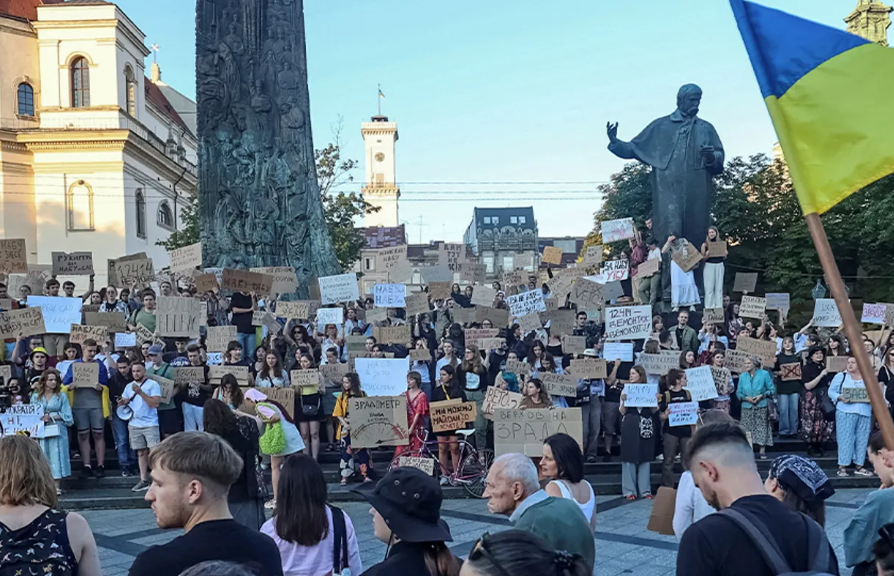
KYIV, Ukraine — Hundreds of people took to the streets in Kyiv and several other Ukrainian cities on Thursday after President Volodymyr Zelenskyy announced major changes in his government, including the planned dismissal of the country’s defense minister. The political shake-up comes at a critical time as Ukraine continues its long and difficult war against Russia, which has now stretched to more than four and a half years.
The protests reflected growing concern among many Ukrainians about the timing of the changes. While the country remains under constant military pressure from Russia, some citizens fear that replacing key government officials could create uncertainty during one of the most challenging periods of the conflict.
Despite the demonstrations, Ukraine’s parliament moved ahead with approving Serhii Koretskyi as the country’s new prime minister. Koretskyi, who previously led the state-owned energy company Naftogaz, received overwhelming support from lawmakers, with 289 votes in favor, only one vote against, and 21 lawmakers choosing to abstain.
President Zelenskyy said he selected Koretskyi because of his experience managing Ukraine’s energy sector, an area that has become increasingly important during the war. Every winter, Russia intensifies its attacks on Ukraine’s power plants and electricity infrastructure, leaving millions of civilians vulnerable to blackouts and freezing temperatures. Zelenskyy believes Koretskyi’s background will help strengthen the country’s ability to keep essential services running during another difficult winter.
READ MORE OTHER ARTICLES
- California Mother Angelica Brophy Still Missing as Family Pleads for Help in Second Week of Search

- U.S. Demands Iran Guarantee Strait of Hormuz Shipping Safety Amid Ceasefire
- Mali, Algeria Restore Diplomatic Relations, Ending Yearlong Airspace and Ambassador Dispute
- US-Iran Tensions Escalate as Military Threats, Diplomatic Disputes, and Regional Mediation Efforts Intensify
- Leyte’s Energy Paradox Sparks Public Appeal to Malacañang Over High Power Costs
- INDIA: Deadly Kerala Landslide Leaves Three Dead, Five Missing as Rescue Operations Continue

The government overhaul comes as Ukraine continues to defend itself against Russia’s full-scale invasion. Since the war began, Zelenskyy has remained in office under martial law, which prevents national elections from taking place while the country is at war. Without elections, the president has instead relied on periodic cabinet reshuffles to adjust his administration and respond to changing wartime needs.
One of the biggest surprises in the latest changes is the planned departure of Defense Minister Mykhailo Fedorov. At just 35 years old, Fedorov earned a reputation as one of Ukraine’s most forward-thinking officials. He was widely credited with introducing new technology and digital systems that helped improve the country’s military operations and strengthen communication on the battlefield.
Many observers believe his focus on innovation contributed to Ukraine’s recent improvements against Russia’s much larger military force. His efforts to modernize defense operations won praise both inside Ukraine and from many international partners supporting the country.
However, despite those achievements, Fedorov is expected to leave the government after serving only six months as defense minister. President Zelenskyy has not publicly explained why he decided to replace him, and no successor has been officially announced.
Ukrainian media reports, which have not been independently confirmed, suggest that Fedorov may have had disagreements with General Oleksandr Syrskyi, the commander of Ukraine’s armed forces. The reported tensions have fueled speculation that differences within the country’s military leadership may have influenced the decision, though government officials have not commented on the claims.
The political developments unfolded as Russia continued its relentless attacks across Ukraine. Overnight missile strikes targeted the capital, Kyiv, killing two people and injuring five others, including a child, according to Ukraine’s Emergency Service. The latest assault served as another reminder that while political debates continue in the capital, civilians across the country remain under constant threat from Russian airstrikes.
For many Ukrainians, the combination of deadly missile attacks and major political changes has created an atmosphere of uncertainty. While some believe fresh leadership could strengthen the government’s response to the war, others worry that replacing experienced officials could disrupt military planning and decision-making at a time when unity is seen as essential.
The protests seen in Kyiv and other cities may also become an important measure of Zelenskyy’s political standing. Throughout the war, he has maintained broad public support for his leadership. However, significant government changes during an ongoing conflict can test public confidence, especially when they involve officials viewed as successful in managing key areas such as national defense.
As Ukraine prepares for another winter under the shadow of war, the new government will face enormous challenges. It must keep the country’s energy system functioning despite expected Russian attacks, support the military on the front lines, protect civilians from continued missile strikes, and maintain public trust while navigating one of the most difficult periods in the nation’s modern history.
Protests Spread Across Ukraine After Zelensky Removes Defense Minister Fedorov
Anger continued to grow across Ukraine as thousands of people voiced their frustration over President Volodymyr Zelenskyy’s decision to remove Defense Minister Mykhailo Fedorov, a move that many Ukrainians believe comes at the worst possible time as the country remains locked in a long and costly war with Russia.
Crowds gathered in Kyiv and several other cities, turning what began as political protests into a powerful public display of support for Fedorov, who is widely credited with helping modernize Ukraine’s military and improving its performance on the battlefield. Many protesters carried Ukrainian flags, shouted Fedorov’s name, and demanded that the government reconsider its decision. Some also directed their anger toward General Oleksandr Syrskyi, commander of Ukraine’s armed forces, chanting for him to step down.
The demonstrations reflected growing concerns that changing military leadership during an active war could weaken Ukraine’s defenses at a time when Russian forces continue to launch daily attacks and attempt to gain territory.
General Syrskyi, now 60 years old, is one of Ukraine’s best-known military commanders. He played a key role in organizing the successful defense of Kyiv during Russia’s full-scale invasion in February 2022, helping prevent Russian forces from capturing the Ukrainian capital in the opening weeks of the war. Later that same year, he was widely praised for leading a successful counteroffensive in the Kharkiv region, where Ukrainian troops regained large areas previously occupied by Russian forces.
Before Ukraine gained independence, Syrskyi was born in 1965 in what was then the Soviet Union. He studied at the Moscow Higher Military Command School and served in the Soviet Artillery Corps before continuing his military career in independent Ukraine. While many recognize his military achievements, some protesters now question whether his reported disagreements with Fedorov contributed to the defense minister’s sudden removal.
Although the Ukrainian government has not officially confirmed any conflict between the two men, speculation has continued to grow after local media reported tensions between them. President Zelenskyy has not publicly explained why Fedorov was dismissed, leaving many Ukrainians searching for answers.
The protests were led largely by younger Ukrainians, many of whom said they were disappointed by the decision. They repeatedly chanted, “A European army for a European country,” expressing their hope that Ukraine’s armed forces continue moving toward modern military standards similar to those of NATO countries.
Many Ukrainians believe Fedorov represented that modernization effort. During his time as defense minister, he focused heavily on technology, innovation, and the use of advanced weapons systems. Military analysts from Western countries have credited his leadership with helping Ukraine slow Russia’s advance along the front lines. They also point to Ukraine’s growing ability to launch long-range drone strikes that have reportedly disrupted fuel supplies inside Russia, creating additional pressure on Moscow’s military operations.
Supporters argue that these achievements made Fedorov one of the government’s strongest performers during the war. For many protesters, his removal came as a complete surprise and raised fears that political decisions are interfering with military strategy.
Among those attending the rally in Kyiv was resident Bohdan Huryak, who said he felt deeply disappointed by the president’s decision.
He explained that he does not usually involve himself in political debates but believes results on the battlefield should matter most during wartime. According to Huryak, many Ukrainians have seen growing confidence among soldiers and civilians because of the military’s recent successes, making Fedorov’s removal difficult to understand.
“We see results, we feel the fighting spirit and confidence in victory rising,” Huryak said, questioning why someone viewed as effective would be removed after serving only six months in the position.
The demonstrations were not limited to the capital. Similar protests took place in the central city of Dnipro and the southern port city of Odesa, showing that concerns over the government’s decision extend beyond Kyiv. The gatherings remained focused on expressing support for Fedorov and demanding greater transparency from Ukraine’s leadership.
The controversy deepened even further when Colonel Pavlo Yelizarov, the deputy commander of Ukraine’s air force, announced his resignation in protest over Fedorov’s dismissal.
In a resignation letter published on social media, Yelizarov warned that removing Fedorov could seriously weaken Ukraine’s ability to defend itself against Russia’s continuing missile and drone attacks. He argued that the decision could have real consequences on the battlefield and might place more civilians at risk as Russia continues targeting cities across the country.
“I believe that the dismissal of Mykhailo Fedorov is a great evil for the country’s defense capability,” Yelizarov wrote in his public statement.
His resignation immediately attracted widespread attention because it marked one of the strongest public criticisms of the government’s decision from within Ukraine’s military leadership.
The political dispute comes as Ukraine continues facing relentless attacks from Russia. Air raid sirens remain a daily reality across much of the country, while missile and drone strikes continue to damage infrastructure, homes, and public facilities. Military leaders are also preparing for another difficult winter, when Russia is expected to intensify attacks on Ukraine’s energy network in an effort to leave millions without electricity and heating.
Against that backdrop, many Ukrainians believe stability inside the government is just as important as military strength on the battlefield. They worry that replacing experienced leaders could create uncertainty when unity is needed most.
For President Zelenskyy, the backlash represents one of the most significant political challenges he has faced since Russia launched its full-scale invasion. While he continues to enjoy broad public support for leading the country during wartime, the growing protests suggest that many Ukrainians want clearer explanations for major decisions involving the nation’s defense leadership.
As the war enters another difficult chapter, the government’s next steps—and its choice of a new defense minister will likely be watched closely both at home and by Ukraine’s international allies. Whether the leadership changes strengthen the country’s war effort or deepen political divisions remains one of the biggest questions facing Ukraine today.
Ukraine Defense Shake-Up: Zelenskyy Replaces Reform-Minded Defense Minister as War Pressures Intensify
Ukraine has entered another significant chapter in its wartime leadership as President Volodymyr Zelenskyy reshuffles his government, with Defense Minister Mykhailo Fedorov confirming his departure after months of speculation. The move comes at a time when the country continues to battle Russia’s full-scale invasion while simultaneously confronting internal challenges involving military reforms, troop shortages, procurement transparency, and public confidence in government institutions.
Although President Zelenskyy did not officially announce the dismissal, Fedorov confirmed late Wednesday through social media that he had left the post, bringing an end to a tenure marked by ambitious modernization efforts, technological innovation, and attempts to overhaul Ukraine’s military bureaucracy.
The leadership change arrives during one of the most demanding periods of the war, as Ukraine continues to defend itself against relentless Russian attacks while seeking to maintain the trust of its citizens and international allies.
Fedorov, who assumed the role of defense minister in January after earning recognition as Ukraine’s digital transformation chief, quickly developed a reputation as one of the country’s most forward-looking officials. Before taking charge of the Defense Ministry, he had become widely known for transforming Ukraine into one of the world’s leading innovators in battlefield drone technology.
Under his earlier leadership, Ukraine rapidly expanded its digital government services, making many public transactions accessible through online platforms while reducing bureaucracy. His success in the civilian sector earned him praise both inside Ukraine and among Western partners who viewed him as a symbol of modernization.
When he entered the Defense Ministry, Fedorov pledged to bring that same innovative mindset to the military.
One of his earliest and most candid admissions involved the enormous manpower problems facing Ukraine’s armed forces. He revealed that approximately 200,000 troops had deserted while nearly two million people had reportedly avoided military conscription, highlighting the immense strain that years of continuous warfare have placed on Ukrainian society.
Rather than downplaying these figures, Fedorov argued that acknowledging the crisis was the first step toward implementing meaningful reforms.
Throughout his time in office, he championed greater investment in advanced military technology rather than relying solely on conventional warfare. According to his own account, one of his boldest decisions involved redirecting funding that had originally been allocated for salary payments toward expanding Ukraine’s arsenal of modern battlefield capabilities.
Those investments included mid-range strike systems, fiber-optic drones, reconnaissance technologies, and other advanced military equipment designed to improve Ukraine’s effectiveness against Russian forces.
The strategy reflected Ukraine’s increasing dependence on technological superiority to offset Russia’s numerical advantages in manpower and conventional weaponry.
Fedorov also highlighted significant progress in drone procurement, an area that has become central to Ukraine’s military operations. Drones now perform a wide range of missions, including surveillance, intelligence gathering, precision strikes, logistics support, and electronic warfare.
Beyond drones, he cited progress in securing contracts related to Patriot air defense systems, conducting successful ballistic missile tests, and reforming military procurement procedures intended to improve efficiency and reduce corruption.
Despite these accomplishments, Fedorov openly acknowledged that many of his broader reform goals remained unfinished.
He admitted that he had been unable to fully transform the Defense Ministry’s organizational structure according to NATO standards a long-standing objective as Ukraine deepens its military cooperation with Western allies.
He also said he failed to completely shift defense procurement toward fully competitive tender systems, a reform designed to improve transparency and reduce opportunities for corruption.
Perhaps most notably, Fedorov conceded that creating a lasting culture of accountability inside one of Ukraine’s largest government institutions remained an unfinished mission.
Reflecting on his tenure, he acknowledged that while many officials had been dismissed under his leadership, even more personnel changes were necessary.
According to Fedorov, numerous individuals inside the ministry continued to resist reform efforts and obstruct modernization initiatives.
His remarks underscored the enormous institutional challenges involved in transforming a wartime defense establishment while simultaneously managing active military operations.
The leadership transition also comes against the backdrop of broader political pressures facing President Zelenskyy.
Last year, Zelenskyy experienced one of the most significant domestic political crises since Russia launched its full-scale invasion on February 24, 2022.
In July, widespread street protests erupted after lawmakers approved legislation that critics argued would weaken the independence of Ukraine’s anti-corruption watchdogs.
The demonstrations represented a rare public challenge to Zelenskyy’s leadership during wartime, as thousands of Ukrainians warned that undermining anti-corruption institutions could threaten both democratic reforms and continued Western financial and military support.
Faced with growing public anger, Zelenskyy moved quickly to reverse course, effectively abandoning the controversial legislation.
The swift reversal demonstrated both the strength of Ukraine’s civil society and the political limits facing even a wartime president enjoying broad international support.
For many observers, the episode illustrated that maintaining public trust has become nearly as important as military success.
Ukraine’s international partners have consistently emphasized that continued military assistance must be accompanied by reforms promoting transparency, accountability, and democratic governance.
These expectations have placed enormous pressure on officials responsible for managing defense spending, military procurement, and institutional reform.
Fedorov’s departure therefore represents more than a routine cabinet change.
It highlights the ongoing struggle to modernize Ukraine’s defense establishment while fighting Europe’s largest land war in decades.
As the conflict continues with no immediate end in sight, Ukraine remains tasked with balancing battlefield demands, technological innovation, military recruitment, institutional reform, and public confidence all while relying heavily on sustained international support.
Although Fedorov leaves office claiming meaningful achievements in expanding military technology and procurement reforms, his own reflections reveal that many of Ukraine’s deepest structural challenges remain unresolved. The next defense leadership will inherit not only an ongoing war but also the difficult mission of completing reforms that many believe are essential for Ukraine’s long-term security, democratic resilience, and future integration with Western institutions.