Keiko Fujimori, who first stepped into the public eye as Peru’s First Lady at age 19, is making her fourth bid for the presidency. Now 51, the conservative leader faces leftist Roberto Sánchez in the runoff, presenting herself as the solution to a decade of political instability, corruption, and rising crime, while her campaign remains shadowed by a past history of corruption allegations and legal battles.
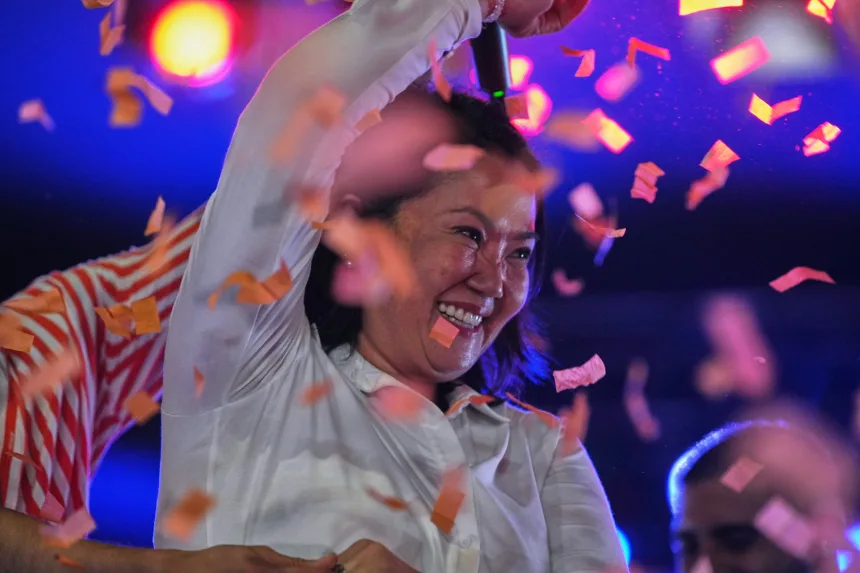
She stepped onto the global stage at just 19 years old, dressed in black, walking timidly beside her father, the man who would cast a long, dark shadow over Peru’s history. That image from the 1994 Summit of the Americas was not merely a photograph; it was the baptism by fire of a political dynasty, the moment Keiko Fujimori ceased to be just a daughter and began her transformation into the heiress of one of the most controversial and polarizing legacies in Latin American politics. Placed in the role of First Lady after her own mother was cast aside exiled and silenced for having the courage to denounce the corruption rotting the heart of the Fujimori administration Keiko did not just inherit a title. She inherited a machine, a movement, and a burden that she has carried, not as a weight, but as a weapon, for over three decades.
Today, at 51 years old, with three crushing electoral defeats behind her and a history stained by judicial battles, imprisonment, and accusations of massive graft, she stands once again at the gates of the Presidential Palace, banging on the door for a fourth time. It is a testament to the tragic state of Peruvian democracy that a woman whose career has been defined by controversy, whose party was dismantled by infighting and scandal, and who spent over a year behind bars facing serious charges of criminal conspiracy and money laundering, is now presented as the “solution” to the nation’s crisis. It is a twisted irony that Keiko Fujimori claims to be the only one capable of “rescuing” Peru, a country that her father helped dismantle through authoritarianism, corruption, and systematic abuse of power.
READ MORE ARTICLES:
- Donald Trump takes centre stage at G7 summit as leaders push to finalise Iran deal and secure Strait of Hormuz
- A Trillion Dollars Beyond Imagination, What Elon Musk’s Wealth Reveals About the Gap Between Billionaires and Ordinary Filipinos
- Elon Musk becomes world’s first trillionaire as SpaceX IPO Reshapes Global Wealth, New Age of Extreme Wealth or A Warning for Humanity?
- Donald Trump Rushes Iran Deal as Tehran Pushes Back: Diplomatic Drama Exposes Deep Mistrust Behind “Historic” Agreement
- Thai Princess Bajrakitiyabha Dies at Age 47 After More Than Three Years in Coma
- Millions Affected as Facebook Suffers Major Outage Across the world
Let us look closely at the narrative she weaves. She speaks constantly of “Order.” She shouts it from every platform, repeats it in every debate, and sells it as the antidote to the chaos that has consumed Peru over the last ten years a decade that saw eight different presidents, collapsing institutions, and a society fraying at the edges. “Order to live, order to invest, order to work,” she chants, framing the election as a binary choice between her, the iron-fisted guardian of stability, and her opponent, Roberto Sánchez, the representative of a left she paints as synonymous with destruction and disorder. It is a brilliant, dangerous, and manipulative strategy. She exploits the fear of the Peruvian people the fear of crime, the fear of instability, the fear of poverty and packages herself as the strongman’s daughter, the one who knows how to rule with a firm hand, just like el Chino, her father.
But what exactly is the “Order” that Keiko Fujimori promises? History provides the answer, and it is terrifying. The “order” of Alberto Fujimori was not peace; it was submission. It was an order maintained through surveillance, through the manipulation of the judiciary, through the forced sterilization of thousands of indigenous women, through death squads, and through the systematic looting of the state treasury. It was an order built on lies, on the silencing of the press, and on the complete concentration of power in the hands of one man and his inner circle. When Keiko Fujimori promises to restore that order, she is not promising justice or prosperity. She is promising a return to the methods that allowed her family and their allies to operate above the law, to treat the state as personal property, and to use public funds to finance their own ambitions.
Her claim that this election is about the “direction of the country” rather than about her is perhaps the most insulting statement of all. This election is about her. It is entirely about her obsession with power, her relentless quest to vindicate her father’s legacy, and her determination to clear her own name from the accusations that have followed her for her entire adult life. Let us not forget the facts that she desperately tries to erase. She was a congresswoman. She founded Fuerza Popular, a political organization that became the most powerful force in Congress, only to use that power to obstruct justice, protect corrupt officials, and destabilize governments that did not bow to her will. She was arrested. She spent 13 months in pre-trial detention because a judge found sufficient evidence that she had led a criminal organization within her own party to receive millions of dollars in illegal contributions from the Brazilian construction giant Odebrecht the company that corrupted governments across the continent.
She denies it, of course. She calls it “political persecution.” She frames herself as a victim of the system, a woman persecuted by the elites and the judiciary simply because of her last name. And when, in January 2025, a court declared the case against her null and void, she celebrated it as total proof of her innocence. But let us be clear: a procedural annulment is not an exoneration. It is not a verdict of “Not Guilty.” It is a technicality, often achieved through the immense power, resources, and influence that the Fujimori network still holds over Peru’s legal system. The evidence of the Odebrecht payments, the testimonies, the financial trails none of these have been proven false; they have simply been swept aside by a judiciary that still trembles before the name Fujimori. To ask the Peruvian people to overlook this history, to ignore the stench of corruption that clings to her political career, is an insult to their intelligence and their dignity.
Now, facing Roberto Sánchez, a progressive candidate who represents a platform of inclusion, transparency, and social justice, Keiko Fujimori tries to paint him as a threat to democracy and the economy. She warns that his policies will lead Peru down the path of Venezuela or Cuba, using the oldest, most worn-out scare tactics of the Latin American right. She ignores the reality that the chaos of the last decade was not caused by the left, but by the collapse of the very model she represents—a model of elite capture, institutional weakness, and impunity. The instability in Peru today is the direct legacy of the system Alberto Fujimori built: a system where institutions were destroyed so that one man could rule without limits, leaving the country with no solid foundation when he finally fell.
She claims she wants to end the crisis, yet she is the crisis. She represents the exact same forces that have kept Peru trapped in a cycle of corruption and inequality for decades. Her rise in the polls, her slight lead in the predictions, is not a sign of popular enthusiasm; it is a symptom of despair. It is the reaction of a population so exhausted by violence, so tired of political failure, so desperate for anything that looks like control, that they are willing to gamble on the daughter of a dictator, ignoring the mountain of evidence that shows she will govern for herself, for her family, and for her cronies, not for the people.
Keiko Fujimori has run for president three times, and three times the Peruvian people have looked at her, looked at her history, looked at her father’s record, and said “No.” They rejected her in 2011. They rejected her in 2016. They rejected her in 2021, despite her claiming victory and crying fraud. Now she returns, older, perhaps more polished, but with the same DNA, the same team, and the same hunger for absolute power. She offers “Order,” but we know what that order looks like. It looks like impunity. It looks like the return of the corrupt. It looks like the closing of doors and the silencing of voices.
Peru stands at a crossroads. One path leads toward a new vision, however imperfect, of a society that tries to heal its wounds and build a democracy for everyone. The other path leads back to the past, to the shadows, to the empire of Fujimori. Keiko Fujimori has spent 30 years preparing for this moment, stepping out from her father’s shadow to try and take the throne for herself. But the Peruvian people must remember: the first time, it was a tragedy. The second time, a farce. But the fourth time? It would be a catastrophe. She is not the solution. She is the problem she claims to solve.
Keiko Fujimori’s Reinvention: Can a Changed Image Finally Break Her Presidential Losing Streak?
For decades, Keiko Fujimori has been one of the most polarizing figures in Peruvian politics admired by her loyal base as the only leader capable of restoring order, yet deeply mistrusted by millions who associate her name with authoritarianism, corruption, and the shadow of her father’s controversial legacy. Now, as she stands on the brink of a fourth presidential run-off, the woman who has defined the country’s political right for a generation is asking voters to see her differently: not as the combative ideologue of the past, but as a mature, tempered leader ready to unite and rebuild a fractured nation.
Her admission“I know that throughout my political life I have made mistakes. I learned from them, but I also came back stronger” is more than just a campaign line. It marks a clear break from the rigid, uncompromising stance that defined her previous campaigns, particularly the bitter 2021 contest against Pedro Castillo. That election, tainted by mutual accusations of fraud and deep social division, ended in a narrow defeat that left her and her movement weakened. In the aftermath, even her supporters recognized that her strategy of framing the race as an existential battle between “communism and democracy” had alienated moderate voters and deepened the very polarization tearing Peru apart.
This time, the shift is deliberate and visible. Gone is the fiery rhetoric that once dominated her speeches; in its place is a calmer, more measured tone. She has openly acknowledged her past confrontational style was an error, telling voters: “It’s true that we were confrontational, and we’ve corrected that.” As political analyst Julio Carrión notes, this is not just a change in style, but a calculated effort to shed the label of a leader driven only by ideology and opposition. By moving away from extreme positions, Fujimori is attempting to position herself as a safe, centrist alternative—one capable of governing a country exhausted by crisis.
Perhaps the most telling sign of this transformation came immediately after the first round of voting. Unlike in previous years, when she was quick to challenge results and align with other hardline voices, she refused to join fellow conservative candidate Rafael López Aliaga in making sweeping, unproven claims of electoral fraud. For a politician whose career has often been surrounded by legal battles and contested results, this restraint sends a powerful message: she wants to be seen not as a threat to democracy, but as its defender.
Yet, political reinvention is never simple. For many Peruvians, Keiko Fujimori remains inseparable from the history and controversies that have marked her life from her role as first lady, to her time in prison under corruption investigations, to the polarizing rule of her father, Alberto Fujimori. Her opponents argue that while her words have changed, her core agenda rooted in the hardline “Fujimorist” principles of strongman rule and impunity remains the same. They point out that apologies for past mistakes do not erase the scandals or the deep divisions her movement has caused.
Still, her strategy reflects a sharp understanding of the current moment. Peru has seen eight presidents in ten years, staggering corruption, and rising violence. Voters are no longer looking for battles; they are looking for stability, order, and a government that works. By acknowledging her errors, softening her tone, and stepping back from extreme rhetoric, Fujimori is betting that the country’s desire for change and security will outweigh old fears and past grievances.
Whether this new image is genuine or merely a campaign tactic will be tested if she wins power. But for now, Keiko Fujimori has successfully reshaped the narrative. She is no longer just the candidate of the right, or the daughter of a former president—she is the candidate asking Peruvians to judge her by who she has become, not just who she used to be. For a woman who has spent her entire life in the public eye, this may be her most difficult, and perhaps most important, campaign yet.
Keiko Fujimori’s Dangerous Gamble: Trading on a Bloody Legacy While Democracy Burns
Let’s be brutally clear: Keiko Fujimori does not stand on her own merits, her own ideas, or her own record. She stands entirely on the fractured, bloodstained legacy of her father, Alberto Fujimori a man who saved Peru from chaos only to dismantle its democracy, violate human rights on a massive scale, and turn the state into a machine for corruption. And now, she is trying once again to sell the country the same dangerous formula, wrapped in slightly softer language but rooted in the same authoritarian impulse that divided Peru and scarred its history forever.
Alberto Fujimori’s legacy is not complicated it is contradictory, yes, but ultimately damning. He pulled Peru back from economic ruin and crushed the brutal Shining Path insurgency, achievements that even his harshest critics cannot erase. But those victories came at a price no nation should ever have to pay: the elimination of checks and balances, the silencing of the press, and the systematic violation of human dignity. The Truth and Reconciliation Commission documented over 60,000 deaths and disappearances during that era, and courts later convicted Fujimori of crimes against humanity including the cold-blooded massacres at Barrios Altos and La Cantuta sentencing him to 25 years in prison. He was not a hero; he was a leader who traded democracy for order, and in doing so, destroyed the very institutions that keep a country free. And Keiko? She has spent her entire political career defending him, absolving him, and presenting herself as the rightful heir to his regime.
For years, this connection has been her biggest liability. In every election she has contested 2011, 2016, 2021 millions of Peruvians marched, protested, and voted with one clear message: “Keiko no va” Keiko won’t make it. They saw exactly what she represents: a continuation of a system that treats the law as an obstacle, dissent as treason, and power as a family birthright. They recognized that behind her promises of security and stability lay a deep threat to independent institutions, judicial freedom, and the very soul of Peruvian democracy. That is why she lost three times, despite massive resources and a loyal base. That is why human rights groups, students, and citizens still take to the streets today, refusing to let history repeat itself.
But here is the terrifying reality: this time, she might actually win not because she has changed, not because she has earned it, but because the opposition has failed miserably.
Political scientist Julio Carrión is right: younger voters, born after 2000, do not remember the fear, the censorship, or the disappearances. They did not live through the era when the president dissolved Congress, controlled the courts, and used state funds to buy loyalty. To them, “Fujimorism” is just a name, not a warning. Worse still, her opponent, Roberto Sánchez, has proven to be a weak, uninspiring alternative. Trying to copy the style and symbols of Pedro Castillo the man whose chaotic presidency ended in his own disgraceful attempt to seize power Sánchez has failed to offer anything new, anything credible, or anything that captures the imagination of the people. He lacks charisma, he lacks a clear vision, and he lacks the moral authority to stand against a movement that has undermined democracy for decades.
So now, Peru stands at a dangerous crossroads. Keiko Fujimori has softened her tone, admitted “mistakes,” and tried to sound like a unifier but make no mistake: the foundation of her power remains the same. She still defends her father’s crimes. She still surrounds herself with the same figures who served his regime. She still believes that order justifies everything, even if it means bending or breaking the rules that protect every citizen.
The anti-Fujimori vote, once powerful enough to stop her three times, is now fragmented, exhausted, and facing a generation that has forgotten or never learned the lessons of the past. And with an opponent who cannot inspire trust or hope, the door is wide open for her to return to power.
This is not an election about two different visions for Peru. It is a choice between protecting the fragile democracy that cost so much to rebuild, or handing the keys back to a political dynasty that has already proven it will sacrifice freedom for control. Keiko Fujimori may have changed her image, but her legacy is still written in the divisions, the corruption, and the abuses of the past. If Peru lets her win, it will not be a victory for stability it will be a defeat for justice, for memory, and for democracy itself.
Keiko Fujimori: A Polarising Figure at the Heart of Peru’s Political Crisis
For decades, Keiko Fujimori has been one of the most divisive figures in Peruvian politics. As she prepares for yet another bid for the presidency, her name remains inextricably linked to the turmoil, institutional erosion, and corruption that have defined the country’s recent history. Whether she wins or loses the upcoming second-round election, her critics insist she bears significant responsibility for the instability that has gripped Peru over the past four years—a burden that shapes every aspect of her campaign and how voters perceive her.
As leader of Fuerza Popular, the dominant force in Congress, Fujimori stands accused of governing through legislative power rather than respecting the separation of branches. Critics argue her party has systematically undermined the autonomy of the executive branch, interfered with independent judicial and oversight bodies, and pushed through legislation that serves narrow interests rather than the public good. Among the most controversial are laws widely labelled as “pro-crime”—measures that, according to independent analysis, have weakened the legal framework and limited the ability of judges and prosecutors to act effectively. A report by Human Rights Watch underscores this concern, noting that instead of strengthening public institutions, lawmakers have actively eroded their independence, creating conditions that have allowed organised crime to expand. The report goes further, concluding that most members of Congress have prioritised personal and political gain over national interest—a charge that lands heavily on Fujimori, as the face and leader of the largest parliamentary group.
Political analyst Carrión puts it plainly: “Her party and she are associated with what has happened in Peru over the last three or four years … So that is a burden she has to bear.” This weight is all the harder to shake because her main rival, Roberto Sánchez, has struggled to turn these criticisms into a decisive advantage. As a sitting congressman himself, Sánchez’s party has occasionally voted alongside Fuerza Popular on key bills, blunting his attacks and leaving voters unsure whether he offers a genuine alternative to the established political culture.
Fujimori has firmly rejected the claim that she and her party are to blame for Peru’s political chaos. In an interview with CNN, she acknowledged only limited mistakes, particularly regarding her handling of former President Pedro Pablo Kuczynski’s administration—an era marked by fierce confrontation that ultimately led to his resignation in 2018. “We were very confrontational with Pedro Pablo Kuczynski’s government, but not obstructionist,” she insisted. “We gave them approval for the most important laws and, above all, broad powers to make reforms … unfortunately, they didn’t know how to take advantage of them.” In her view, her party provided the tools for progress; it was others who failed to deliver.
This debate unfolds against a backdrop of deep public disillusionment. Dysfunction and allegations of corruption have tainted nearly every major political force in the country, leaving voters deeply wary of all candidates. That sentiment was starkly visible in the first round of voting, where none of the 35 contenders secured even 20% of the vote—a clear sign of an electorate searching for an option it can trust, but struggling to find one.
With the second round approaching and voting mandatory, polls show a nation still deeply divided. Many remain undecided; others speak of choosing “the lesser evil”, while a significant number say they will spoil their ballots as a protest against the entire political class. Yet for all the criticism, Fujimori retains a committed base of support. Supporters argue that after four presidential campaigns, she is now better prepared, with a clearer plan and the ability to build a government team capable of restoring investor confidence and stability.
Her backers point to concrete commitments she has made: to respect the Constitution, serve a full term, uphold a market economy, attract private investment, protect civil liberties, and address Peru’s massive unmet social needs. Rafael Belaúnde, who ran against her in the first round and now supports her, frames his choice as both pragmatic and strategic. “Ms. Fujimori, about whom one may have doubts or even disagreements, has committed to respecting the rules and addressing the country’s most urgent problems,” he explained. He added that he sees her as a stronger, more mature leader than in previous campaigns, and views her opponent Sánchez as a greater risk to Peru’s fragile economy.
More than 30 years after entering public life, Keiko Fujimori stands on the threshold of history. Victory would make her Peru’s ninth president in just ten years—a statistic that alone tells the story of a nation struggling for continuity and stability. But whatever the result, her legacy is already bound up with the crisis she promises to solve. For her critics, she is part of the problem; for her supporters, she is the only viable path forward. In the end, the election is not just about choosing a leader—it is a referendum on Peru’s recent past, and whether the country can move beyond the divisions and dysfunctions that have defined it for so long.
Keiko Fujimori: The Daughter of Power, the Shadow of a Dynasty, and Peru’s Divided Future
Few political figures across Latin America have stirred such intense and conflicting feelings as Keiko Fujimori. For over two decades, she has stood at the very centre of Peruvian public life, carrying a surname that evokes, in equal measure, memories of economic recovery and the heavy weight of authoritarian rule. Now, after three unsuccessful attempts to reach the presidency, she stands closer than ever to the highest office in the land. Her rise brings into sharp focus a question that has long haunted the nation: Is Peru preparing to elect a new leader with a fresh vision, or is it preparing to turn back the clock and embrace the legacy of the Fujimori era once more?
Her entry into politics was not a conventional beginning. At just 19 years old, Keiko Fujimori stepped into the role of First Lady following the high-profile separation of her parents, while her father Alberto Fujimori held the presidency. What many initially viewed as a private family matter evolved into the foundation of a powerful political dynasty, one that continues to shape the course of Peruvian politics decades later. This early experience placed her directly within the machinery of power, giving her a unique vantage point, but also tying her identity irrevocably to the administration she would later seek to inherit and defend.
For her millions of supporters, Keiko represents stability in a country worn down by years of crisis. Peru has cycled through presidents, faced constant congressional clashes, endured widespread corruption scandals, and suffered economic volatility. Against this backdrop, they look back at the government of Alberto Fujimori as a time when the state acted decisively: defeating armed insurgencies, restoring order, and steering the economy toward growth. To them, the Fujimori name is synonymous with strong leadership and the ability to deliver results when other leaders and parties have failed. In Keiko, they see the chance to restore that same sense of purpose and governance.
Yet, for her critics, that same name carries a very different meaning, and it is here that the heart of Peru’s political divide lies. The presidency of Alberto Fujimori remains one of the most contentious chapters in the nation’s history. While his supporters credit him with bringing peace and prosperity, his tenure was also marked by severe democratic erosion, widespread allegations of human rights abuses, and the concentration of power in the hands of the executive. His eventual downfall, flight from the country, and subsequent conviction and imprisonment for crimes against humanity and corruption cemented a legacy that remains deeply contested. Keiko has spent her entire political career navigating this contradiction at times defending her father’s policies and achievements, at others attempting to distance herself from the darker aspects of his rule. Still, for many Peruvians, she remains inseparable from the movement and the system he built.
Beyond the legacy of her father, Keiko faces challenges entirely her own. She has been the subject of high-profile investigations involving campaign financing and allegations of money laundering. While major legal cases against her have been dismissed or stalled due to procedural issues, these controversies have shaped public perception. Opponents argue the investigations reveal a pattern of ethical ambiguity and undermine her claim to clean leadership. Her supporters, conversely, frame these legal battles as politically motivated attacks, part of a broader effort by rival factions and institutions to block her path to power. This divide over her integrity mirrors the deeper split in how Peruvians understand their recent history.
Her fourth bid for the presidency unfolds against a backdrop of extraordinary national instability. Over the past decade, Peru has become a case study in political fragility, seeing multiple presidents come and go, with frequent clashes between the executive branch and a powerful, often obstructive Congress. Public trust in all institutions from the legislature to the judiciary has collapsed. In this environment, familiarity becomes a powerful asset, even when it comes with controversy. Voters tired of constant change, broken promises, and fragmented parties often turn to established figures, regardless of their past, simply because they represent a known quantity.
Recent election results lay bare just how deeply split the nation is. Keiko Fujimori and her rival, Roberto Sánchez, were separated by a fraction of a percentage point in the first round, a result that mirrors the divide running through Peruvian society. Urban voters versus rural communities, conservatives against progressives, those who defend the old order and those who demand sweeping change all are locked in a struggle over the country’s identity and direction. No candidate has managed to build a broad consensus, and the electorate remains largely polarised along lines that have existed for decades.
Perhaps the most striking feature of Keiko’s political career is her endurance. In a system where parties collapse, alliances dissolve, and leaders vanish from the public stage almost overnight, she has remained a constant presence. Time and again, after defeat or scandal, she has rebuilt her organisation, reconnected with her base, and returned to fight for power. To her supporters, this is a mark of resilience, proof of her commitment to the country and her cause. To her critics, it represents something else entirely: the stubborn survival of a political dynasty that Peru has never fully managed to leave behind.
Ultimately, the debate over Keiko Fujimori is about far more than one candidate or one election. It is a debate over memory, over democracy, and over what kind of nation Peru wants to be. Voters are not simply choosing a president; they are being asked to decide how to interpret their own history whether to see the Fujimori years as a necessary period of strong leadership or as a dangerous departure from democratic norms.
As Peru stands at another crossroads, the name Fujimori continues to dominate the national conversation. Twenty-five years after her father left office in disgrace, Keiko remains both the product of that legacy and a test of how far the country has come. Her candidacy poses a fundamental question: Can a modern democracy move forward while still being defined by the dynasties and divisions of its past? The answer will not only shape the next government; it will determine how history remembers one of the most powerful, controversial, and enduring political families in Latin America.
- Philippine Coast Guard Team Leader Arrested in Biliran Over Alleged Extortion Complaint
- PRC Release September 2026 LET/LEPT Room Assignments Elementary and Secondary; Thousands of Aspiring Teachers Advised to Prepare Early
- Andy Burnham Landslide Win Fuels Challenge to Keir Starmer, Shakes Labour Leadership Race in UK
- 24 Filipinos Detained in Russia Released After High-Level Marcos-Putin Talks: Diplomatic Win and Call for Stronger Worker Protection
- From First Lady at 19 to Presidential Hopeful, Keiko Fujimori’s Fourth Bid to Lead Peru Amid Crisis and Controversy