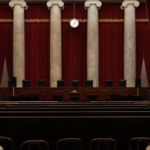
The U.S. Supreme Court has temporarily given the Federal Communications Commission (FCC) more time to resolve a dispute over discounted political advertising rates, delaying a lower court’s deadline as Democrats and Republicans compete for affordable television and radio airtime ahead of the November midterm elections.
WASHINGTON — The U.S. Supreme Court has temporarily eased a deadline imposed on the Federal Communications Commission (FCC) in a dispute over discounted political advertising rates, giving the agency more time to review a challenge that could affect campaign spending ahead of the November midterm elections.
On Thursday, Chief Justice John Roberts suspended a lower court order requiring the FCC to issue a decision by Friday on a complaint filed by four Democratic candidates. Roberts also directed the challengers to submit their response by Saturday, leaving the Supreme Court to consider whether the temporary pause should remain in effect.
The dispute centers on the FCC’s interpretation of rules governing the lowest unit charge, which requires broadcasters to offer legally qualified political candidates their lowest advertising rates during specified periods before an election.
READ OTHER ARTICLES:
- Every 40 Seconds, a Life Lost: The Quiet Crisis Behind the Philippines’ Suicide Numbers
- Tianangi ni Rosmar Tan na siya ang Binaggit ni Vice Ganda Tungkol sa Glutathione CEO at Money Laundering
- PRC: Room Assignments EELE-ETLE October 2026 Electronics Engineering Board Exam
- LAC Sessions Now Count as Teaching Hours, Says Angara
In a March notice, the FCC’s Media Bureau indicated that the discounted rates could extend beyond individual candidates to include political party committees and certain joint fundraising organizations.
Four Democratic candidates, including Sherrod Brown, Jon Ossoff and Roy Cooper, have challenged the agency’s guidance, arguing that it improperly broadens the scope of the discount to groups that Congress did not intend to cover.
The outcome could have significant financial implications for both political parties. Republican committees reportedly have a fundraising advantage over their Democratic counterparts heading into the midterms and have planned tens of millions of dollars in advertising purchases based on the discounted rates.
The case has already reached the Supreme Court. On September 4, the justices temporarily blocked a Fourth Circuit Court of Appeals ruling that would have restricted the discounted rates to legally qualified candidates.
The Supreme Court’s earlier intervention was procedural rather than a final ruling on the legality of the FCC’s interpretation. The justices indicated that the Democratic challengers should allow the agency to complete its administrative review before pursuing their case in court.
The Fourth Circuit, based in Richmond, Virginia, subsequently ordered the FCC to act by noon Friday, citing repeated delays and the limited time remaining before Election Day.
The Trump administration challenged that directive, describing it as an excessive exercise of judicial authority. The FCC and two Republican committees also asked the Supreme Court to intervene.
Democratic challengers have warned that delaying a decision until after the election could effectively eliminate the practical value of their lawsuit. Once the midterms have passed, the opportunity to obtain relief before the election would largely disappear.
The dispute has gained additional significance following a separate Supreme Court decision in June that struck down federal limits on coordinated spending between political parties and their candidates. The ruling increased the potential importance of party-candidate advertising coordination, making access to lower broadcast rates an increasingly consequential campaign issue.
For now, the Supreme Court has not determined whether the FCC’s broader interpretation of political advertising discounts is lawful. Its latest action gives the agency temporary relief while the justices consider the Democratic challengers’ response.
The next step will depend on the court’s decision after the Saturday filing deadline, with the November midterms approaching and both parties closely watching the outcome. / Reuters
- US Supreme Court Gives FCC More Time in Political Ad-Rate Dispute

- Every 40 Seconds, a Life Lost: The Quiet Crisis Behind the Philippines’ Suicide Numbers
- Tianangi ni Rosmar Tan na siya ang Binaggit ni Vice Ganda Tungkol sa Glutathione CEO at Money Laundering
- PRC: Room Assignments EELE-ETLE October 2026 Electronics Engineering Board Exam
- LAC Sessions Now Count as Teaching Hours, Says Angara
- LET Results September 2026 Teachers Board Exam in Elementary & Secondary