What began as a string of playful AI-generated memes comparing their falling-out to a romantic breakup has laid bare a far more serious reality: the once-celebrated political alliance between U.S. President Donald Trump and Italian Prime Minister Giorgia Meloni has unraveled into a bitter public rift, triggering a diplomatic storm that threatens to reshape transatlantic relations and spark a national debate over Italy’s standing on the global stage.
ROME, Italy — What began as a humorous internet meme has rapidly evolved into a symbol of one of the most unexpected diplomatic breakdowns in recent Western politics.
Across Italian social media, users have been widely sharing a series of artificial intelligence-generated images depicting Italian Prime Minister Giorgia Meloni navigating the familiar stages of recovering from a painful breakup. In one image, she debuts a dramatic new hairstyle. In another, she scrolls through advertisements for singles-only holidays. Other images show her training for a marathon or creating a profile on a dating application.
Although entirely fictional, the satirical images have resonated deeply with Italians because they mirror what many believe is happening politically rather than romantically the apparent collapse of Meloni’s once-close relationship with United States President Donald Trump.
READ MORE ARTICLES:
- BANGLADESH: Mother and Three Daughters Killed in Brutal Home Attack in Lakshmipur
- Donald Trump Returns to Washington Hilton Under Tight Security After Foiled Assassination
- 235 Dead After Powerful Venezuela Earthquakes as Rescuers Continue Search
- Venezuela Earthquake Kills 164, Thousands Affected
- Earthquakes in Venezuela knock Internet down to 59% Capacity, Recovery Underway
- 3 Patay, 5 Sugatan sa Pamamaril sa San Jose National High School sa Tacloban City
What only months ago appeared to be one of Europe’s strongest transatlantic partnerships has instead transformed into an increasingly public dispute marked by personal criticism, diplomatic disagreements, and growing uncertainty over Italy’s relationship with Washington.
From Diplomatic Success to Political Liability
Not long ago, Meloni’s personal rapport with Trump was widely regarded as one of her greatest foreign policy achievements.
Following years spent reshaping her political image from leading a party with roots in Italy’s post-fascist movement to becoming one of Europe’s most influential conservative leaders her close access to the White House represented an extraordinary political milestone.
Last April, Meloni became the European Union leader selected to travel to Washington for high-level talks with Trump amid escalating tensions over proposed American tariffs on European imports.
The meeting was viewed as confirmation that Italy had secured a privileged position within the Trump administration and that Meloni had become one of the few European leaders capable of maintaining Trump’s confidence.
Political analysts described her as a bridge between Europe and the United States—a leader uniquely positioned to mediate difficult negotiations while strengthening Italy’s influence on the global stage.
That perception, however, has changed dramatically.
First Signs of Trouble
The relationship first showed signs of strain in late March after Italy denied American military aircraft permission to use the NATO airbase at Sigonella in Sicily for operations connected to growing tensions in the Middle East.
Italian officials explained that the decision was based on constitutional requirements that mandate parliamentary approval before allowing such military deployments.
The move also reflected widespread domestic opposition to deeper Italian involvement in regional conflicts.
Although Rome described the decision as a legal and constitutional obligation rather than a political rebuke, observers noted that it created the first significant disagreement between Meloni’s government and the White House.
Despite initially enjoying a close political relationship with U.S. President Donald Trump, Meloni’s ties with Washington became increasingly strained in early 2026, leading to one of the most visible diplomatic disagreements between the two allies.
The dispute first surfaced after Italy declined to authorize the use of its military facilities—including the strategically important Sigonella Air Base in Sicily—for U.S. military operations linked to rising tensions with Iran. Italian officials maintained that such authorization required parliamentary approval under the country’s constitution, emphasizing that the decision reflected legal procedures rather than opposition to the United States.
Relations deteriorated further when Trump publicly criticized Pope Leo XIV on social media, accusing the pontiff of showing weakness in his stance on international affairs related to Iran. Meloni strongly rejected the comments, describing them as inappropriate and defending the Vatican’s role as a respected voice promoting dialogue and peace.
The diplomatic disagreement intensified following the G7 Summit in France. During a televised interview, Trump claimed that Meloni had repeatedly sought a photo opportunity with him during the gathering. The Italian prime minister swiftly denied the allegation, calling it entirely false.
In a public statement, Meloni declared, “Neither I nor Italy ever beg,” insisting that Italy would always conduct its diplomacy with dignity and independence. She also suggested that the U.S. president should focus on domestic political challenges instead of making unfounded claims about allied leaders.
The exchange sparked widespread political reaction in Italy. Leaders from both the governing coalition and opposition parties rallied behind Meloni, describing Trump’s remarks as disrespectful toward both the prime minister and Italy itself.
ust as tensions between Italy and the United States seemed to ease after weeks of public disagreement, remarks from NATO Secretary General Mark Rutte have sparked renewed discussion about Italy’s involvement in the U.S.-led military action against Iran. This has put Prime Minister Giorgia Meloni under fresh pressure both at home and abroad.
Last Wednesday, Rutte told Fox News that around 500 U.S. warplanes had taken off from bases in Italy to support “Operation Epic Fury” the name given to the joint U.S.-Israeli campaign against Iran. He also claimed this was part of a broader European effort, with thousands of flights across the continent assisting the mission.
His statement caused immediate political shockwaves in Rome, and the Italian government reacted strongly.
Vatican Dispute Escalates Tensions
Relations deteriorated further only weeks later.
Following public remarks by newly elected Pope Leo XIV calling for restraint and criticizing ongoing international conflicts, Trump launched an unexpected attack on the pontiff through his Truth Social platform.
The U.S. president reportedly criticized the Pope, describing him as “weak on crime.”
The remarks generated immediate controversy across Italy, where Catholicism remains deeply intertwined with national identity and political culture.
Meloni publicly condemned Trump’s criticism, describing the comments as “unacceptable.”
For many observers, it marked the first time the Italian leader had openly challenged Trump on an issue carrying significant symbolic importance for the Italian public.
Relations between U.S. President Donald Trump and the Vatican have fallen apart, creating one of the most serious diplomatic rifts between any American government and the Catholic Church in modern times. The conflict stems from deep disagreements over U.S. military operations against Iran, immigration rules, and the Church’s vision for peace around the world.
Matters grew worse after the United States carried out airstrikes and imposed naval blockades against Iran. Pope Leo XIV, the first pontiff born in America, issued a strong condemnation of the campaign. He stated that those who follow Christ do not use bombs, and called threats of large-scale harm to civilians completely unacceptable. The Vatican has long stood for dialogue and reconciliation, and has repeatedly opposed war and the spread of nuclear weapons.
President Trump hit back with a string of public criticisms shared on Truth Social and in media appearances. He labeled the Pope as soft on crime, ineffective in matters of global affairs, and influenced by far-left views. Trump also claimed the Pope’s position put Catholics at risk by allowing Iran to develop nuclear capability. The Vatican rejected this claim outright, noting it has opposed all nuclear weapons for decades.
Even in the face of such attacks, Pope Leo XIV remained firm. He said he feels no intimidation from the Trump administration and will keep advancing the Gospel’s call for peace and unity.
The divide goes beyond foreign policy. Pope Leo XIV has started work to clarify and reinforce the Church’s guidelines on when war can be morally justified. This effort drew attention from the White House. Vice President JD Vance initially advised caution regarding the Pope’s theological direction, though he later said he valued ongoing conversations with the Vatican.
The dispute has also revealed differing views within the administration itself. Interior Secretary Doug Burgum publicly dismissed the Pope’s warnings about the risks of unregulated artificial intelligence, while Vice President Vance praised the pontiff’s broader teachings on ethics and human worth.
The rift became even clearer when Pope Leo XIV turned down multiple requests from President Trump. These included an invitation to serve on a proposed peace advisory board and an offer to take part in events marking America’s 250th anniversary.
To try to improve the atmosphere, Secretary of State Marco Rubio traveled to Rome for private talks with the Pope and senior Church leaders. Both sides described the discussion as productive, yet President Trump continued his public criticism of the Pope during the same period. This contrast shows just how difficult it will be to restore good relations.
The conflict has also had political consequences within the United States. A number of prominent conservative Catholic figures have expressed unease over Trump’s direct attacks on the papacy. As disagreements over war, immigration, and moral leadership persist, the tense dynamic between the White House and the Vatican remains one of the most closely followed diplomatic issues worldwide.
Trump Responds With Personal Criticism
Trump’s response quickly transformed a diplomatic disagreement into a deeply personal dispute.
During an interview with the Italian newspaper Corriere della Sera, the U.S. president expressed disappointment with Meloni, saying he had expected more courage from her leadership.
He suggested that both Meloni and Italy had fundamentally changed and questioned her political character.
The unusually direct criticism surprised many analysts, particularly given the close political ties both leaders had displayed since Trump’s return to the White House.
A Critical Moment for Meloni
This controversy comes at a challenging time for Meloni. She has already faced a setback following the loss of a recent constitutional referendum, and with national elections approaching next year, she must navigate a shifting political environment.
Major questions now surround her leadership: How will she shape Italy’s role on the global stage? What will happen in her difficult relationship with French President Emmanuel Macron a long-time rival but now a key partner amid tensions with Washington? Most urgently, can she rebuild the close working relationship she once had with Donald Trump?
Experts warn that time to repair ties may be running out.
“This situation will be hard to fix,” said Gianni Riotta, writer and deputy head of the Council for the United States and Italy. “Meloni’s hope of acting as a link between Europe and America no longer seems realistic; she could not balance both sides forever.”
Speaking to the BBC, Riotta added: “She tried to satisfy both sides on issues like Ukraine and trade tariffs. But the divide widened over the Pope. When Trump criticized Pope Leo XIV, Meloni had to defend him — a necessary choice given Italy’s history and religious identity. Trump follows a simple rule: you are either with him or against him. Once that trust broke, tensions rose, and Meloni responded by presenting herself as a firm and unwavering leader.”
Diplomatic Efforts Ahead
While Rome does not want relations with the U.S. to fall apart, national pride and principle remain important.
Earlier this week, reports suggested some government ministers planned to skip the U.S. Embassy’s annual Independence Day celebration, moved this year to July 2. This was seen as a show of support for Meloni, who was not expected to attend anyway.
Since then, the mood has softened. Foreign Minister Antonio Tajani announced he would take part in the event “with confidence,” and Meloni’s allies say the plan for a coordinated boycott has been dropped, leaving officials free to choose whether to attend.
The real test of their relationship will come in a few weeks at the NATO summit in Ankara. There, Trump and Meloni will meet face-to-face for the first time since their public exchanges at the G7 meeting in France.
Their discussion will be closely observed to see if their differences can be settled, or if their once strong partnership has now come to an end.
Brief Hope for Reconciliation
For a short period, the relationship appeared to recover.
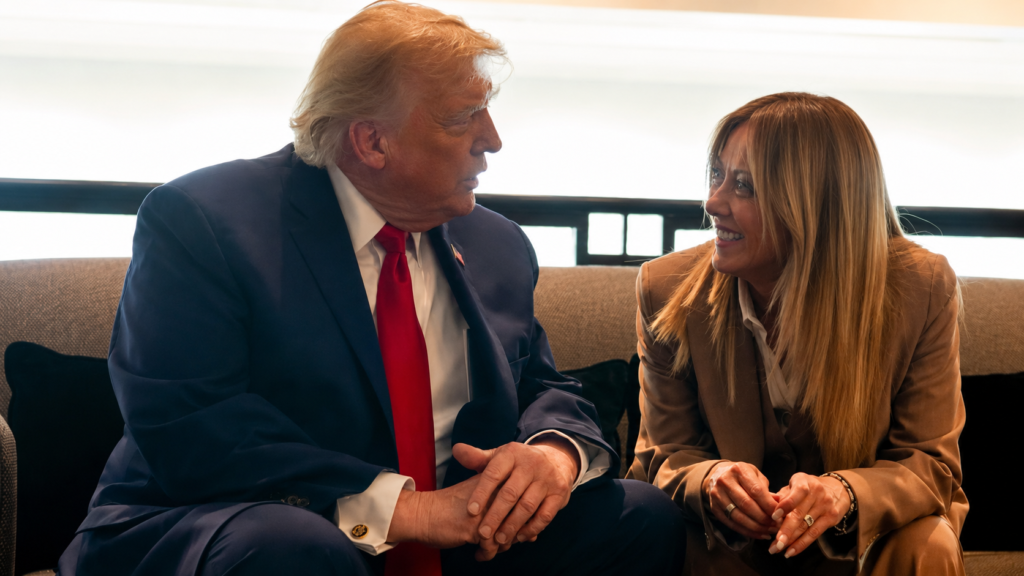
During the G7 Summit held in Évian-les-Bains, France, photographers captured Trump and Meloni seated together in what appeared to be a lengthy and constructive conversation.
Italian officials later described the meeting as a productive exchange that had clarified misunderstandings.
Meloni herself told reporters that discussions had been positive and free of conflict, fueling hopes that the tensions had subsided.
Those expectations would prove short-lived.
Fresh Controversy Over Photo Opportunity
Only days later, Trump reignited the dispute during a telephone interview with Italian television network La7.
According to the Italian-language broadcast, Trump claimed Meloni had repeatedly requested a photograph with him during the G7 summit and suggested that he agreed only out of sympathy.
The remarks immediately drew widespread attention throughout Italy.
Meloni forcefully rejected the allegation.
In a recorded video statement, she described Trump’s version of events as entirely fabricated.
She questioned why the American president would publicly target one of the United States’ closest allies while emphasizing that Italy had always conducted itself with dignity on the international stage.
“I do not know why the President of the United States behaves this way toward his own allies,” Meloni said.
She added that while she regretted Trump’s approach toward friendly nations, one point remained clear.
“Neither I nor Italy ever beg.”
Her comments quickly became one of the country’s most discussed political statements.
Italy Unites Behind Its Prime Minister
The dispute prompted an unusually unified response across Italy’s political landscape.
Italian Foreign Minister Antonio Tajani immediately canceled a planned diplomatic visit to Washington, signaling the seriousness with which Rome viewed the situation.
President Sergio Mattarella personally contacted Meloni to express his support.
Members of the governing coalition strongly condemned Trump’s remarks, describing them as offensive not only toward the prime minister but toward Italy as a nation.
Perhaps more significantly, opposition politicians many of whom frequently criticize Meloni’s domestic agenda—also defended the prime minister, arguing that Trump’s comments had crossed the line from political disagreement into an insult against Italian national dignity.
Calls for a formal apology emerged from lawmakers representing multiple political parties.
Despite the mounting criticism, Trump showed no indication of softening his position.
Posting from Camp David on his Truth Social platform, he insisted that Meloni had repeatedly requested the photograph and suggested she was now attempting to repair relations following what he described as America’s military success against Iran.
His remarks further fueled diplomatic tensions already strained by disagreements over military cooperation and foreign policy.
Even as the dispute over personal remarks began to fade from headlines, another issue quickly emerged.
Discussions surrounding American access to Italian military installations once again placed Rome and Washington on opposite sides.
Questions over national sovereignty, defense cooperation, and Italy’s constitutional authority regarding foreign military operations have once again complicated relations between the longtime NATO allies.
Analysts believe these disagreements extend far beyond personality clashes, reflecting broader differences over security strategy and Europe’s role in future international conflicts.
The deterioration in relations represents a remarkable reversal for Meloni.
Only last year, international media frequently referred to her as the “Trump whisperer,” highlighting her ability to maintain direct communication with one of the world’s most unpredictable political figures.
She was notably the only European Union leader invited to sit prominently during Trump’s January 2025 presidential inauguration an honor viewed by many as evidence of her privileged access to the White House.
Today, however, that once-celebrated relationship has become increasingly controversial.
Critics within Italy argue that Meloni invested too much political capital in cultivating ties with Trump, leaving her government vulnerable to public embarrassment as relations deteriorated.
Across Europe, diplomats are now questioning whether Italy can continue serving as an effective bridge between Washington and Brussels amid growing personal tensions between the two leaders.
A Meme Reflecting Political Reality
The viral AI-generated images that initially entertained Italian social media users have since taken on deeper political meaning.
While intended as satire, they now symbolize what many Italians see as the collapse of one of Europe’s most influential political partnerships.
For Meloni, the challenge extends beyond repairing relations with Washington.
She must also reassure European allies, maintain domestic political credibility, and redefine Italy’s diplomatic role at a time when international alliances are becoming increasingly fragile.
What began as a seemingly close partnership between Donald Trump and Giorgia Meloni has evolved into one of the most closely watched diplomatic disputes in the Western world one whose consequences may continue shaping transatlantic relations long after the memes disappear from social media.
Giorgia Meloni: Italy’s First Female Prime Minister and a Leader in the Global Spotlight
Italian Prime Minister Giorgia Meloni has become one of Europe’s most closely watched political leaders since taking office on October 22, 2022, making history as the first woman to lead Italy’s government. As leader of the right-wing Brothers of Italy (Fratelli d’Italia) party, which she co-founded in 2012, Meloni has reshaped Italy’s political direction while emerging as a prominent voice in European and international affairs.
Meloni’s political career spans nearly two decades. She first entered the national legislature in 2006, winning election to Italy’s Chamber of Deputies at the age of 29. Her rapid rise continued two years later when then-Prime Minister Silvio Berlusconi appointed her Minister for Youth, making her the youngest person ever to serve in the position. She held the post from 2008 to 2011, gaining national recognition as one of Italy’s emerging conservative leaders.
Her defining political breakthrough came after the collapse of Prime Minister Mario Draghi’s unity government in 2022, which triggered early parliamentary elections. Riding a wave of public support, Brothers of Italy captured roughly 26 percent of the national vote, emerging as the country’s largest political party. The result enabled Meloni to form a center-right coalition government with a comfortable parliamentary majority, officially beginning her tenure as prime minister.
Balancing Conservative Policies and International Diplomacy
Meloni has long been associated with Italy’s conservative political movement and has often emphasized policies centered on stricter immigration controls, the protection of traditional family values, and greater national sovereignty.
However, since assuming office, she has sought to present a more pragmatic image internationally. While maintaining her conservative domestic agenda, Meloni has reaffirmed Italy’s commitment to the North Atlantic Treaty Organization (NATO) and strengthened cooperation with Western allies. She has consistently supported continued military, humanitarian, and economic assistance for Ukraine following Russia’s full-scale invasion, positioning Italy as a reliable partner within both NATO and the European Union.
While managing tensions with Washington, Meloni has remained actively engaged in European diplomacy.
She recently traveled to Berlin to participate in the E5 Leaders Summit, hosted by German Chancellor Friedrich Merz, where European leaders discussed regional security, economic coordination, defense cooperation, and the future of support for Ukraine.
Shortly afterward, Meloni joined French President Emmanuel Macron in Antibes, France, for a high-level bilateral summit aimed at reinforcing cooperation between Italy and France. Discussions focused on strengthening collaboration in key areas, including energy security, migration policy, defense initiatives, and broader European stability.
Nearly four years into her premiership, Giorgia Meloni has become one of Europe’s most influential political figures. Her leadership has reshaped Italy’s domestic politics while elevating the country’s profile within the European Union and NATO.
Although recent diplomatic tensions with the United States have presented significant challenges, Meloni continues to play a central role in discussions shaping Europe’s future. As Italy navigates evolving geopolitical pressures, her ability to balance domestic priorities with international partnerships is expected to remain one of the defining features of her leadership.