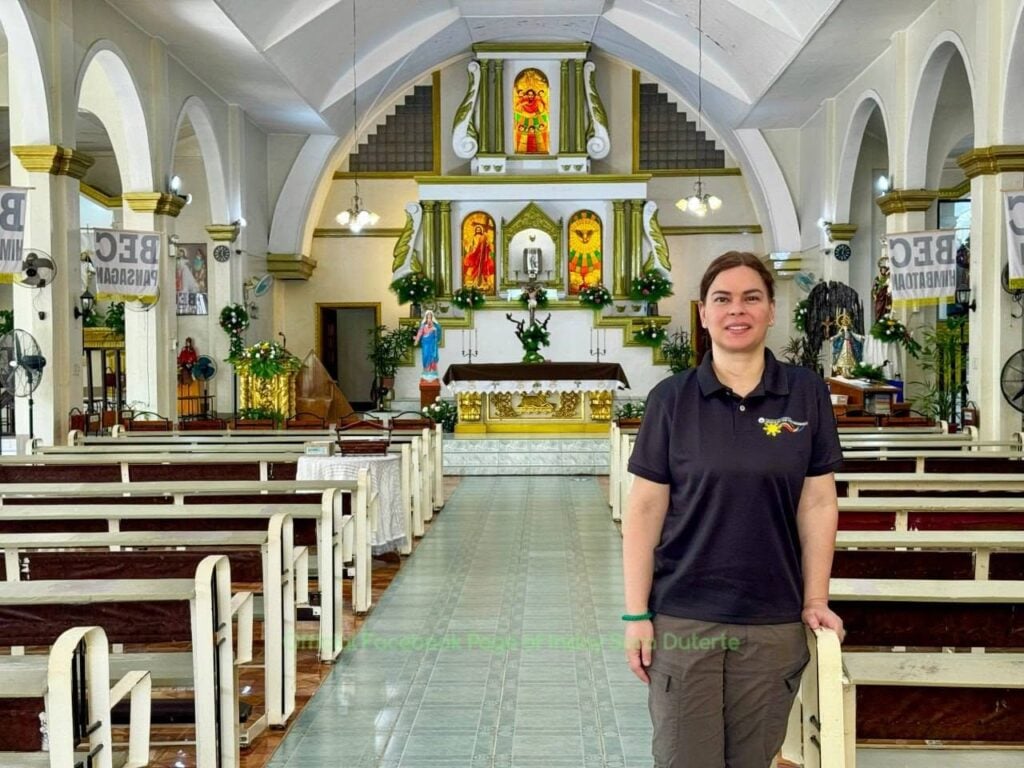
BAYBAY CITY, Philippines — In politics, timing is rarely accidental. Just a day after the controversial Senate hearing involving 18 so-called “ex-Marines,” Vice President Sara Duterte quietly appeared in Baybay City, Leyte—a place that unexpectedly sits at the crossroads of a growing political controversy. Officially, her visit was framed as a simple act of community engagement. She joined Brigada Eskwela activities at a small rural school, attended a prayer gathering at the well-known Pomponan Church, and participated in an aid distribution program for tricycle and pedicab drivers.
Yet politics is often defined not by what is said, but by what is seen.
The Vice President’s visit occurred in the political territory of individuals closely linked to lawyer Levito Baligod, the legal counsel of the 18 former Marines whose Senate testimony has generated national attention and fierce debate. The connection is difficult to ignore. Barangay Chairman Gongie Galenzoga, who warmly welcomed Duterte, is the brother of Marilou “Malot” Galenzoga-Baligod, the wife of Baligod himself.
This is where the story becomes more than a simple community visit.
For years, the Galenzoga-Baligod family has maintained political ties with the Duterte camp. Their political campaigns have repeatedly sought and showcased Duterte endorsements. Photographs and campaign materials from previous elections prominently featured Rodrigo Duterte alongside members of the family. Their alliance has never been a secret. It has been visible, public, and politically advantageous.
Against this backdrop, the Vice President’s appearance inevitably raises questions. Was the visit merely humanitarian, or was it also a signal of political solidarity?
The Senate hearing itself was already surrounded by controversy. Conflicting testimonies, allegations of political maneuvering, and competing narratives have left the public struggling to determine where the truth lies. Adding fuel to the fire were claims raised by National Bureau of Investigation Director Jaime Santiago Matibag, who disclosed information alleging that former congressman Mike Defensor had offered financial incentives to the former Marines in exchange for testimony. The allegations were later amplified when Palawan Representative Jose Alvarez publicly claimed that Defensor had attempted to recruit support for efforts related to President Ferdinand Marcos Jr.
READ MORE ARTICLES:
- Timing and Connections: VP Sara Visits Lawyer of Controversial Ex-Marines Amid Senate Hearing, Political Rivalries, and New Allegations
- President Marcos Joins LGBTQIA+ Community in Celebrating Pride Month, Reaffirms Commitment to Equality and Inclusion
- 2-anyos na Bata, Natagpuang Patay na Lumulutang sa Hukay sa Ormoc City
- Alan Cayetano Remains Senate President Amid Leadership Dispute as Minority Bloc Challenges Control of Senate
- DepEd Order No. 015, series of 2026, Revised Guidelines on Classroom Assessment, Grading System, and Awards and Recognition for the K to 12 Basic Education Program
- Legarda Questions Legality of Senate Leadership Takeover, Cites Constitutional Quorum Requirement
- Karen Davila Urges Senators to Direct Sympathy to Suffering Filipinos Amid Jinggoy Estrada’s Arrest
- CPALE RESULTS: PRC Announces 3,004 New CPA Certified Public Accountants as May 2026 Licensure Examination Released
These accusations have yet to be conclusively proven, but they illustrate the intensely political environment surrounding the hearing.
What stands out is that many of the political figures targeted by the testimony are associated with the Marcos-Romualdez administration or are known critics of the Duterte family. This pattern has led observers to ask whether the controversy is purely about exposing wrongdoing—or whether it is also part of a broader political struggle between rival factions competing for influence ahead of future elections.
The Baybay connection does not automatically prove coordination. It does not establish that the Duterte camp directed or orchestrated the actions of the former Marines. Responsible analysis requires acknowledging that political associations alone are not evidence of conspiracy.
However, political relationships matter. They provide context. They reveal networks of trust, loyalty, and shared interests that often influence events behind the scenes. The longstanding alliance between Baligod and the Duterte family places a visible Duterte connection near the center of a controversy that many initially viewed as independent and detached from partisan politics.
For ordinary Filipinos, the deeper concern is not simply who is connected to whom. The greater issue is whether political institutions are being used to advance truth or to settle political scores. When hearings become arenas for factional warfare, public confidence in democratic institutions suffers. Citizens begin to question whether investigations are motivated by justice or by political strategy.
The public deserves transparency from all sides. If the testimony of the former Marines is credible, it should withstand scrutiny regardless of political affiliations. If there are political actors influencing events behind the scenes, those connections should be openly examined. Accountability must apply equally to allies and opponents alike.
The Baybay episode serves as a reminder that in Philippine politics, personal relationships, political alliances, and public events are often interconnected. Whether Sara Duterte’s visit was purely coincidental or carried deeper political significance may remain a matter of interpretation. But the timing, the location, and the people involved ensure that questions will continue to be asked.
And in politics, unanswered questions often become the most powerful story of all.
Sara Duterte Prays for Peace, Calls for Rodrigo Duterte’s Return During Leyte Church Visit
Vice President Sara Duterte visited the Diocesan Shrine of St. Anthony de Padua in Baybay City, Leyte last Friday, where she offered prayers for peace, gratitude, and the well-being of the Filipino people.
In a social media post following her visit, Duterte described the church as one of Leyte’s prominent pilgrimage sites that attracts numerous devotees from across the province. During her visit, she lit a candle and joined fellow worshippers in prayer.
“We offered a prayer and lit a candle in gratitude for all the blessings and for the peace of our people,” Duterte said.
The Vice President also appealed to Filipinos to pray for the return of former President Rodrigo Duterte to the country, a statement that quickly drew attention from supporters and political observers alike.
“Let’s also pray fervently for the return of Former President Rodrigo Duterte to our country,” she wrote.
The visit formed part of Duterte’s activities in Leyte, where she also participated in community engagements and outreach efforts. Her stop at the historic shrine highlighted the role of faith and spirituality in public service and community life.
Concluding her message, Duterte called on Filipinos to strengthen their love for the nation and uphold values centered on faith, patriotism, and family.
“My fellow countrymen, let us love the Philippines—for God, for the Country, and for every Filipino Family,” she said.
The Diocesan Shrine of St. Anthony de Padua is regarded as one of the important religious destinations in Leyte, drawing pilgrims and devotees seeking prayer, reflection, and spiritual renewal throughout the year.
Duterte’s visit comes at a time when national political discussions remain intense, with supporters of the former president continuing to express hopes for his return and active participation in public life.
- Why the Ellora Caves in India Never Made the Seven Wonders List
- Sara Duterte | Lawyer, Biography, Political Career & Issues
- Ombudsman Files Fourteen Graft Cases Against Congressman Over Contract Links Today
- Macau Giant Pandas Complete Stunning Comeback For First Governors Cup Victory
- Typhoon Noul Threatens Southern China, Hong Kong Cancels Flights, Thousands Evacuated