Amid rising electricity costs and growing interest in renewable energy, Manila Electric Co. (Meralco) is pushing for stricter regulations on rooftop solar installations, citing safety concerns over improper and unpermitted setups that could lead to fires. While the power distributor insists the move is meant to protect consumers, advocacy groups and frustrated customers question whether tighter rules could discourage households from turning to solar power as an alternative to high electricity bills.
MANILA, Philippines — Power distributor Manila Electric Co. (Meralco) is calling for stricter regulations on rooftop solar panel installations, citing reports of fires allegedly caused by systems that failed to meet safety standards.
Meralco spokesperson Joe Zaldarriaga said there have been incidents involving improperly installed solar panels, particularly those that did not undergo proper safety inspections or secure permits from local government units. He also raised concern over what he described as “guerrilla installations” rooftop solar systems set up without the necessary approvals and compliance checks.
READ MORE ARTICLES
- CSC Government Employees Banned from All Gambling Activities
- Impeachment of Vice President Sara Duterte-Carpio: Discussion, Judgment, Politics, and Consequences
- Lopez Inc. Leadership Shake-Up: 71% Family Bloc Forces Out Piki Lopez Amid Governance Storm
- #FACTCHECK: Deen Chase Says President Bongbong Marcos Jr. Has HIV/AIDS
- CEBU: Meet the Mind Behind RUTA, the AI App Aiming to Simplify Cebu Commuting
- Two Americans Among 19 Killed in Clash Between Philippine Troops and Suspected Communist Rebels
“Isang maling instalasyon may result in accidental fire,” Zaldarriaga warned, emphasizing that even a single incorrect installation could spark a blaze. He clarified, however, that the power distributor is not against consumers seeking more affordable and renewable energy options.
“It’s primarily a safety issue,” Zaldarriaga explained. “Nandito kami para tumulong na umusbong itong mga rooftop solar installations as long as it is done properly, safely, and in consonance with government regulations.” He stressed that Meralco supports the expansion of rooftop solar systems, provided these are installed in accordance with existing laws and safety standards.
The issue was also highlighted in a report by Mariz Umali on the television news program 24 Oras, where Meralco reiterated that its proposal aims to protect consumers rather than restrict access to cheaper power sources.
Meanwhile, consumer advocacy group Power for People Coalition (P4P) pushed back against Meralco’s call for tighter rules. The group argued that safety concerns are already addressed by existing local government building and electrical codes, as well as inspections conducted by the Bureau of Fire Protection.
Gerry Arances, convenor of the coalition, warned that any additional regulation that could harm consumers would be legally challenged. “If that will be detrimental, we will definitely go to court to make sure electric consumers are protected,” Arances said.
The debate highlights the growing tension between promoting renewable energy adoption and ensuring public safety. As rooftop solar installations become more popular among households seeking to lower electricity costs, regulators, power distributors, and consumer groups continue to weigh how best to balance safety, affordability, and accessibility.
Opinion & Commentary: High Power Bills, Solar Restrictions, and the Real Burden on Filipino Consumers
In recent months, Manila Electric Co. (Meralco) has once again trended online not because of innovation or reform, but because of soaring electricity bills that many Filipinos say have become unbearable. For ordinary consumers already struggling with inflation, stagnant wages, and rising daily expenses, every increase in power rates feels like another blow.
Meralco insists that a significant portion of the bill does not actually go to the company. Around 11% of the total charge consists of government-mandated taxes and “pass-through charges,” including Value-Added Tax (VAT), Local Franchise Tax, Real Property Tax, and Energy Tax for high-consuming households. These are collected by Meralco but remitted to the government. The largest chunk of the bill roughly 64% is the Generation Charge, which goes to power suppliers, not directly to Meralco.
Technically, this explanation is correct. But for consumers, the breakdown hardly matters. Whether it goes to Meralco, private suppliers, or the government, the reality is simple: it is still the Filipino people who pay.
Now comes another controversial issue the call for stricter permits and regulations for rooftop solar installations. Meralco argues that this is about safety. According to its spokesperson, improper or “guerrilla” installations without permits and inspections could lead to accidental fires. On paper, that sounds reasonable. Safety should always be a priority.
But many Filipinos are asking a deeper question: Why does it feel like barriers are being placed just as people are trying to find cheaper alternatives?
If solar energy becomes widespread in the Philippines, some electric companies could indeed lose revenue. That is basic economics. When households generate their own electricity, dependence on distribution utilities decreases. In a country where power rates are among the highest in Southeast Asia, solar energy represents not just sustainability but survival.
It is difficult not to see the irony. In parts of Manila, tangled “spaghetti wires” hang across streets a visible reminder of decades of infrastructure neglect. Electrical fires have long been a problem in densely populated communities. If safety is the true concern, then comprehensive modernization of distribution lines and stricter enforcement against illegal connections should also be prioritized.
The bigger frustration, however, goes beyond Meralco. Many Filipinos feel trapped in a system where taxes are high, corruption scandals regularly make headlines, and accountability seems rare. Issues involving misuse of public funds and unexplained wealth among certain officials continue to erode public trust. Meanwhile, ordinary citizens carry the burden through taxes, through rising utility bills, through daily sacrifices.
This is why the debate over solar permits is emotionally charged. It is not just about safety compliance. It is about fairness. It is about whether policies protect consumers or protect powerful interests.
Renewable energy should empower citizens, not intimidate them with excessive bureaucracy. If permits are necessary, they must be transparent, affordable, and efficient not another layer of red tape.
The Filipino people are not against regulation. They are against imbalance. They are against a system where hardship is normalized for the many while privilege protects the few.
If the goal is truly safety, then enforce standards fairly. If the goal is sustainability, then encourage innovation. But if policies appear to restrict alternatives while electricity remains expensive, public skepticism will only grow stronger.
At the end of the day, the issue is not just about Meralco or solar panels. It is about trust and whether the system works for the people, or against them.
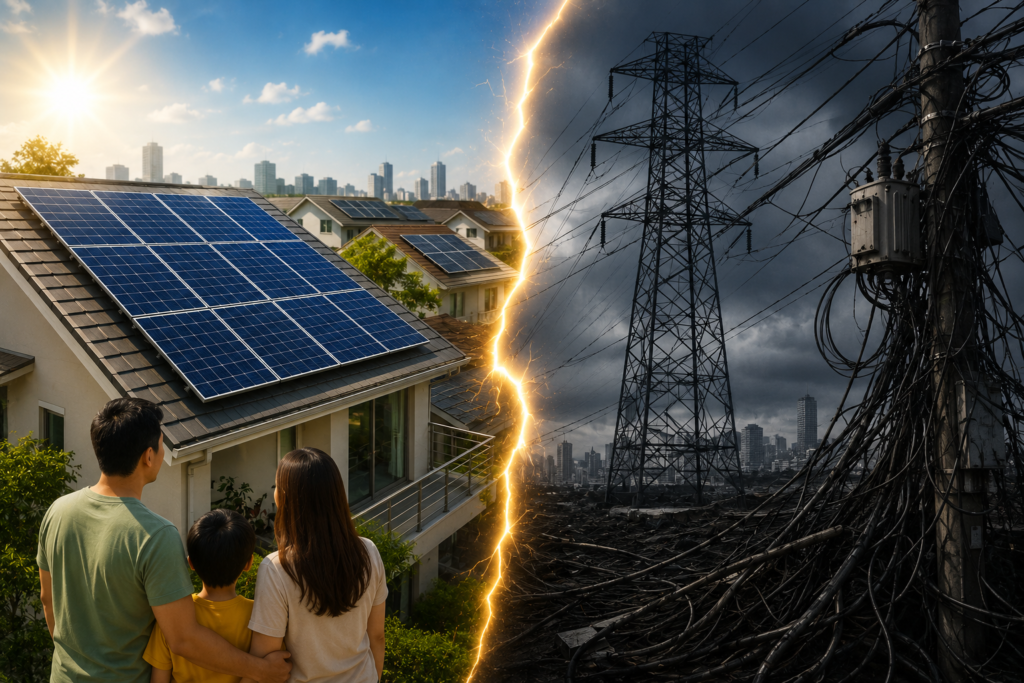
Solar Power vs. Traditional Utility: A Visual Reflection of the Energy Debate
The powerful side-by-side comparison that captures the growing debate between rooftop solar energy and traditional electricity distribution. On one side, a bright and hopeful scene shows a modern home equipped with solar panels, symbolizing clean energy, lower bills, and energy independence. A smiling family stands beneath the panels, representing empowerment and financial relief a future where households generate their own electricity and reduce dependence on large power providers.
The words “Clean. Affordable. Sustainable. Power to the People.” reinforce the message that solar energy is not only environmentally friendly but also economically liberating. The imagery suggests stability, progress, and optimism, highlighting the appeal of renewable energy in a country where electricity costs remain a heavy burden for many families.
In contrast, the other side of the image paints a darker narrative. A corporate building representing a major power distributor looms under a stormy sky, surrounded by tangled electrical wires. The visual tone is heavier, symbolizing high bills, regulatory hurdles, and consumer frustration. An electric bill marked “High Bill” is prominently displayed, alongside references to pass-through charges and taxes. A chained lock labeled “Permit Required” suggests restrictions and additional bureaucracy tied to rooftop solar installations.
The lightning bolt dividing the two sides dramatizes the tension between centralized power utilities and decentralized renewable energy systems. It visually captures the conflict between safety regulations and consumer access, between corporate infrastructure and household independence.
Overall, the image functions as an editorial statement. It does not merely compare two energy sources — it reflects a broader public conversation about affordability, regulation, trust, and empowerment. As more Filipinos explore rooftop solar to reduce expenses, debates continue over safety standards, permits, and the future of the country’s energy landscape.
The picture ultimately asks a question without words: Should energy remain concentrated in the hands of large utilities, or should households be encouraged to take power literally and financially into their own hands?
- School Safety Must Be a National Priority After San Jose National High School Tragedy
- RA 9344: Balancing Compassion, Rehabilitation, and Accountability in Juvenile Justice
- Concept of Society: Perspectives from Filipino, American, & Western Authors
- Keir Starmer to Step Down as Prime Minister and Labour Leader, Triggering Leadership Contest After Months of Political Turmoil and Internal Rebellion
- Why Tech Investors Must Watch the Federal Reserve Amid AI Expansion?