In a digital world where every scroll feels like a race against an algorithm, Friendster is making a bold comeback not to compete for attention, but to slow everything down. The once-pioneering social network, launched in 2002 and shuttered in 2018, has relaunched in April 2026 as a “slow social” platform that rejects ads, algorithms, and vanity metrics in favor of real-life connections and user privacy.
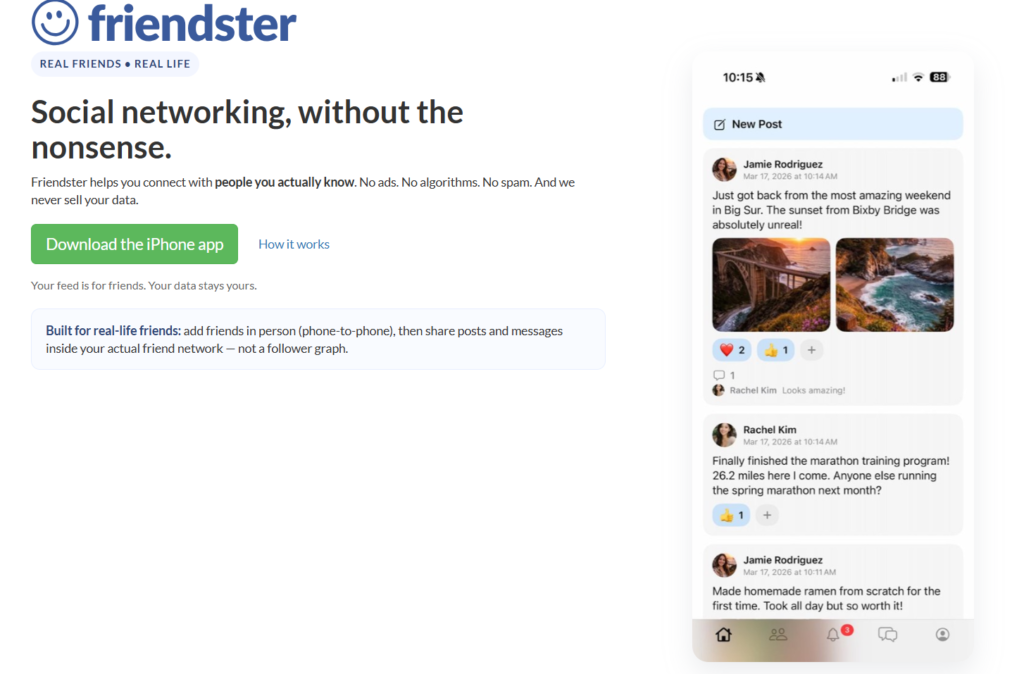
In an age where every scroll feels like a race against an algorithm, Friendster is attempting something radical: slowing everything down.
Launched in 2002, Friendster was once a pioneer of online social networking, long before today’s digital giants reshaped how we interact. After shutting down in 2018 and disappearing from the social media landscape for nearly a decade, the platform has reemerged in April 2026 with a bold promise not to compete in the attention economy, but to reject it altogether.
READ MORE ARTICLES:
- Ukraine Marks 40th Anniversary of Chornobyl Disaster, Facing Fresh Nuclear Safety Risks Amid Ongoing War
- Min Aung Hlaing Grants Amnesty, Secures Release of Win Myint as Aung San Suu Kyi Remains Detained
- Donald Trump Turns on Ally PM Giorgia Meloni After Public Clash Over Pope and Iran Policy
- President Marcos Jr, Appoints Trade Envoy Dita Angara-Mathay as New Secretary of Tourism
Now branded as a “slow social” platform, Friendster is positioning itself as the antidote to algorithm-driven feeds and performative online culture. Unlike mainstream platforms that thrive on likes, shares, followers, and viral trends, this new version strips away the metrics. No follower counts. No suggested strangers. No endless scroll engineered to keep you hooked.
Instead, Friendster insists on something almost old-fashioned: real-life connections.
Adding a friend requires physically touching phones together a symbolic and literal return to human interaction. Your friend list isn’t a collection of digital acquaintances or faceless accounts; it’s meant to be people you’ve actually met. In an era of curated personas and parasocial relationships, that’s a striking shift.
Equally bold are its business principles. The platform promises no ads, no algorithm, no spam DMs and perhaps most notably, no selling of user data. “Period,” as they emphasize. In a time when privacy concerns dominate conversations about tech companies, this stance feels less like marketing and more like a statement.
But can “slow social” survive in a fast-paced digital world?
The younger generation has grown up inside algorithmic ecosystems where validation is quantified and visibility is currency. Meanwhile, older users who once built their first online communities on Friendster may now find nostalgia mixed with curiosity. The challenge lies in whether enough people are willing to trade convenience and viral reach for intentional, smaller circles.
Currently available only on iOS, with no announcement yet for Android, the relaunch feels almost deliberately restrained another reflection of its philosophy. No grand blitz. No explosive rollout. Just a quiet return.
Friendster’s comeback is more than a revival; it’s a critique. It questions what social media has become and asks whether connection should be measured in numbers at all.
In a world dominated by noise, Friendster is betting that silence and sincerity might be the next revolution.
In an era defined by endless scrolling, algorithm-driven feeds, and curated perfection, Friendster is attempting a dramatic reset.
After nearly a decade of silence, the once-pioneering social network has officially relaunched in April 2026 not as a competitor in today’s attention economy, but as its deliberate opposite. The revival of Friendster introduces what its new owners call a “slow social” platform, centered on real-life interaction and radical privacy.
A Reinvention for 2026
Under new ownership, the platform has been rebuilt from the ground up. The domain friendster.com was acquired for $30,000 and revived by Philadelphia-based programmer Mike Carson through Friendster Labs Inc..
Unlike modern platforms that rely heavily on recommendation engines and targeted advertising, the new Friendster strips away what it describes as the “noise” of contemporary social media.
In-Person Connections Only
Perhaps its most striking feature: users can only add friends by physically tapping phones together. There are no follower counts, no suggested strangers, and no public popularity metrics. The design forces intentional, real-world interaction before any online connection can be made.
The app is currently available exclusively on iPhone through the Apple App Store. There is no web-based version and no Android app a limitation that appears intentional as the company focuses on a tightly controlled rollout.
Privacy at the Core
The platform promises:
- No advertisements
- No algorithmic feed manipulation
- No sale of user data
In a digital landscape increasingly scrutinized for surveillance capitalism and data harvesting, Friendster is positioning itself as a sanctuary for private, small-scale social networking.
Before its 2026 revival, Friendster was widely regarded as the “grandfather” of social networking.
The Early Years (2002–2011)
Launched in 2002, Friendster became one of the first major social networks to attract millions of users worldwide. It allowed highly customizable profiles using CSS themes, background music, and personal “testimonials” features that would later influence platforms like Facebook and MySpace.
At its peak, it was particularly popular across Southeast Asia.
The Gaming Pivot (2011–2015)
After being overtaken by Facebook in the late 2000s, Friendster was acquired by MOL Global and repositioned as a social gaming site. The shift failed to regain its former dominance.
Closure (2018)
The original service was paused in 2015 and officially shut down in 2018, marking the end of one of the internet’s earliest social media giants — until now.
Domain and Registration Details
The domain friendster.com was originally registered on March 22, 2002. It is currently registered through Porkbun LLC (IANA ID: 1861).
- Registered On: March 22, 2002
- Expires On: March 22, 2030
- Last Updated: March 17, 2025
- Status: Client delete prohibited; client transfer prohibited
- Name Servers: AWS DNS infrastructure
The relaunch raises a broader question: can “slow social” succeed in a world conditioned by viral content and instant engagement?
By removing ads, algorithms, and public metrics, Friendster is betting that users are ready for a smaller, quieter digital space one that mirrors real-life relationships instead of gamifying them.
Whether it becomes a niche refuge or sparks a wider industry shift remains to be seen. But after nearly 24 years since its original debut, Friendster is once again trying to redefine what social networking can be this time, by doing less, not more.
Friendster Relaunches on iOS Only, Android Version Still in Development
Friendster’s long-awaited return in April 2026 has sparked excitement among former users and curious newcomers alike. However, the revived platform is currently available only on iOS, leaving Android and web users waiting for further updates.
The new version of Friendster is being rolled out as part of a “soft launch,” according to its developer, Friendster Labs Inc.. The strategy allows the company to test and refine the platform’s new features before expanding to other operating systems.
Why iOS First?
Developers often prioritize iOS during early launches because it is easier to build and test apps for a limited number of devices. Apple’s tightly controlled hardware ecosystem means fewer variations to account for, compared to the thousands of Android device models currently in circulation.
Reports from Inquirer Technology indicate that there is no confirmed timeline yet for an Android release. For now, the app remains exclusive to iPhone users through the Apple App Store.
Privacy-Focused Technology Needs Optimization
The revived Friendster positions itself as a “slow social” platform that emphasizes real-life interaction and privacy. One of its standout features is phone-to-phone tapping, which allows users to add friends only through physical proximity.
Such technology relies heavily on device sensors and communication protocols that vary across Android manufacturers. Before releasing an Android version, developers must ensure the feature works consistently across different hardware configurations a process that requires additional time and testing.
Unlike the original early-2000s social network, the new Friendster is not owned by its former company. It has been rebuilt from scratch by Philadelphia-based developer Mike Carson after acquiring the domain and relaunching the platform under Friendster Labs Inc.
Because the project is being developed on a more limited scale, resources and rollout capacity are currently focused on stabilizing the iOS version before expanding further.
In addition to the absence of an Android app, there is currently no official web or browser-based version of Friendster. Users cannot log in via desktop or laptop at this time, reinforcing the platform’s mobile-first approach.
For Android users eager to join the new Friendster, the best course of action is to monitor official updates through Friendster.com and the company’s social media channels. An Android version has not been ruled out, but no launch date has been announced.
For now, the relaunch remains an iPhone-exclusive experiment a careful, measured comeback for one of the earliest names in social networking.
- Enrique Razon Reigns as Philippines’ Richest Billionaire for Third Consecutive Year
- COMMENTARY: Sara Duterte’s Impeachment Battle Ends, but the 2028 Political Contest Begins
- Walang Pasok sa NCR at 22 Lalawigan Ngayong Huwebes, Agosto 6; Sinuspinde ng Malacañang ang Klase at Trabaho sa Pamahalaan
- Marcos Appoints Ronald Chua as New Sandiganbayan Justice; Randolph Pascasio Named to Court of Appeals
- BSKE 2026, Posibleng Mailipat sa 2028 sa Ilalim ng House Bill