Norway is mourning the death of King Harald V, who died peacefully at the age of 89 after a 35-year reign that transformed him into a widely admired symbol of unity, openness and national resilience. His death marks the end of an era for the Norwegian monarchy, with tributes pouring in as the country prepares to welcome his son, King Haakon, as its new monarch.
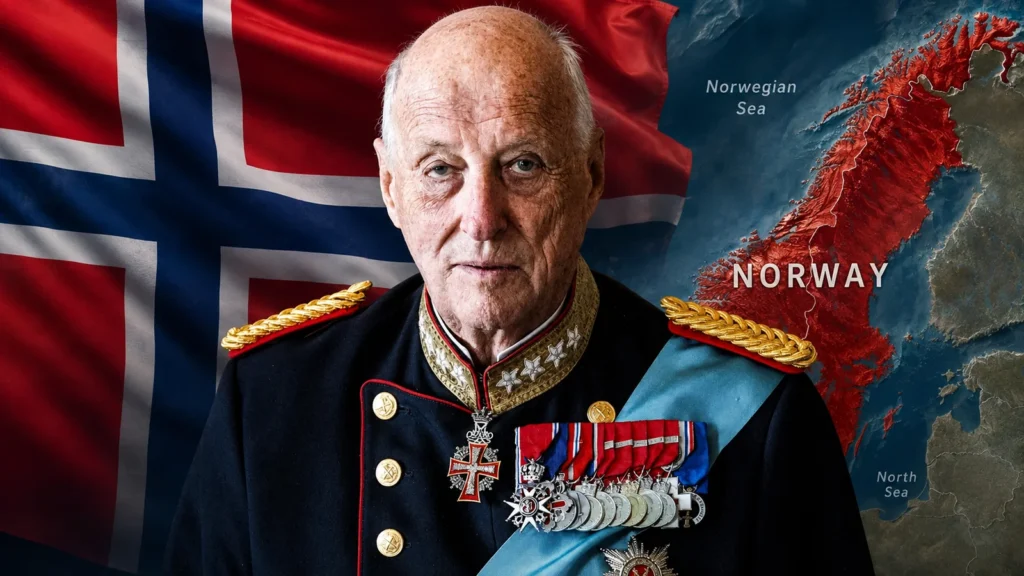
Norway is mourning the death of King Harald V, who passed away at the age of 89 after more than three decades on the throne and became widely remembered as a modern, approachable and unifying figure in the country.
The Norwegian royal palace in Oslo announced that Harald died peacefully at 6:35 a.m. local time on Friday at the national hospital, where he had been receiving treatment for a rare blood condition after being taken there last week.
Following his death, the royal flag above the palace was lowered to half-mast as Norway entered a period of national mourning ahead of his funeral. Mourners also gathered outside the palace, bringing flowers and Norwegian flags to pay their respects to the king.
Harald’s death marks the end of a 35-year reign that saw major changes in the Norwegian monarchy. Historians and royal observers say he helped make the institution more open, modern and closely connected to ordinary people.
Ole-Jørgen Schulsrud-Hansen, a historian and royal correspondent for TV2, said Harald’s reign helped make the Norwegian monarchy more egalitarian and transparent, including in matters involving royal finances and health.
Tove Taalesen, a royal correspondent for Nettavisen, described Harald as “one of us,” reflecting the strong connection many Norwegians felt with him. Caroline Vagle, a royal expert for Se og Hør magazine, similarly said the king had always been very close to the people.
Harald was known for showing emotions and speaking in a way that made him appear less distant from the public. His willingness to display humor, vulnerability and personal feelings helped create an image of a king who was approachable rather than overly formal.
Royal observers often described him as the “People’s King” and even as the nation’s “grandfather.” The description echoed the reputation of his father, King Olav V, who was also affectionately known as a king closely connected to ordinary Norwegians.
During some of Norway’s most difficult moments, Harald used his position to encourage unity and calm. After the devastating 2011 terrorist attacks in Oslo and on the island of Utøya, he called on Norwegians to stand together and support one another rather than allow fear to take control.
His reign was also notable for his decision to challenge long-standing royal traditions. One of the most important moments came when he married Sonja Haraldsen, a woman who was not born into royalty.
Harald met Sonja, the daughter of a businessman, at a party. Their relationship faced a major obstacle because royal approval was required before the crown prince could marry a commoner.
The couple waited nine years before receiving permission to marry. Harald eventually told his father that if he could not marry Sonja, he would remain single. His father eventually gave his consent.
Harald and Sonja married at Oslo Cathedral on August 29, 1968. Their marriage became an important turning point for the Norwegian royal family and helped open the way for future members of the family to marry people outside royal circles.
The decision was especially significant because it challenged the traditional expectation that members of a royal family should marry within aristocratic or royal circles. Harald’s choice later allowed his own children to make similar decisions.
For royal expert Caroline Vagle, the change also helped reduce what she described as a traditionally male-dominated royal family and contributed to a more modern image of the monarchy.
Harald was also notable as Norway’s first king born in the country since the 14th Century. He was born on February 21, 1937, at the Skaugum estate near Oslo.
His childhood was deeply affected by the Second World War. Harald was only three years old when Nazi Germany invaded Norway. His mother, Crown Princess Märtha, fled with her children across the border to Sweden. The family later traveled to the United States after receiving an invitation from US President Franklin D. Roosevelt.
After the war ended, Harald returned to Norway with his family and continued his education. He also completed compulsory military service, preparing for the responsibilities that would eventually come with his position as heir to the throne.
He became crown prince in 1957. From 1960 to 1962, he studied social science, history and economics at Balliol College, Oxford, further broadening his education before taking on greater royal responsibilities.
Harald eventually became king in 1991 following the death of his father, King Olav V. Over the next 35 years, he helped guide Norway through periods of social change, political challenges and national crises.
His reign was not without controversy or personal difficulties. In his later years, Harald and his family experienced a number of health challenges as well as scandals involving members of the wider royal family.
Despite these difficulties, Harald remained a highly recognizable and influential national figure. His long service helped maintain the monarchy’s position in Norwegian public life while allowing the institution to gradually adapt to a changing society.
Tributes from other European monarchies also reflected the respect Harald earned during his decades as king.
King Charles III sent his “most heartfelt condolences” following the death of his “dear cousin.” Harald was a second cousin of the late Queen Elizabeth II.
King Carl XVI Gustaf of Sweden also remembered Harald as a close friend to him, his family and Sweden. He wished Harald’s son, Haakon, success and good fortune as the new king.
Harald is survived by his wife of nearly 58 years, Queen Sonja, their daughter Princess Märtha Louise, their son King Haakon, and six grandchildren.
With Harald’s death, Norway now begins a new chapter under his son, King Haakon, 53. Haakon is expected to assume the responsibilities of the monarchy as the country mourns the loss of a king who spent most of his life preparing for and serving in the role.
An extraordinary council of state with the government was scheduled to take place later on Friday, marking the formal beginning of the transition to the new reign.
For many Norwegians, however, the transition is more than a constitutional change. It marks the end of an era shaped by a king who gradually brought the monarchy closer to everyday life.
Harald’s legacy will likely be remembered not only through his 35 years as king but also through the way he changed the public image of Norway’s royal family. By being open about emotions, embracing humor, marrying a commoner and standing beside his people during difficult times, he helped create a monarchy that appeared less distant and more connected to society.
His reign demonstrated that a modern monarch could preserve tradition while also adapting to the expectations of a changing country.
As flowers continue to be placed outside the royal palace and Norway observes its period of mourning, King Harald V is being remembered as a king who chose to stand with his people earning a reputation as Norway’s “People’s King.”ADS
Norway Mourns King Harald V, a Beloved Monarch Who United the Nation
Norway is mourning the death of King Harald V, a monarch remembered not only for his more than three decades on the throne but also for his compassion, openness and ability to stand with his people during some of the country’s darkest moments.
King Harald died peacefully at Oslo University Hospital on Friday, August 28, at 6:35 a.m. He was 89 years old, according to the Norwegian Royal Court. His death marked the end of a reign that began in 1991 and lasted more than 35 years.
His son, Crown Prince Haakon, has now succeeded him as King Haakon VIII, beginning a new chapter for the Norwegian monarchy.
Harald was born on February 21, 1937, and became crown prince after his father, King Olav V, took the throne. When Olav became seriously ill in 1990, Harald took on the responsibility of serving as regent. He officially became king following his father’s death on January 17, 1991.
At first, Harald was known as a relatively quiet and shy man. Over the years, however, he gradually became more confident and approachable. Historian Trond Norén Isaksen described his development as a transformation into a more open and empathetic monarch.
Rather than presenting himself as a distant royal figure, Harald increasingly showed an understanding of ordinary people’s lives and emotions. His personal style helped make the Norwegian monarchy appear more connected to society.
One of the defining moments of his reign came in July 2011, when Norway suffered one of the worst attacks in its modern history.
Anders Behring Breivik carried out a bombing in Oslo that killed eight people before traveling to the island of Utøya, where he attacked a youth camp and killed 69 more people, most of them teenagers.
The tragedy deeply shocked Norway.
The following day, King Harald addressed the nation on television. Weeks later, he delivered another emotional speech in which he spoke directly to the victims and their families. Speaking not only as king but also as a husband, father and grandfather, Harald struggled to hold back his emotions.
“I can only imagine the depth of your pain. As King of this nation, I feel for each and every one of you,” he said.
For many Norwegians, the moment became a powerful example of what they wanted their monarchy to represent: compassion, unity and a willingness to stand beside citizens during times of suffering.
Historian Ole-Jørgen Schulsrud-Hansen later described the moment as one that remained deeply remembered by the Norwegian people and represented an important picture of what a modern monarchy could be.
Harald also became known for his support of a diverse and changing Norway.
In 2016, he attracted international attention after giving a speech emphasizing that Norwegian society included people from different countries, religions, cultures and backgrounds.
He spoke about Norwegians whose families came from countries such as Afghanistan, Pakistan, Poland, Sweden, Somalia and Syria. He also emphasized that people could have different beliefs or no religious beliefs at all, and that people could love others regardless of gender.
The message was simple: Norway belonged to everyone.
Beyond his royal duties, Harald was also a passionate athlete and environmental advocate.
He was an accomplished sailor and represented Norway in sailing at three Olympic Games. He also played a role in environmental protection and was among the people who helped establish the Norwegian branch of the World Wide Fund for Nature, later serving as its president for two decades.
His family life was also closely followed by the Norwegian public.
In 2001, Crown Prince Haakon married Mette-Marit Tjessem Høiby. She had a young son, Marius, from a previous relationship. Harald and Queen Sonja welcomed the child into the family, although the royal household later clarified that he was never a member of the royal family.
Harald’s daughter, Princess Märtha Louise, also attracted attention after her relationships and business activities became subjects of public debate. She eventually stepped back from official royal duties following controversies surrounding her personal and professional life.
Some Norwegians questioned whether Harald was too tolerant of the difficult decisions made by members of his family. Others saw his approach as consistent with his personality.
Rather than immediately issuing strict orders or publicly condemning relatives, Harald often appeared to favor discussion and understanding.
As his health weakened, the king gradually reduced his official responsibilities. In April 2024, he permanently reduced the number of public engagements he attended.
His health became a growing concern in his final years. He had previously suffered health problems, including an infection while visiting Malaysia in 2024, when he received a temporary pacemaker before later receiving a permanent one.
In August 2026, Harald was hospitalized again. The Royal Court said he was being treated for a serious health condition and later for a bacterial infection in his bloodstream. His condition deteriorated in the days before his death, and Crown Prince Haakon served as regent and carried out his father’s official duties.
The king died at Oslo University Hospital on August 28. Norwegian authorities confirmed his death, while the country’s armed forces announced that mourning ceremonies would take place, including a 21-round gun salute from nine military saluting stations.
Harald’s death also comes at a difficult time for the Norwegian royal family.
In recent years, controversies involving members of the family have placed the monarchy under increased public scrutiny. The legal case involving Marius Borg Høiby, as well as controversy surrounding Crown Princess Mette-Marit’s past contact with Jeffrey Epstein, created difficult headlines for the royal household.
Mette-Marit has also faced serious health problems. She underwent a lung transplant in 2026 after living with a rare form of pulmonary fibrosis.
These events contributed to declining public support for the monarchy. However, critics generally separated Harald himself from the controversies surrounding other members of his family.
His personal popularity remained considerably stronger than the broader public opinion surrounding the royal institution.
Analysts have noted that Harald’s greatest strength was his ability to remain above political arguments and serve as a symbol of national unity.
For more than three decades, he represented Norway at home and abroad, attending national celebrations, meeting citizens, supporting athletes and speaking to the country during moments of grief.
Norwegian Prime Minister Jonas Gahr Støre described Harald as a monarch who helped bring people together and said the king had shown an unwavering belief in the Norwegian people. The prime minister also said Norway had a profound love for its king.
Now, that long chapter has come to an end. King Haakon VIII inherits the throne at a challenging moment. He will have to carry the responsibilities once held by his father while also dealing with questions surrounding his own family and the future of the monarchy.
But for many Norwegians, the immediate focus is not on political questions or royal controversies.
It is on remembering a king who spent most of his adult life serving his country.
Harald’s reign was marked by war memories, social change, national tragedy, sporting achievements, family controversies and personal health struggles. Through all of them, he remained a familiar figure to generations of Norwegians.
His greatest legacy may not be a particular political decision or royal tradition. Instead, it may be the image of a king who chose to speak to his people in simple human terms especially when the country needed comfort.
As Norway enters a new era under King Haakon VIII, the country now says goodbye to Harald V, a monarch remembered by many as a humble, compassionate and deeply beloved king.