The Strait of Hormuz serves as a critical maritime link connecting the Persian Gulf to the Gulf of Oman and the wider open ocean. Lying between two major landmasses, its northern shores belong to Iran, while the southern coastline is formed largely by Oman’s Musandam Peninsula and falls within the country’s Musandam Governorate. A small section of the peninsula’s southwestern edge is administered by the United Arab Emirates (UAE). Spanning approximately 167 kilometres (104 miles) in length, the strait varies considerably in width stretching around 97 kilometres (60 miles) at its broadest point and narrowing to just 39 kilometres (24 miles) at its narrowest.
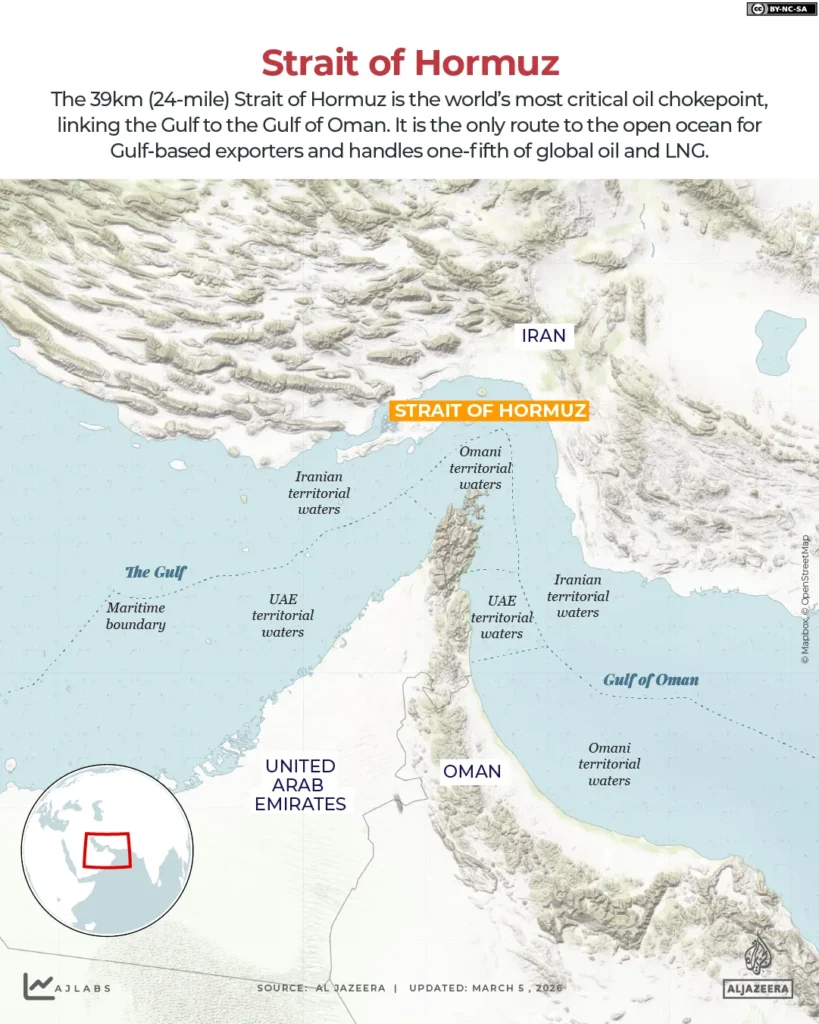
Far more than just a stretch of water, the strait stands out as the sole sea passage from the Persian Gulf to the open seas, making it one of the world’s most geostrategically significant maritime choke points. Between 2023 and 2025 alone, it carried roughly 20% of the world’s total trade in liquefied natural gas and about 25% of all oil transported by sea each year. It represents a primary artery for fuel and energy shipments bound for Europe and Asia, and is particularly indispensable to Europe’s energy security. Furthermore, the strait constitutes the only maritime trade route for several key Gulf nations—including the UAE, Qatar, Bahrain, Kuwait, and Iraq. Any prolonged interruption to shipping here can rapidly trigger severe global energy shortages and supply-chain disruptions.
Prior to the outbreak of the 2026 Iran War, the strait had historically remained open through many periods of regional conflict, distinguishing itself from waterways such as the Straits of Tiran and Bab-el-Mandeb , which have seen extended closures. Still, stability was never guaranteed: Iran had periodically issued threats to close the passage, and reports indicated that preparations to mine the strait had been put in place at various times. With the onset of war in 2026, those concerns became reality. Iranian blockading actions led to the physical closure of the waterway an event that developed into the central focus of the conflict and triggered what is now known as the 2026 Strait of Hormuz crisis.
The Origins and Meaning of the Name “Hormuz”
The name borne by the Strait of Hormuz carries with it a long and fascinating history, one whose exact origins have remained open to interpretation and scholarly debate over the centuries, with no single account universally accepted as definitive. Indeed, the roots of the word “Hormuz” are described by historians and linguists alike as vague and uncertain, drawing from a rich tapestry of languages, ancient beliefs, and long-forgotten figures that reflect the strait’s position as a meeting place of civilizations since time immemorial. Several compelling theories have been put forward to explain how this world-famous waterway came to bear the name it does today, each offering a different glimpse into the region’s cultural and historical heritage.
One of the most widely discussed possibilities suggests that the name springs from the Persian language, specifically from the term “Hur-Mogh,” which translates roughly to “Place of Dates” , a fitting and evocative description in a region where date palms have long flourished and where the fruit has sustained communities along the gulf coasts for thousands of years. This theory draws upon the local geography and the natural abundance of the lands surrounding the strait, implying that early inhabitants named the passage after the rich groves that greeted travellers arriving from the sea . Many researchers regard this explanation as the most plausible and likely origin.
Yet another prominent theory traces the name back to the spiritual and religious traditions of ancient Persia, proposing that “Hormuz” is derived from the Middle Persian pronunciation of “Hormoz,” the name of the supreme Zoroastrian deity Ahura Mazda, the all-wise and all-seeing lord of light, wisdom, and creation. In this telling, the strait would have been known by the name of the highest god, perhaps reflecting the reverence with which the waters were regarded, or serving as a divine marker along the boundary of the known world . This connection is strongly favoured by some historical sources and resonates deeply with Persia’s ancient cultural and religious legacy.
Beyond these two leading possibilities, other intriguing explanations have also emerged from the pages of history. One such account suggests that the strait was named in honour of Ifra Hormizd, the mother of King Shapur II of Persia, who reigned with great authority from the year 309 until 379 AD . She was a powerful and influential figure whose memory may have been honoured by having one of the world’s most important maritime passages bear her name through the ages. Still another theory reaches back into the classical world, proposing that the name finds its roots in the ancient Greek language, specifically in the word “hormos,” meaning a safe cove, sheltered bay, or anchorage , a term that Greek sailors and geographers might have applied to the waters of the strait, which offered protection and refuge amid the open seas.
What emerges from all these competing theories is not a simple single answer, but rather a deeper appreciation of how the strait has stood at the crossroads of languages, empires, and faiths for millennia . Its very name is a testament to the many peoples who have sailed these waters, traded along its shores, and sought to capture its essence in words that have echoed down through history. Whether it was named for its fruitful lands, in honour of a supreme god, in memory of a royal mother, or for the shelter its waters once gave to sailors of old, the name Hormuz remains a fitting and enduring symbol of the region’s layered past, one that continues to invite curiosity and reflection even today.
Through centuries of exploration, trade, and conflict , including the age of the Kingdom of Hormuz, the Portuguese–Safavid wars, and pivotal naval engagements such as the Battle off Hormuz in 1625 and the Battle of the Strait of Hormuz in 1553 , the name has endured, carried across oceans and down through generations, its meaning enriched by every new interpretation yet never reduced to a single, simple truth.
The Strait of Hormuz: Origins, History, and Legacy of a Legendary Waterway
The name and identity of the Strait of Hormuz are woven deeply into centuries of trade, exploration, and geopolitical rivalry, reflecting its enduring role as one of the most celebrated and vital waterways on Earth. Long before it bore the name we know today, its waters were recognised as the gateway to the Persian Gulf, described with remarkable clarity in the Periplus of the Erythraean Sea, a mariner’s guide dating back to the 1st century. In that ancient account, the strait is not yet named, but its geography is laid bare: at the head of a chain of islands lies a mountain range known as Calon, and beyond this opens the mouth of the great Persian Gulf, famed even then for its abundant pearl fisheries. To one side rise the lofty mountains called Asabon, and to the other stands a prominent, rounded peak named Semiramis, with the crossing between them measured at roughly six hundred stadia an early testament to the narrow passage that has defined its fate ever since.
Beyond this threshold stretches the vast expanse of the Persian Gulf, reaching far inland toward a legal trading port known as Apologus, situated near the Euphrates River and the settlement of Charaex Spasini, linking this narrow crossing to the heartlands of ancient commerce and civilisation. Centuries later, between the 10th and 17th centuries AD, the region gave rise to the Kingdom of Ormus, a powerful and prosperous state whose name would eventually become the root of the strait’s modern designation, forever binding the waterway to the legacy of the empire that once flourished upon its shores.
As the centuries unfolded, the Strait of Hormuz emerged from the shadows of ancient writings to become a stage for global ambition, its strategic importance growing with every new era of exploration and international power. From the 15th century onward, its commanding position drew the attention of far-reaching nations, and it became the first point of western military dominance in the gulf. The Portuguese arrived in the region in 1507, establishing a sustained presence that would endure until 1750, securing fortresses, controlling shipping, and asserting authority over the critical passage that linked the East and West. Their arrival marked a turning point, as European naval power took hold of the strait, shaping trade routes and regional politics for generations.
This dominance did not go unchallenged; as other maritime powers rose to prominence, rivalries inevitably followed. By the 17th century, England had entered the region, bringing fresh competition and sparking new disputes over control of the strait’s waters. What began as a Portuguese sphere of influence thus evolved into a broader contest for mastery of this vital way, where the convergence of geography, commerce, and military strength ensured that the Strait of Hormuz would remain not merely a passage of water, but a living symbol of global power and historical significance, its story written across millennia of exploration, empire, and struggle.
Navigation, Sovereignty, and the Legal Tug-of-War Over the Strait of Hormuz
Safe passage through the Strait of Hormuz depends on a carefully designed traffic separation scheme put in place to minimise the risk of collision, ensuring that one lane is reserved exclusively for inbound vessels and the other for those heading outwards. Each lane stretches two nautical miles across, with a median zone of equal width keeping incoming and outgoing traffic safely apart. Commercial vessels from nations bound by the United Nations Convention on the Law of the Sea are required to adhere to this system while exercising their right of transit passage. Yet geography complicates governance in striking ways: the traffic separation scheme itself lies within Omani territorial waters, though extraordinarily large ships must briefly pass through Iranian territory to the southeast, as the waters closer to the United Arab Emirates shoreline are too shallow to accommodate them. This practical reality means that almost every ship making the journey must traverse the territorial waters of both Iran and Oman, creating overlapping jurisdictions and differing interpretations of international law that have persisted for decades.
The legal framework governing passage through the strait is further complicated by the fact that neither Iran nor the United States has formally ratified UNCLOS, even though both nations, alongside most others around the world, continue to assert the rights of transit passage that the convention codifies. Disputes over these rights stretch back more than half a century, beginning in 1959 when Iran redrew its maritime boundaries, extending its territorial sea to twelve nautical miles and declaring that only innocent passage not full transit passage would be recognised through these newly expanded areas. Oman followed suit in 1972 by issuing its own decree extending its territorial waters to the same twelve-nautical-mile limit, and by the early 1970s the combined reach of Iranian and Omani territorial waters meant that the narrowest stretch of the strait, between Oman’s Great Quoin Island and Iran’s Larak Island, fell entirely within the claimed maritime boundaries of the two nations. Tensions over navigation were compounded in 1971 when Iran took control of the Greater and Lesser Tunbs islands, located to the west of the strait—a move undertaken over strong Arab objections that significantly extended Iranian influence over critical shipping channels.
For much of the 1970s, this patchwork of competing claims had remarkably little practical impact, as neither Iran nor Oman attempted to obstruct the passage of warships through the waters. That relative calm began to erode during the 1980s, when both countries put forward legal positions that diverged sharply from established international maritime custom. Upon ratifying UNCLOS in 1989, Oman formally reaffirmed a 1981 royal decree asserting that only innocent passage would be permitted through its territorial sea, and went further to require that foreign warships obtain explicit advance permission before transiting its waters.
Iran, meanwhile, took a separate but equally restrictive path: upon signing the convention in 1982, it issued an official declaration stating that only nations party to the treaty would be entitled to its rights, including the right of transit passage through international straits. In 1993, Iran codified these differences in domestic law, introducing comprehensive maritime regulations that directly conflict with UNCLOS provisions most notably by mandating that warships, submarines, and nuclear-powered vessels must secure formal permission before exercising even innocent passage through Iranian territorial waters. The United States has consistently declined to recognise the navigation restrictions put forward by either nation, and has formally contested both sets of claims as inconsistent with international law, creating a persistent and unresolved legal standoff that continues to shape relations, risk perceptions, and the practical realities of navigation in one of the world’s most vital waterways.
Oil Trade Flow: The Strait of Hormuz as the Global Energy Lifeline
The Strait of Hormuz stands as the single most critical chokepoint in the global movement of energy, a narrow waterway that bridges the oil-rich Persian Gulf with the vast expanse of the Arabian Sea and the world’s major trade routes. Over the decade spanning 2014 through 2024, the pattern of oil trade flowing through this strategic passage has evolved in volume, direction, and composition, yet its centrality to global commerce has remained unshaken, defining the rhythms of supply and demand across continents.
Between 2023 and 2025, the scale of what traverses this strait tells a story of global dependence: roughly one-fifth of the world’s entire trade in liquefied natural gas and fully one-quarter of all oil carried by ships moves through these waters, a statistic that underscores not just its geographic importance, but its function as the beating heart of international energy exchange. This is no recent development, but rather the continuation of a trend stretching back decades, with numbers that have risen and shifted yet always pointed to the same truth: the Strait of Hormuz is where the global energy map converges.
Looking back to 2011, the United States Energy Information Administration recorded that an average of 14 tankers departed the Persian Gulf each single day, carrying 17 million barrels of crude oil—some 2.7 million cubic metres—bound for markets abroad. Even then, the direction of trade was unmistakable: more than 85 per cent of this crude oil was headed for Asian markets, with Japan, India, South Korea, and China standing as the largest buyers, their industries, power grids, and transportation networks increasingly reliant on the steady stream emerging from the Gulf. By 2018, that daily flow had swelled to 21 million barrels, a volume valued at approximately $1.2 billion each day when measured at 2019 prices—a figure that conveys not just physical quantity but immense economic weight, representing trillions of dollars in energy moving annually through one narrow passage.
The origins of this trade lie concentrated within the Persian Gulf‘s rim nations Saudi Arabia, Iraq, Iran, Kuwait, the United Arab Emirates, Qatar, and Oman nations that together hold the bulk of the world’s proven oil reserves and sit atop vast natural gas deposits. From ports along these coasts, supertankers and large cargo vessels emerge into the Gulf of Oman and onward to the Arabian Sea, from where oil is carried onward across the Indian Ocean, toward East Asia, South Asia, and onward still to Europe and beyond. The destinations have remained dominated by the great Asian economies, whose rapid growth, urbanisation, and expanding energy needs have turned them into the primary absorbers of Gulf exports, creating deep, enduring trade links that stretch from the shores of the Middle East to the ports of the world’s most populous and fastest-growing region.
Beyond oil alone, the Strait of Hormuz serves as a vital artery for the movement of the very resources that sustain global agriculture and food security. The Persian Gulf region has emerged as one of the world’s foremost hubs for fertiliser production and export, with nations including Iran, Qatar, Saudi Arabia, and Oman ranking among the planet’s leading suppliers of urea and ammonia—key nitrogen fertilisers essential to crop yields across every continent. Through the 2020s, this region has consistently accounted for between 30 and 35 per cent of all urea traded internationally, and roughly 20 to 30 per cent of ammonia exports. In all, as much as 30 per cent of the fertilisers that move between countries pass through the Strait of Hormuz, meaning that its significance extends far beyond energy markets to touch global food systems themselves.
What makes this trade flow so consequential, however, is not merely its size or reach, but the reality that it must all pass through one narrow, constrained passage. Should shipping through the Strait of Hormuz face significant disruption over an extended period, the consequences would ripple outward across the globe. Major Asian importers Japan, India, South Korea, and China chief among them would face immediate and severe risks to their oil supply, with the potential for shortages, sharp price surges, and widespread economic dislocation. Such is the strait’s role that any interruption here would unsettle energy markets everywhere, demonstrating that the flow through these waters is not simply a regional matter, but a foundation of global stability.
Over the decade from 2014 to 2024, the numbers have shifted, trade volumes have risen, and the balance between crude oil, petroleum products, and liquefied natural gas has evolved, yet the fundamental reality has remained the same: the Strait of Hormuz remains the world’s most vital energy chokepoint. Every barrel that passes through it carries implications for economies far away; every change in its flow pattern reshapes market calculations across the globe. It is here that the geography of supply meets the geography of demand in its most concentrated form, making the oil trade flow through the strait not just a statistic of commerce, but a defining feature of the modern world.