Two American-born economists who spent their careers asking how everyday household and business choices add up to the swings of an entire economy won the Nobel memorial prize in economics on Monday. Robert E. Hall of Stanford University and Michael Woodford of Columbia University were honored for building the theoretical foundation that central banks and governments now rely on to steer economies through shocks. ADD APTIKONS ON GOOGLE
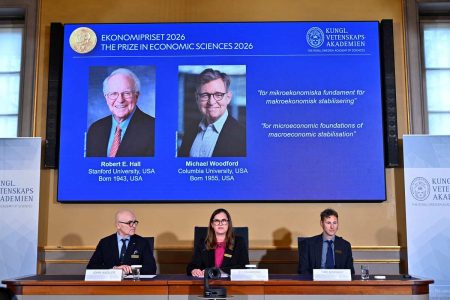
Robert E. Hall and Michael Woodford are announced as the laureates of the 2026 Sveriges Riksbank Prize in Economic Sciences in Memory of Alfred Nobel at the Royal Swedish Academy of Sciences in Stockholm, Sweden, on Oct 12.
STOCKHOLM — Two American-born economists who spent their careers asking how individual choices add up to the swings of a whole economy were awarded the Nobel memorial prize in economics on Monday.
ADSRobert E. Hall of Stanford University and Michael Woodford of Columbia University were honored for their work on the microeconomic foundations of macroeconomic stabilisation, a mouthful of a phrase for a simple and consequential idea: to steer an economy through turbulence, you first have to understand the everyday decisions of the households and firms that make it up.
The Royal Swedish Academy of Sciences announced the award in Stockholm. “The laureates’ work has provided us with a stable theoretical foundation for the models that are now used by central banks and governments around the world,” said John Hassler, chair of the Committee for the Prize in Economic Sciences, in a news release. “With them, we are better equipped to deal with shocks in the economy, such as energy crises or sudden changes in how much households consume.”
In other words, when prices spike or spending suddenly dries up, the frameworks built on the laureates’ ideas are the tools officials reach for.
The economics prize is formally the Bank of Sweden Prize in Economic Sciences in Memory of Alfred Nobel. Sweden’s central bank established it in 1968 to honor Nobel, the 19th-century Swedish businessman and chemist who invented dynamite and created the five original Nobel Prizes. Purists note that it is technically not a Nobel Prize, though it is always presented alongside the others on Dec. 10, the anniversary of Nobel’s death in 1896.
READ OTHER ARTICLES:
- US Supreme Court Gives FCC More Time in Political Ad-Rate Dispute
- Xi-Trump Summit Leaves U.S.-China Tensions Unresolved
- Donald Trump Administration Prepares Sweeping Sanctions Against ICC
- Donald Trump Expands Drug Pricing Deal, Projecting $27.6 Billion 50 State Savings
- DOJ Reaches Agreements With NYU, UPMC Over Transgender Care for Minors
Last year, the prize went to three researchers who study business innovation, for explaining how new products and inventions drive economic growth and human welfare, even as they leave older companies in the dust. This year’s economics announcement closes out a week of Nobel honors, which were previously awarded in medicine, physics, chemistry, literature and peace.
The prize comes with 12 million Swedish kronor, about $1.2 million, whether it goes to an individual, a small group of laureates or an organization.
ADSRobert E. Hall and Michael Woodford Win 2026 Nobel Prize in Economics for Research on Economic Stability
Their groundbreaking work helps explain how consumer behavior, business decisions, and central bank policies can reduce economic crises, control inflation, and protect jobs. Two prominent American economists, Robert E. Hall and Michael Woodford, have been awarded the 2026 Nobel Prize in Economic Sciences for their influential research on how governments and central banks can make economies more stable and better prepared to withstand financial shocks.
The Royal Swedish Academy of Sciences announced the award on October 12, 2026, recognizing the economists for their contributions to the microeconomic foundations of macroeconomic stabilization. Their work has helped improve the way economists understand the relationship between individual decisions, business activities, government policies, and the overall performance of an economy.
According to research by Aptikons, Hall and Woodford have made important contributions to modern macroeconomics, a field that examines the economy as a whole, including inflation, unemployment, economic growth, and changes in national income. Their research has helped explain why economies experience periods of rapid growth followed by slowdowns, recessions, or other financial difficulties.
The award recognizes a fundamental idea in economics: understanding an entire economy requires looking closely at the decisions made by individual households and businesses. These decisions may appear small when considered separately, but when millions of people and companies make them at the same time, their combined effects can influence prices, employment, production, and economic growth.
Hall is a professor emeritus of economics at Stanford University and a senior fellow emeritus at the Hoover Institution. His research has focused on consumer behavior, household spending, economic fluctuations, and unemployment. His work has helped economists understand how people make spending decisions and how those decisions can change when their incomes, expectations, or financial circumstances shift.
Woodford, meanwhile, is the John Bates Clark Professor of Political Economy at Columbia University. He is widely recognized for his research on monetary policy, the process through which central banks influence interest rates and financial conditions to help maintain economic stability. His work has also examined how businesses set prices and how people’s expectations about future economic conditions affect present-day decisions.
Together, their contributions have helped strengthen economic models that policymakers use to understand how changes in interest rates, government spending, consumer demand, and business pricing can affect the wider economy.
The importance of their work becomes clearer during periods of economic uncertainty. When inflation rises sharply, for example, families may find that their salaries no longer cover the same amount of food, transportation, housing, and other basic needs. Businesses may face higher operating costs, while central banks must decide whether to raise interest rates to slow price increases or keep borrowing costs lower to support economic activity.
These decisions are difficult because policies intended to solve one economic problem can create another. Raising interest rates may help reduce inflation, but it can also make loans more expensive for households and businesses. This may discourage spending and investment, potentially slowing economic growth and putting jobs at risk. Keeping interest rates too low for too long, on the other hand, can contribute to excessive demand and persistent price increases.
Hall and Woodford’s research provides a stronger theoretical foundation for understanding these competing effects. Their work helps economists examine how people and businesses respond to policy changes and how those responses influence economic conditions over time.
Reporting by Reuters, NPR, and Euronews has highlighted the broader importance of economic research that helps policymakers understand and manage economic fluctuations. One of the major challenges in modern economics has been developing models that remain useful not only during normal periods but also when unexpected events disrupt markets and daily life.
Economic models developed in earlier decades faced significant challenges during the major oil shocks of the 1970s. Sudden increases in energy prices contributed to rising inflation and economic weakness in several countries, exposing the difficulty of dealing with situations in which prices rise even as economic activity slows.
These experiences strengthened the need for economic theories that could better explain the behavior of households, businesses, and policymakers under changing conditions. Researchers increasingly sought to connect decisions made at the individual level with movements in the overall economy. This approach is known as microeconomic foundations. In simple terms, it means studying the choices made by consumers and businesses to understand broader economic outcomes.
When families expect prices to increase, they may decide to buy essential goods earlier than planned. If many households make the same decision, demand can rise in the short term. Businesses may respond by increasing production or adjusting their prices, depending on their costs and expectations about future demand.
Similarly, when companies expect higher production costs, they may raise prices before those costs fully take effect. Workers may then seek higher wages to keep up with living expenses, creating additional pressure on business costs. These interactions can influence the direction of inflation and make it more difficult for policymakers to restore price stability. By examining how these decisions are connected, economists can better understand why inflation sometimes persists and why changes in interest rates or other policies may take time to affect the economy.
Woodford’s research has been particularly influential in explaining the role of expectations and communication in monetary policy. His work emphasizes that central banks influence the economy not only through their immediate decisions but also through what they communicate about their plans for the future. This idea is often associated with forward guidance, a policy tool through which a central bank communicates its intentions or expectations regarding future interest rates and monetary policy.
Clear communication can help households and businesses make more informed decisions. If companies understand the central bank’s likely approach to inflation, they may be better able to plan investments and pricing strategies. Families may also make more informed decisions about borrowing, saving, and major purchases. The same principle applies to financial markets, where investors closely monitor central bank announcements to assess the future direction of interest rates and economic conditions.
However, communication alone cannot guarantee economic stability. Central banks must also make credible decisions, respond to changing information, and explain their policies clearly enough for the public to understand their objectives. Woodford’s research helps explain why these expectations are an important part of how monetary policy works.
Hall’s research offers another important perspective by examining the decisions of consumers and households. Consumer spending represents a major part of economic activity in many countries, making household behavior essential to understanding changes in demand and economic growth. When people feel financially secure, they may be more willing to spend money on goods and services. This spending supports businesses, which may hire more workers, expand operations, and invest in new equipment. The resulting activity can help strengthen the economy.
During periods of uncertainty, however, households may reduce spending and increase savings because they are worried about losing their jobs, facing higher prices, or experiencing lower income. If this behavior becomes widespread, businesses may experience declining sales and reduce production or employment.
These changes can reinforce one another. Lower spending can weaken business revenue, while job losses can further reduce household income and consumer demand. Such a cycle can deepen an economic downturn. Understanding how households respond to uncertainty allows economists to develop better explanations of economic fluctuations and helps policymakers evaluate how different policies may affect spending, employment, and overall demand.
The combined significance of Hall and Woodford’s work lies in connecting these individual decisions with the larger forces that shape national economies. Rather than treating inflation, unemployment, and economic growth as separate developments, their research helps explain how these outcomes interact and how policy decisions can influence their direction.
This knowledge is especially important when economies face unexpected shocks, including wars, pandemics, disruptions to energy supplies, and sudden changes in global trade. Such events can raise production costs, interrupt supply chains, reduce consumer confidence, and force governments and central banks to make difficult decisions.
The COVID-19 pandemic, for example, disrupted production and transportation around the world while changing how households spent money and how businesses operated. Subsequent supply problems and shifts in demand contributed to inflationary pressures in many economies. The episode demonstrated how quickly economic conditions can change and why policymakers need reliable ways to assess the effects of their decisions.
Energy shocks present similar challenges. When oil and natural gas prices rise sharply, transportation, electricity, manufacturing, and food distribution can become more expensive. Businesses may pass some of these costs on to consumers, while households have less money available for other purchases.
Central banks must then assess whether inflation is likely to fade as supply conditions improve or remain elevated because price increases are spreading throughout the economy. Their decisions can influence borrowing costs, business investment, household spending, and employment. Hall and Woodford’s research does not eliminate these challenges or provide a simple solution to every crisis. Instead, it gives economists and policymakers a stronger framework for understanding how economic decisions interact and why policies sometimes produce different results than expected.
The research also highlights the importance of considering both monetary policy and fiscal policy. Monetary policy is generally managed by a country’s central bank and includes decisions about interest rates and financial conditions. Fiscal policy involves government decisions on taxation, public spending, and borrowing. These policies can influence the economy in different but connected ways. Lower interest rates may encourage borrowing and investment, while government spending can support demand for goods and services. Yet the effectiveness of these measures depends on the circumstances, the public’s response, and the condition of the economy when the policies are introduced.
Policymakers must therefore consider more than the immediate effects of their decisions. They also need to understand how households, companies, investors, and financial institutions may react over the following months and years. The recognition of Hall and Woodford also underscores the importance of economic research in shaping decisions that affect ordinary people. Although the language of macroeconomics can sound technical, the issues it addresses are closely connected to daily life.
Inflation determines how much families pay for groceries and transportation. Interest rates affect the cost of mortgages, business loans, and credit. Economic growth influences job opportunities and income prospects, while recessions can threaten employment and financial security.
For workers, more stable economic conditions can help protect jobs and reduce uncertainty about future income. For small businesses, predictable financial conditions can make it easier to plan expenses, hire employees, and invest in expansion. For governments, a better understanding of economic fluctuations can improve the assessment of policies intended to support growth while keeping inflation under control.
The lessons are relevant to developing economies as well as wealthy nations. Countries with limited financial resources may have less room to respond to major economic shocks, making careful policy decisions particularly important.
In the Philippines, for example, increases in global oil prices can raise transportation and production costs, affecting the prices of food and other essential goods. Higher inflation can place pressure on household budgets, particularly among families that spend a large share of their income on basic necessities. Changes in global interest rates can also affect borrowing costs, investment decisions, and financial conditions.
The research recognized by the Nobel committee offers a useful framework for understanding these connections, although its application must account for each country’s institutions, economic structure, and specific circumstances.
Ultimately, the award to Hall and Woodford recognizes decades of research aimed at improving economists’ understanding of how economies respond to changing conditions. Their work has helped build a more detailed picture of the relationships between individual choices, business decisions, public expectations, and government policies.
Their central contribution is a reminder that economic stability depends not only on what policymakers decide but also on how people and businesses respond to those decisions. Policies are more likely to work as intended when economists understand the behavior behind spending, pricing, investment, and employment.
As countries continue to confront inflation, energy price shocks, geopolitical tensions, and uncertainty about global growth, the need for sound economic analysis remains significant. Research that improves the understanding of these forces can help policymakers make better-informed decisions, although no economic model can remove all risks or prevent every recession.
The 2026 Nobel Prize in Economic Sciences therefore recognizes the lasting importance of connecting the decisions people make in their daily lives with the broader forces that determine the health of national economies. For Hall and Woodford, the honor highlights how theoretical research can contribute to a more practical understanding of economic stability and the challenges facing policymakers around the world.
ADSRobert E. Hall: Biography, Education, Career, Achievements, Family, and Business Contributions
Robert Ernest “Bob” Hall is an American economist, professor, researcher, and author known for his significant contributions to economic theory, employment, inflation, consumer behavior, taxation, and government economic policy. Born on August 13, 1943, in Palo Alto, California, United States, Hall has built a distinguished academic career through his work at leading universities and economic research institutions. His studies have helped economists, policymakers, and business leaders better understand how individuals, companies, and governments make decisions that influence the economy.
Hall developed an interest in economics early in his academic life. He pursued higher education at the University of California, Berkeley, where he earned a Bachelor of Arts degree in Economics in 1964, graduating summa cum laude, an academic distinction awarded for exceptional academic achievement. He continued his studies at the Massachusetts Institute of Technology (MIT), earning a Ph.D. in Economics in 1967. His doctoral adviser was Robert Solow, a distinguished economist who later received the Nobel Memorial Prize in Economic Sciences. Hall’s strong educational foundation prepared him for a career in economic research, university teaching, and public policy.
Before establishing himself at Stanford University, Hall held academic positions at the University of California, Berkeley, and MIT. In 1978, he joined Stanford University, where he developed a prominent reputation as a professor of economics and a senior fellow at the Hoover Institution. Throughout his career, he has studied important economic issues, including employment, inflation, competition, technological development, consumer spending, and economic growth. His research has contributed to a deeper understanding of how economic decisions made by individuals and businesses affect national economic performance.
Hall has also made important contributions to the National Bureau of Economic Research (NBER), a leading American organization devoted to economic research. He directed its research program on economic fluctuations and growth from 1978 to 2013. He also chaired the organization’s Committee on Business Cycle Dating, which identifies the beginning and ending dates of recessions in the United States. This work has helped researchers, businesses, investors, and government institutions better understand changes in economic activity and the causes and consequences of economic downturns.
Although Hall is not primarily known as a traditional business entrepreneur, his research and publications have influenced business strategy, financial thinking, taxation, and public policy. One of his notable contributions was his collaboration with economist Alvin Rabushka on the book The Flat Tax. The publication advocated a simplified tax system intended to reduce complexity and change how individuals and businesses are taxed. Their proposal became an influential subject of debate among economists, policymakers, and business communities. Hall also coauthored Digital Dealing: How e-Markets Are Transforming the Economy, which examines how electronic markets and technological advances influence economic activity and commercial transactions.
Hall’s professional work has also involved advising government institutions and contributing to discussions on economic policy. His expertise has been relevant to organizations such as the U.S. Department of the Treasury, the U.S. Department of Justice, and the Federal Reserve Board. Through his academic research, policy discussions, and publications, Hall has helped explain the relationships among taxation, consumer behavior, employment, monetary policy, and economic stability. His career demonstrates how specialized knowledge and research can influence important decisions affecting businesses, workers, consumers, and governments.
Hall has received recognition for his achievements in the economics profession. He served as president of the American Economic Association in 2010 and as its vice president in 2005. He was also recognized as a Distinguished Fellow of the association and elected to the National Academy of Sciences, reflecting the significance of his contributions to economic research. His work with Alvin Rabushka on tax reform also attracted attention for its influence on discussions about tax policy and financial reform.
In his personal life, Hall is married to Susan E. Woodward, an economist associated with Sand Hill Econometrics. The couple lives in Menlo Park, California. Public biographical accounts identify Hall as the father of three children, although detailed information about his family’s private lives is limited. Despite his professional prominence, Hall has largely maintained a private family life while dedicating much of his career to academic research, teaching, and economic policy.
One of Hall’s most important research interests is consumer behavior, particularly how people make spending decisions based on their expectations of future income. His work has helped economists examine why households may adjust their consumption when their financial circumstances or expectations change. He has also studied economic fluctuations, employment, recessions, and the broader factors that influence production and growth. These subjects remain important to policymakers seeking to manage inflation, respond to economic shocks, and promote stable economic development.
Hall’s career offers valuable lessons for students, professionals, and aspiring business leaders. His academic achievements demonstrate the importance of education and continuous learning, while his decades of research highlight the value of developing specialized expertise. His work also illustrates how ideas developed through research can influence practical decisions involving taxation, government policy, and business. Rather than building his reputation primarily through commercial ventures, Hall established his professional standing through scholarship, teaching, publications, and service to economic research institutions.
Robert E. Hall’s life and career represent a significant contribution to modern economics. From his education at Berkeley and MIT to his long association with Stanford University and the National Bureau of Economic Research, he has devoted his professional life to understanding how economies function and how individual decisions shape broader economic outcomes. His research on consumer spending, taxation, employment, and economic fluctuations has influenced academic discussions and public policy. Through his teaching, writing, and research, Hall has helped expand economic knowledge and demonstrated how intellectual achievement can make a lasting contribution to society.
ADSMichael Woodford Shares 2026 Nobel Economics Prize for Research on Inflation and Economic Stability
American economist Michael Woodford and Stanford professor Robert E. Hall receive international recognition for research that has helped explain how interest rates, inflation, and people’s financial decisions affect the economy.
American economist Michael Woodford has earned international recognition for his work on monetary policy, inflation, and economic stability, sharing the 2026 Sveriges Riksbank Prize in Economic Sciences in Memory of Alfred Nobel with Robert E. Hall of Stanford University. The award, announced on October 12, recognizes their contributions to economic research that has improved the understanding of how governments and central banks can respond to recessions, rising prices, and other major economic challenges.
Their work focuses on a fundamental question: How do the decisions of households, businesses, and policymakers influence the overall economy? By studying these connections, Woodford and Hall have helped economists better understand why economies expand, slow down, and sometimes experience serious financial difficulties.
Woodford, a professor at Columbia University in New York, has spent much of his career examining issues that directly affect people’s daily lives. His research explores why prices rise, how interest rates influence spending, and how decisions made by central banks can affect workers, consumers, businesses, and investors.
Although his work involves complex economic theories, the basic idea is easy to understand. An economy is shaped by the choices people make every day. Families decide how much to spend or save, businesses determine whether to hire workers or expand operations, and governments make decisions that influence borrowing costs and economic activity. These choices are closely connected, and changes in one area can affect the entire economy.
Woodford’s research has helped explain how these relationships work and why central banks must consider more than current inflation figures or interest rates when deciding how to manage the economy.
His path to becoming a leading figure in monetary economics began with an education that combined economics, law, and advanced research. He earned an undergraduate degree from the University of Chicago in 1977, a law degree from Yale Law School in 1980, and a doctorate in economics from the Massachusetts Institute of Technology in 1983.
This academic background helped prepare him to study the relationship between public policy, economic institutions, and individual decision-making. Instead of pursuing a conventional career in law or business, Woodford focused on academic research and teaching, eventually becoming one of the most influential scholars in modern monetary economics.
He began teaching at Columbia University in 1984 before moving to the University of Chicago and later Princeton University. In 2004, he returned to Columbia, where he became the John Bates Clark Professor of Political Economy. Through his teaching, research, and publications, he has helped shape discussions about how central banks should respond to inflation and changes in economic activity.
One of the central themes of Woodford’s work is the role of interest rates in determining economic conditions. When inflation rises too quickly, central banks often increase interest rates to make borrowing more expensive. This can discourage some purchases, reduce demand, and help ease pressure on prices.
However, higher interest rates can also make mortgages, car loans, credit cards, and business financing more expensive. Companies may delay expansion plans, consumers may reduce spending, and employers may become more cautious about hiring. These effects can slow economic growth.
When an economy weakens, central banks may lower interest rates to encourage borrowing, spending, and investment. Yet this approach also requires careful judgment because stimulating demand too much can contribute to renewed inflation. Woodford’s research helps explain why these decisions are difficult and why policymakers must consider how households, businesses, and financial markets are likely to respond.
He has emphasized that people’s expectations about the future can be just as important as current economic conditions. A business that expects production costs to rise may increase its prices in advance. Workers who believe living expenses will continue climbing may seek higher wages. Investors who expect interest rates to remain high may adjust their portfolios or delay certain investments. When millions of people and businesses make similar decisions, their actions can influence inflation, employment, and economic growth. These expectations can also affect whether a central bank’s policies succeed.
This is why communication has become an important part of modern monetary policy. When central banks clearly explain their goals and provide credible information about their plans, households and businesses may make decisions based on a better understanding of future economic conditions.
For example, if people believe a central bank is committed to keeping inflation under control, they may be less likely to expect prices to rise indefinitely. That confidence can influence wage negotiations, pricing decisions, and investment plans. However, communication works only when the public believes policymakers can follow through on their commitments.
Woodford’s research has helped economists understand these relationships through models associated with New Keynesian economics. This approach examines how the decisions of individuals and businesses affect the wider economy while recognizing that prices and wages do not always change immediately. Businesses may keep prices steady because changing them can be costly or because they are uncertain about customer demand. Workers’ wages may also take time to adjust to changing economic conditions. As a result, changes in interest rates and consumer spending can affect production and employment before prices fully respond.
These delays help explain why economies can experience periods of high inflation, weak growth, or rising unemployment. They also show why policymakers must carefully consider when to act and how strongly to respond to changing conditions.
Woodford’s work has helped provide a framework for examining these challenges. His research does not offer a perfect solution to every economic problem, but it gives economists tools to study how different policies may affect households, businesses, and the broader economy.
His influence is particularly clear in his 2003 book, Interest and Prices: Foundations of a Theory of Monetary Policy. The book examines how central banks can use interest rates and policy commitments to influence economic activity and maintain price stability. It has become an important reference for economists, university researchers, and central-bank officials.
Rather than treating inflation, interest rates, and economic growth as separate issues, Woodford’s approach examines how they interact. It considers how decisions made by households and businesses affect the results policymakers are trying to achieve.
The book received the Association of American Publishers’ 2003 award for Best Professional/Scholarly Book in Economics, further establishing Woodford’s reputation as a leading researcher in monetary policy.
His professional achievements extend beyond this publication. He received a MacArthur Fellowship in 1981 and a Guggenheim Fellowship, and he has been recognized by major academic organizations. His other honors include the Deutsche Bank Prize in Financial Economics in 2007, the Banque de France and Toulouse School of Economics Prize in Monetary Economics in 2018, and the Erwin Plein Nemmers Prize in Economics in 2024.
In 2025, he shared the BBVA Foundation Frontiers of Knowledge Award in Economics, Finance and Management with Olivier Blanchard and Jordi Galí. He is also a fellow of the American Academy of Arts and Sciences and the Econometric Society. The 2026 economics prize adds to this record of achievement and highlights the importance of research that connects individual decisions with the performance of entire economies.
Woodford’s work also has practical implications for businesses. Companies may not control interest rates or government policy, but they must respond to the effects of both. Higher borrowing costs can make expansion more expensive, while weaker consumer spending can reduce sales. Lower interest rates may encourage investment, but businesses must still consider whether customers are prepared to spend.
A manufacturer deciding whether to build a new facility, a retailer planning to open another location, or a small business applying for a loan may all be affected by monetary policy. Understanding how interest rates and economic expectations influence the market can help business leaders assess risks and make better-informed decisions.
Financial markets are also sensitive to central-bank announcements. Investors regularly examine policy statements for clues about future interest rates, inflation, bond prices, stock valuations, and currency movements. Woodford’s research helps explain why the way policymakers communicate their decisions can influence markets even before a new policy takes effect.
His contribution to business, however, is primarily intellectual rather than entrepreneurial. Woodford is known for his work as an economist and professor, not for founding a major company or building a commercial enterprise. His influence comes from developing economic theories that help policymakers, investors, and business leaders understand the forces affecting financial conditions and economic activity.
His research also recognizes that economic models have limitations. Real-world economies are complicated, and people do not always behave as theories predict. Families and businesses have different priorities, access to different information, and varying levels of confidence about the future. Unexpected events, including wars, energy shortages, financial crises, and technological changes, can also disrupt economic activity.
For this reason, economic models are best understood as tools for analyzing problems rather than perfect systems for predicting every outcome. Woodford’s work contributes to this effort by helping economists examine how expectations, interest rates, and individual decisions interact. Compared with his professional accomplishments, Woodford’s family life has received limited public attention. Institutional biographies focus mainly on his education, academic appointments, research, publications, and awards. Reliable public information about his spouse and children is limited, so specific family details should not be assumed without confirmation.
What is well established is his long commitment to academic research and teaching. Through his work at Columbia University and his contributions to the economics profession, he has helped advance the study of monetary policy and its effects on economic stability.
His recognition alongside Hall also highlights the importance of understanding how individual behavior influences national economic performance. A single household’s spending decision may have a limited effect, but the combined decisions of millions of households and businesses can influence demand, production, employment, and inflation.
This connection matters to governments and central banks, particularly when economic conditions become uncertain. Policymakers must consider how people will respond to changes in borrowing costs, prices, and financial conditions before deciding which measures to adopt.
The challenge is especially important when inflation remains high or economic growth weakens. Central banks must work to maintain stable prices without unnecessarily damaging employment or business activity. Their decisions can have consequences that extend well beyond financial markets and affect the everyday lives of ordinary people.
Woodford’s research provides a framework for understanding these difficult choices. It explains why expectations matter, why policy decisions can have delayed effects, and why clear communication can influence economic behavior.
For students and aspiring economists, his career demonstrates how years of study and research can influence public policy and international economic discussions. His education at the University of Chicago, Yale Law School, and MIT provided a broad academic foundation, while his work at Columbia, Chicago, and Princeton helped him develop and share his ideas.
For business owners and consumers, his research offers a reminder that economic conditions are shaped not only by government decisions and financial statistics but also by the choices people make in response to changing circumstances.
Michael Woodford’s career has centered on understanding how monetary policy affects the real world. His research on interest rates, inflation, and economic expectations has helped shape modern monetary economics and improve the way economists analyze economic stability.
His recognition alongside Robert E. Hall in the 2026 economics prize highlights the value of research that helps explain how households, businesses, and governments influence one another. Their work has strengthened the economic tools available to policymakers seeking to understand recessions, manage inflation, and support stable economic growth.
For Woodford, the recognition represents a major milestone in a career devoted to answering difficult questions about how economies work. His lasting contribution lies in showing how the decisions of individuals and businesses connect to the larger forces that shape financial stability, economic opportunity, and prosperity.
- Robert E. Hall and Michael Woodford Win Nobel Prize in Economics

- US Supreme Court Gives FCC More Time in Political Ad-Rate Dispute
- Every 40 Seconds, a Life Lost: The Quiet Crisis Behind the Philippines’ Suicide Numbers
- Tianangi ni Rosmar Tan na siya ang Binaggit ni Vice Ganda Tungkol sa Glutathione CEO at Money Laundering
- PRC: Room Assignments EELE-ETLE October 2026 Electronics Engineering Board Exam
- LAC Sessions Now Count as Teaching Hours, Says Angara