Amy Eskridge was an American researcher, engineer, and co-founder of the Institute for Exotic Science whose work helped shape modern discussions about Unidentified Aerial Phenomena (UAP). Through her research on advanced propulsion concepts, material analysis, and scientific transparency, she encouraged evidence-based investigations into unexplained aerial reports, leaving a lasting influence on the UAP research community despite ongoing debates over the field.
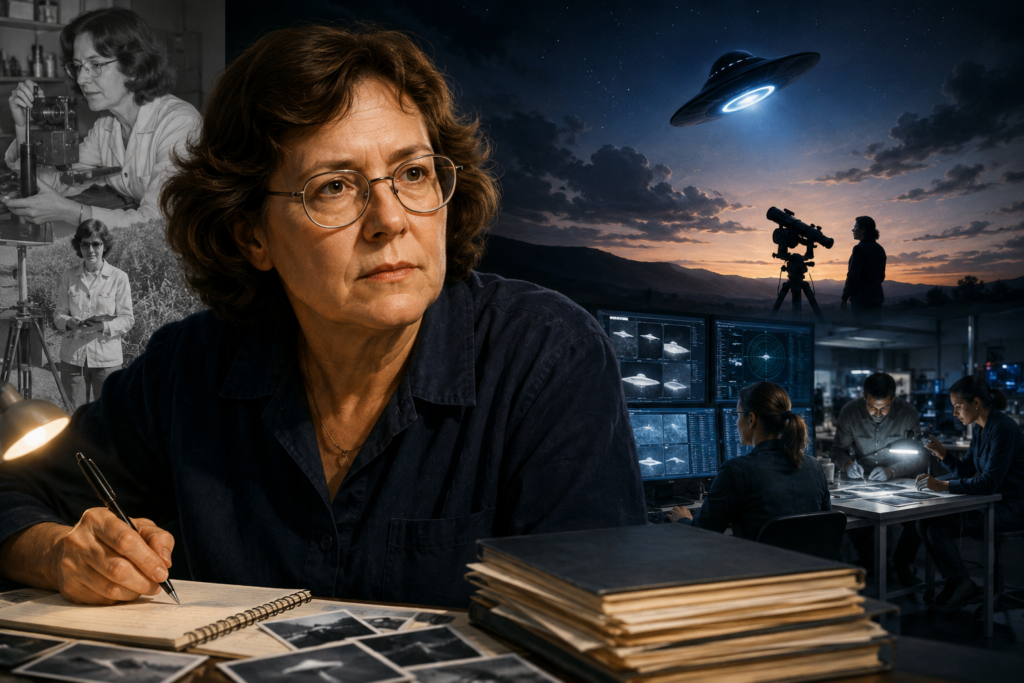
HUNTSVILLE, Alabama — For decades, reports of unidentified objects in the sky were often dismissed as science fiction, mistaken observations, or conspiracy theories. In recent years, however, governments, scientists, and researchers have begun treating Unidentified Aerial Phenomena (UAP) as a subject worthy of careful investigation. Among the researchers who helped encourage a more scientific approach was engineer and researcher Amy Eskridge, whose work inspired discussions about advanced technology, unusual materials, and the importance of keeping an open yet critical mind when studying unexplained events.
ROLE AND DESCRIPTION:
Key People
- Amy Eskridge – Engineer and researcher known for promoting scientific investigation into unidentified aerial phenomena (UAPs), advanced propulsion concepts, and unusual materials. She emphasized evidence-based research, transparency, and collaboration over sensational claims.
Organization
- Institute for Exotic Science – Research organization co-founded by Amy Eskridge to explore unconventional scientific topics, including advanced propulsion, exotic materials, and unexplained aerial phenomena using scientific methods.
Institution
- Government Agencies – Public institutions that Eskridge encouraged to cooperate with independent researchers by sharing information related to UAP investigations and unexplained aerial incidents.
- Academic Institutions – Universities and research organizations that Eskridge believed should participate in independent analysis, peer review, and scientific verification of UAP-related research.
Scientific Field
- Unidentified Aerial Phenomena (UAP) – Objects or aerial events that cannot immediately be identified. Eskridge advocated investigating these reports using standard scientific methods rather than dismissing them outright.
- Advanced Propulsion – Theoretical or experimental propulsion technologies that could surpass conventional aerospace systems. One of the Institute for Exotic Science’s primary research interests.
- Exotic Materials – Unusual or reportedly anomalous materials claimed by some to be connected with UAP incidents. Eskridge supported laboratory testing to determine whether they possessed unique physical properties.
- Materials Analysis – Scientific examination of physical samples using laboratory techniques to determine their composition and characteristics before drawing conclusions.
Scientific Principle
- Scientific Method – The systematic process of observation, testing, experimentation, and verification that Eskridge believed should guide all investigations into unexplained phenomena.
- Peer Review – Independent evaluation of scientific work by qualified experts to distinguish credible findings from unsupported claims.
- Transparency – Open sharing of research methods, evidence, and data among scientists, government agencies, and the public to enable independent verification.
- Critical Thinking – An evidence-based approach to evaluating extraordinary claims without accepting or rejecting them prematurely.
Concept
- Extraterrestrial Technology – Hypothetical technology originating from non-human civilizations. Eskridge stated her research did not prove its existence but argued that unexplained evidence deserved scientific examination.
- Unexplained Aerial Sightings – Reported observations of aerial objects or events that remain unidentified after initial investigation and may warrant further scientific study.
- Scientific Curiosity – The willingness to investigate difficult or unconventional questions while maintaining rigorous scientific standards.
- Evidence-Based Investigation – An approach relying on verifiable data, repeatable testing, and objective analysis instead of speculation or assumptions.
- Independent Verification – The process of having separate researchers confirm scientific findings using the same evidence and methods to ensure reliability.
- Advanced Aerospace Concepts – Emerging or theoretical aerospace technologies discussed within scientific and UAP research communities as potential areas for future investigation.
Eskridge became known through her involvement in the Institute for Exotic Science, an organization she co-founded to explore scientific questions that are often considered unconventional. Rather than promoting extraordinary claims without evidence, the institute sought to encourage researchers from different scientific backgrounds to examine difficult questions using established methods of observation, testing, and analysis. Its goal was to investigate topics that mainstream research had largely overlooked while maintaining a commitment to scientific inquiry.
READ MORE OTHER ARTICLES:
- Amy Eskridge’s Scientific Legacy Continues Shaping Modern UAP Research and Discovery

- Military Pilot Testimonies Strengthen Credibility of Unidentified Aerial Phenomena Investigations Worldwide
- Why Tech Investors Must Watch the Federal Reserve Amid AI Expansion?
- Anaerobic Bacteria and Cyanobacteria Identified as Ancient Sources of Petroleum and Natural Gas
- NASA Verify Earth Briefly Captures ‘Mini-Moon’ Asteroid 2024 PT5
- Artemis II Crew Makes Historic Lunar Flyby, Ushering in New Era of Moon Exploration
One of the areas that attracted the greatest attention was the study of advanced propulsion concepts. Traditional aircraft rely on engines that produce thrust through well-understood principles of physics. Eskridge and other researchers were interested in whether future technologies could someday operate in entirely different ways. Their work explored theoretical ideas, reviewed existing scientific literature, and examined whether new discoveries in physics might eventually lead to revolutionary methods of flight. While much of this work remained theoretical, it encouraged broader conversations about the limits of current aerospace engineering.
Eskridge also became recognized for her interest in examining materials reportedly connected to unusual aerial incidents. She believed that if any physical evidence existed, it should be studied carefully using modern laboratory techniques rather than speculation. Her approach emphasized chemical analysis, microscopic examination, and comparisons with known industrial materials.
Some reports claimed that certain samples displayed unusual structural characteristics or uncommon isotopic compositions. However, many scientists have stressed that such findings require independent verification and clear documentation of where the materials originated before any extraordinary conclusions can be drawn. Because the origin of many alleged UAP-related materials has not been firmly established, these claims remain unconfirmed within the broader scientific community. Even so, Eskridge argued that investigating such materials was worthwhile because careful testing could either explain them through known science or identify questions deserving further research.
Beyond laboratory work, Eskridge became an advocate for greater openness in scientific research involving UAPs. She believed that researchers, universities, government agencies, and private organizations should cooperate more closely instead of working in isolation. In her view, transparency would allow independent experts to examine evidence, challenge findings, and improve the quality of research through peer review.
Her position reflected a growing movement among scientists and journalists who believe that unexplained aerial sightings should be investigated without immediately assuming either ordinary explanations or extraordinary ones. Instead, they argue that every case should be evaluated according to the available evidence.
This balanced approach gained additional attention as governments around the world, particularly the United States, increased their public discussion of UAP investigations. Congressional hearings, military pilot testimonies, and official reports have acknowledged that some aerial incidents remain unexplained after initial analysis. At the same time, government agencies have repeatedly stated that “unexplained” does not mean the objects are extraterrestrial. Many cases are eventually attributed to balloons, drones, atmospheric conditions, sensor limitations, or other conventional explanations, while a smaller number remain unresolved because of insufficient data.
Eskridge’s work fit into this evolving landscape because she consistently emphasized the importance of gathering better evidence rather than relying on speculation. She encouraged researchers to collect measurable data, improve scientific instruments, and publish findings that could be independently evaluated. Her philosophy was that unanswered questions should motivate deeper investigation instead of automatic belief or dismissal.
The Institute for Exotic Science became a meeting place for engineers, physicists, materials scientists, and independent researchers interested in discussing difficult scientific problems. Although many of the topics explored were outside mainstream research, the institute promoted interdisciplinary collaboration and encouraged participants to approach unusual claims with both curiosity and skepticism.
Many people interested in UAP research remember Eskridge not because she claimed to have solved the mystery of unidentified aerial phenomena, but because she consistently argued that science should be willing to investigate challenging questions. She maintained that understanding the unknown requires patience, careful experimentation, and a willingness to revise conclusions when new evidence becomes available.
Since she stepped away from active research in 2022, her work has continued to be referenced in discussions about advanced propulsion concepts, materials science, and scientific transparency. Researchers who share her interest in unexplained aerial phenomena often cite her efforts to encourage collaboration across scientific disciplines and her belief that rigorous analysis should always come before extraordinary conclusions.
Amy Eskridge’s legacy serves as a reminder that scientific progress often begins with difficult questions. While many mysteries surrounding UAPs remain unsolved, her contributions helped encourage a more disciplined conversation about how such phenomena should be studied. Whether future investigations ultimately reveal new technologies, misunderstood natural phenomena, or entirely ordinary explanations, her emphasis on evidence, open inquiry, and scientific integrity continues to influence researchers seeking answers to one of the most intriguing questions in modern science.
Who Was Amy Eskridge?
Amy Eskridge was an American engineer, researcher, and science communicator whose work stood at the crossroads of established aerospace knowledge and some of the most challenging, understudied questions in modern science. What set her apart from many others who explored unusual topics was her steady commitment to approaching every subject with careful, evidence-based thinking—she never sought to make sensational headlines or jump to conclusions, but instead pushed for open, rigorous inquiry into ideas that most of mainstream science had long set aside as too speculative or unworthy of serious attention. She became a respected voice in circles focused on Unidentified Aerial Phenomena, or UAP, not because she claimed to have all the answers, but because she insisted these topics deserved the same methodical study as any other field of science, and that progress would only come when experts from different backgrounds set aside assumptions and worked together.
While detailed public records of her formal education are not widely available, it is well documented that she built a solid foundation in engineering, and spent years working professionally in the aerospace and defense sectors. This hands-on experience gave her a practical understanding of how propulsion systems, materials science, and aerospace design actually work in the real world—knowledge she brought to every area of her later research, ensuring she never strayed too far from what could be measured, tested, or analyzed. Though specific details about her university training, degrees, or early academic milestones have not been independently verified and shared publicly, her professional body of work and the depth of her technical discussions made clear she possessed deep expertise in her field.
Over the course of her career, Eskridge balanced practical engineering work with independent research that reached far beyond the boundaries of conventional thinking. She spent years exploring advanced propulsion concepts—ideas about how we might one day travel through air and space using methods that go far beyond the limits of today’s rocket and engine technology. She also co-founded the Institute for Exotic Science, an organization created specifically to provide a structured, scientific home for the study of topics often dismissed as too strange or controversial. She spoke regularly at conferences, joined discussions on podcasts and research panels, and spent countless hours connecting engineers, physicists, materials scientists, and independent researchers who rarely had the chance to exchange ideas with one another. At every step, she made it clear she was not trying to prove that any single theory was true, or that unexplained events must come from other worlds—she simply wanted to make sure no possibility was written off before it had been properly examined.
Her curiosity led her to explore a wide range of interconnected subjects, all tied together by a desire to push the limits of what humanity understands about science and technology. She studied alternative energy concepts, analyzed unusual materials that seemed to defy expected properties, and dug into the latest findings in exotic physics that could rewrite how we understand the fundamental rules of the universe. She took a keen interest in the growing field of UAP research, arguing that the many reliable reports of strange aerial sightings from trained observers, military personnel, and radar systems deserved far more serious attention than they had received for decades. She also advocated strongly for scientific transparency, saying that research loses much of its value when it is hidden away, and that sharing data openly helps all fields move forward faster. No matter how far-reaching her questions became, she always held firm to the belief that every claim, every observation, and every idea needed to be tested against real evidence.
For the most part, Eskridge kept her personal life private, choosing to let her work speak for itself rather than seeking public attention or sharing details about her life outside the lab and the conference hall. What is known is that she poured nearly all her energy into her research, her writing, and building connections between people who could help advance the fields she cared about. She spent hours reviewing dense scientific literature, organizing collaborative research projects, and finding ways to explain complex technical ideas so that members of the public could understand them too. There is little confirmed information about her family, close relationships, or personal interests outside of science, and she rarely spoke of these matters in public appearances, preferring to keep the focus firmly on the work that mattered most to her.
Unsurprisingly, given the nature of the topics she explored, Eskridge’s work drew both deep admiration and sharp criticism. Some critics argued that subjects like UAP and unproven propulsion systems were too far removed from established science to be worth the time and resources of serious researchers, while others agreed that these areas deserved attention but questioned whether certain reports or claims had been properly verified. Skeptics often reminded the broader community that extraordinary ideas require extraordinary proof, a principle Eskridge herself fully agreed with—she never asked anyone to accept a claim without solid evidence, and welcomed independent checks on any research she or others presented. She also spoke out in favor of greater government openness about UAP-related data, noting that information kept hidden for national security reasons could also hold valuable scientific insights, though she recognized that balancing public transparency with legitimate safety concerns was never an easy task. Importantly, there is no verified record of Eskridge ever being found guilty of scientific misconduct, fraud, or any kind of wrongdoing throughout her career.
Today, Amy Eskridge is remembered most for the way she changed how people think about what science is willing to explore. She showed that it is possible to ask bold, unconventional questions without abandoning the discipline, standards, and careful review that make science reliable. She helped shift the conversation around UAP research from sensational speculation to serious inquiry, and inspired a new generation of researchers to look beyond the limits of what is already known, while never losing sight of what can be proven. Many of the questions she spent her life exploring remain unanswered, and the technologies she envisioned are still far from becoming reality—but her work laid important groundwork, and her belief that curiosity and rigor go hand in hand continues to guide researchers studying unexplained phenomena and the future of aerospace technology. / aptikons