Military pilots are among the world’s most highly trained aerial observers, making their reports of unidentified aerial phenomena (UAP) difficult to dismiss. Backed by advanced sensor data, radar tracking, and official government investigations, these extraordinary encounters have fueled renewed debate over what truly occupies our skies and why many of these mysteries remain unresolved despite growing calls for greater transparency.
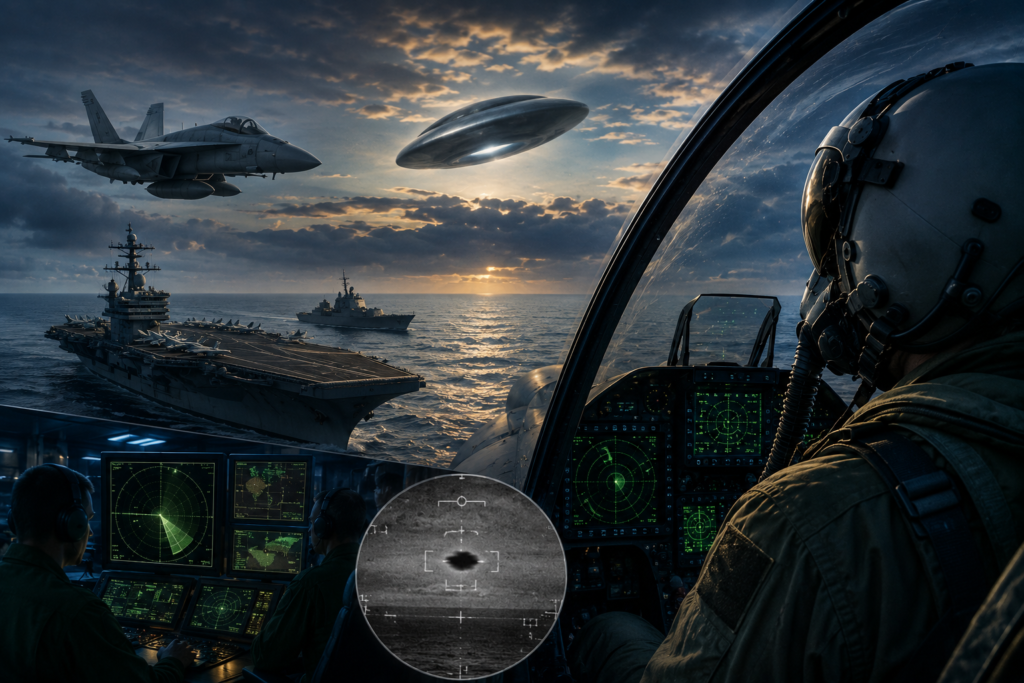
Southern California, California, USA — Few topics generate as much curiosity and debate as unidentified aerial phenomena (UAP), formerly more commonly referred to as UFOs. While many reported sightings come from civilians, the accounts that have drawn the greatest attention in recent years are those from military pilots. Unlike casual observers, these individuals are extensively trained to recognize aircraft, identify atmospheric conditions, and respond to potential aerial threats. Their professional experience has led many researchers, lawmakers, and members of the public to view their testimonies as deserving careful examination.
ROLES AND DESCRIPTION
- Commander David Fravor
- Role: U.S. Navy pilot
- Description: A retired U.S. Navy commander who became one of the most prominent military witnesses after reporting the 2004 USS Nimitz “Tic Tac” UAP encounter. His firsthand account is frequently cited in discussions about UAP credibility.
- Military Pilots
- Role: Primary witnesses
- Description: Highly trained aviators responsible for identifying aircraft, assessing aerial threats, and reporting unusual aerial phenomena. Their professional training makes their observations significant.
- Radar Operators (USS Princeton)
- Role: Supporting witnesses
- Description: Military personnel who reportedly tracked unidentified objects on radar before and during the 2004 Nimitz encounter, providing technological corroboration for pilot observations.
- U.S. Department of Defense (Pentagon)
- Role: Government authority
- Description: The U.S. defense agency that confirmed the authenticity of several military-recorded UAP videos while stating the objects remained unidentified.
- U.S. Navy
- Role: Military organization
- Description: The branch of the U.S. Armed Forces whose pilots and personnel were involved in the 2004 USS Nimitz incident.
- USS Nimitz Carrier Strike Group
- Role: Military unit
- Description: The naval strike group conducting training exercises during the 2004 encounter where military personnel reported observing the “Tic Tac” object.
- USS Princeton
- Role: Guided-missile cruiser
- Description: The U.S. Navy ship equipped with advanced radar systems that reportedly detected anomalous aerial objects during the Nimitz incident.
- Iranian Air Force Pilots
- Role: Military witnesses
- Description: Fighter pilots involved in the 1976 Tehran incident who reported encountering an unidentified object and experiencing instrumentation anomalies.
- Iranian Air Force
- Role: Military organization
- Description: The service branch that documented the 1976 Tehran UAP encounter and investigated the reported incident.
- U.S. Intelligence Agencies
- Role: Intelligence organizations
- Description: Agencies that reviewed and documented information related to the 1976 Tehran incident.
- Members of the U.S. Congress
- Role: Government officials
- Description: Lawmakers who have advocated for increased transparency, reporting requirements, and investigations into UAP incidents.
- UAP Investigative Offices/Task Forces
- Role: Investigative bodies
- Description: Government organizations established to collect, analyze, and assess reports of unidentified aerial phenomena, particularly those with potential national security implications.
It is important, however, to distinguish between the credibility of a witness and the certainty of an explanation. A highly trained pilot can provide an exceptionally reliable description of what they observed, yet that does not automatically determine what the object actually was. This distinction is at the heart of modern discussions surrounding UAPs.
Military aviators operate in some of the world’s most demanding environments. Their careers require thousands of hours of flight training, continuous evaluations, and the ability to make life-or-death decisions within seconds. They learn to identify friendly and hostile aircraft, recognize optical illusions, interpret sophisticated sensor systems, and understand how weather, lighting, and electronic interference can affect perception.
READ MORE OTHER ARTICLES:
- Amy Eskridge’s Scientific Legacy Continues Shaping Modern UAP Research and Discovery

- Military Pilot Testimonies Strengthen Credibility of Unidentified Aerial Phenomena Investigations Worldwide
- Why Tech Investors Must Watch the Federal Reserve Amid AI Expansion?
- Anaerobic Bacteria and Cyanobacteria Identified as Ancient Sources of Petroleum and Natural Gas
- NASA Verify Earth Briefly Captures ‘Mini-Moon’ Asteroid 2024 PT5
- Artemis II Crew Makes Historic Lunar Flyby, Ushering in New Era of Moon Exploration




Because of this rigorous preparation, military pilots are generally regarded as highly credible observers. When multiple experienced aviators independently report witnessing unusual flight characteristics such as rapid acceleration, abrupt directional changes, or prolonged hovering it naturally attracts attention from investigators. Their observations are considered valuable not because they are assumed to be infallible, but because they come from individuals specifically trained to observe and assess aerial activity under challenging conditions.
One of the most widely discussed examples is the 2004 USS Nimitz incident involving Commander David Fravor and other U.S. Navy personnel. During a training mission off the coast of Southern California, Fravor reported encountering a white, oblong object that appeared to maneuver in ways he believed were unlike conventional aircraft. Radar operators aboard the USS Princeton had reportedly tracked unusual objects over several days before the visual encounter, and additional sensor recordings later became public.
The incident has become a focal point in UAP discussions because it combines eyewitness testimony with radar tracking and infrared imagery. While these multiple sources of information increase the significance of the event, they have not produced a universally accepted explanation. Analysts have proposed various possibilities, including advanced military technology, sensor anomalies, misinterpretation of observational data, or genuinely unidentified phenomena. To date, no official investigation has concluded that the object represented extraterrestrial technology.
Government attitudes toward UAPs have evolved considerably over the past decade. After years in which such reports often received little public attention, the U.S. Department of Defense acknowledged the authenticity of several military-recorded videos showing unidentified aerial objects. Importantly, authenticating the videos simply confirmed that they were genuine military recordings it did not confirm the identity or origin of the objects depicted.
This shift in official policy marked a significant change. Governments increasingly recognize that unexplained aerial observations deserve investigation, particularly when they occur near military training areas or involve restricted airspace. National security concerns alone justify systematic analysis, regardless of whether the explanations ultimately prove ordinary or extraordinary.
Historical cases have also contributed to ongoing discussions. One frequently cited example is the 1976 Tehran incident, during which Iranian Air Force pilots reported encountering an unidentified object while attempting to intercept it. Official reports described alleged equipment malfunctions occurring during portions of the encounter, leading the event to receive attention from both Iranian authorities and U.S. intelligence agencies.
Despite decades of analysis, the Tehran case remains debated. Supporters view it as one of the strongest historical military encounters, while skeptics argue that equipment failures, atmospheric conditions, or human perception may explain aspects of the incident. As with many notable UAP reports, the available evidence allows multiple interpretations rather than a single definitive conclusion.
A recurring theme in military UAP investigations is the presence of multiple forms of evidence. Unlike many civilian sightings, military encounters sometimes involve several independent sources of information occurring simultaneously. These may include pilot observations, ship- or ground-based radar, infrared targeting systems, communications logs, and additional eyewitnesses.
When different systems appear to detect the same event, investigators gain a stronger foundation for analysis. However, experts caution that sophisticated sensors can also produce misleading readings, especially under unusual environmental conditions or when multiple systems interact in unexpected ways. Consequently, corroborating sensor data strengthens the importance of an incident without necessarily resolving its underlying cause.
Recent years have also seen increased legislative interest in the subject. Members of the U.S. Congress from both major political parties have called for improved reporting procedures and greater transparency regarding military UAP investigations. Public hearings, whistleblower testimony, and the creation of specialized investigative offices have moved the discussion from the fringe into mainstream national security conversations.
This growing attention reflects a broader recognition that unidentified objects in restricted airspace deserve careful study. Whether such incidents ultimately involve foreign surveillance platforms, classified domestic programs, natural phenomena, sensor limitations, or currently unexplained events, understanding them carries practical implications for aviation safety and national defense.
Nevertheless, significant questions remain unanswered. Many reports continue to be classified because they involve sensitive military capabilities, intelligence collection methods, or operational procedures. This lack of public information inevitably fuels speculation, making it difficult for outside researchers to independently evaluate the evidence.
As a result, discussions surrounding military UAP encounters often become polarized. Some interpret the available evidence as suggesting technology beyond current human capabilities, while others argue that extraordinary claims require extraordinary evidence and that more conventional explanations should be exhausted first. Both perspectives underscore the importance of rigorous investigation rather than assumptions.
Ultimately, the credibility of military pilots stems from their professional expertise, disciplined observation, and experience operating in complex aerial environments. Their testimonies deserve serious consideration, particularly when supported by independent sensor data and corroborating witnesses. At the same time, credible observations do not automatically establish extraordinary conclusions.
The growing willingness of governments to investigate UAPs reflects an important shift toward evidence-based inquiry. Whether future investigations reveal misunderstood natural phenomena, previously unknown technologies, or entirely new scientific insights, the objective should remain the same: careful analysis guided by data rather than speculation.
As more information becomes available through official investigations, scientific research, and international cooperation, humanity may gain a clearer understanding of these mysterious aerial encounters. Until then, military pilot testimonies remain among the most significant pieces of evidence in the ongoing effort to understand one of aviation’s most enduring mysteries not because they provide definitive answers, but because they present observations that continue to challenge conventional explanations while inviting deeper, more objective investigation. / aptikons