Erling Haaland scored twice as Norway shocked five-time champions Brazil with a dramatic 2-1 victory in the 2026 FIFA World Cup Round of 16 at MetLife Stadium, extending Norway’s unbeaten all-time record against the South American football powerhouse.
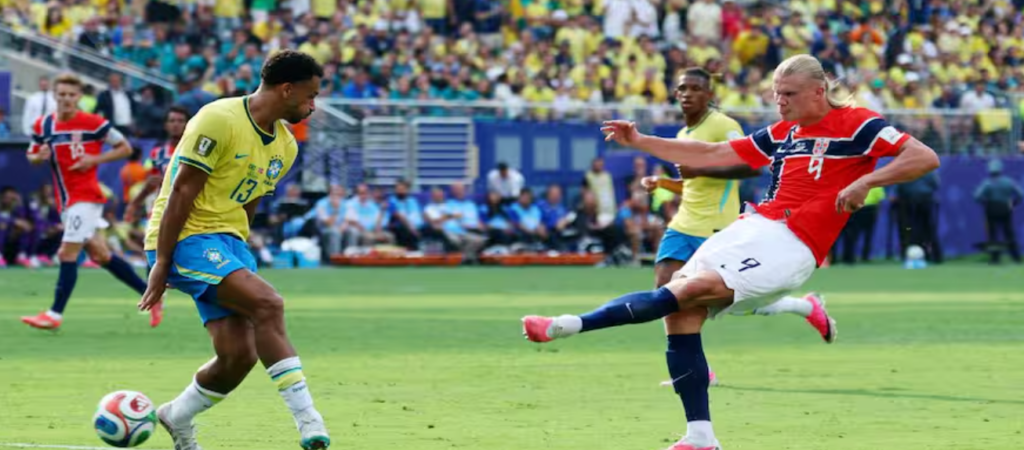
2026 FIFA World Cup delivered another unforgettable chapter on Sunday as Norway produced one of the tournament’s biggest upsets, defeating Brazil, 2-1, in the Round of 16 at MetLife Stadium. Powered by a magnificent late-game brace from Erling Haaland, the Scandinavian side eliminated the five-time world champions and advanced to the quarterfinals, while extending one of international football’s most remarkable unbeaten records.
For much of the evening, Brazil appeared poised to take control of the contest. The South American giants dictated possession throughout the opening half, creating several dangerous opportunities against a disciplined Norwegian defense. However, despite their territorial dominance, Brazil repeatedly failed to find the decisive breakthrough, a missed opportunity that would ultimately prove costly.
The defining moment of the first half came when Brazilian midfielder Bruno Guimarães stepped up to take a penalty after Norway conceded a foul inside the box. With an opportunity to hand Brazil a crucial advantage before halftime, Guimarães instead saw his effort go begging, leaving the match deadlocked at 0-0. The miss injected fresh belief into the Norwegian camp while frustrating a Brazilian side that had controlled large portions of the game.
READ MORE ARTICLES:
- LeBron James Nears Emotional Cavaliers Return as Free Agency Buzz Intensifies
- Belgium Crushes United States as World Cup Dream Ends in Heartbreaking Defeat
- Argentina Stuns Egypt with Epic Comeback to Reach World Cup Quarterfinals
- Ramos: Boomers’ Pressure Buried Gilas in Crushing Qualifier Defeat
- Alex Eala’s Historic Wimbledon Run Ends, Inspires Nation Despite Heartbreaking Loss
Norway emerged from the halftime break with renewed confidence, gradually growing into the match as Brazil struggled to convert possession into meaningful chances. Their compact defensive organization frustrated Brazil’s attacking stars, forcing the five-time world champions into rushed decisions and speculative attempts that rarely troubled the Norwegian goalkeeper.
As the match entered its closing stages, Norway found the moment they had patiently waited for.
In the 79th minute, captain Martin Ødegaard orchestrated a flowing attacking move that culminated in a perfectly delivered cross into the penalty area. Rising above Brazil’s defenders with impeccable timing and extraordinary power, Haaland thundered a towering header beyond the goalkeeper to send Norwegian supporters into jubilation. The goal not only broke the deadlock but also dramatically shifted the momentum in favor of the European side.
Brazil desperately pushed forward in search of an equalizer, committing additional numbers into attack and leaving gaps at the back. Norway exploited those spaces with ruthless efficiency.
In the 90th minute, Haaland struck again.
Capitalizing on a swift counterattack, the prolific striker calmly finished past the Brazilian goalkeeper to double Norway’s advantage, completing a sensational individual performance on football’s biggest stage. His second goal appeared to extinguish Brazil’s hopes and sent shockwaves throughout the stadium as one of the tournament favorites found themselves staring at elimination.
Brazil managed to reduce the deficit deep into stoppage time when superstar Neymar converted a penalty in the 90+10th minute after a late foul inside the Norwegian penalty area. Although the goal provided a brief glimmer of hope, there was simply not enough time remaining for Brazil to complete a comeback.
Moments later, the final whistle confirmed one of the most memorable upsets of the tournament.
For Norway, the victory represented far more than a place in the World Cup quarterfinals. It reinforced one of the most fascinating historical records in international football. Despite facing Brazil on multiple occasions over nearly four decades, Norway remains the only national team in the world that has played Brazil more than once without ever suffering defeat.
The remarkable streak now stands at five matches.
Their rivalry began in 1988 with a 1-1 draw before Norway earned an impressive 4-2 victory in a friendly in 1997. A year later, the Norwegians stunned Brazil once again with a dramatic 2-1 victory during the group stage of the 1998 FIFA World Cup, a result remembered as one of the biggest surprises of that tournament. The teams later shared a 1-1 draw in a 2006 international friendly before Norway added another historic chapter by defeating Brazil 2-1 in the 2026 World Cup Round of 16.
Across those five meetings, Brazil has failed to register a single victory against the Scandinavian nation, making Norway an enduring anomaly in the rich history of international football.
The latest triumph also highlighted Norway’s growing status among world football’s elite. Led by Haaland’s clinical finishing and an organized defensive structure, the team demonstrated composure, resilience, and tactical discipline against one of the sport’s most decorated nations.
For Haaland, the evening further strengthened his reputation as one of the game’s premier goal scorers. Delivering when the stakes were at their highest, his two decisive goals transformed a tightly contested knockout match into a career-defining World Cup performance and ensured his name would forever be associated with one of Norway’s greatest football victories.
Meanwhile, Brazil faces another painful chapter in its pursuit of a record-extending sixth World Cup title. Despite entering the knockout stage as one of the tournament favorites and controlling significant stretches of play, missed opportunities including Guimarães’ first-half penalty and defensive lapses proved devastating against a Norwegian side that punished every critical mistake.
As Norway marches into the quarterfinals with confidence and history on its side, Brazil returns home to reflect on another World Cup campaign that ended far earlier than expected. On a night filled with tension, resilience, and unforgettable drama at MetLife Stadium, Norway once again proved to be Brazil’s most elusive international opponent, extending an unbeaten record that has now lasted nearly four decades while authoring one of the greatest victories in the nation’s football history.
Brazil Falls to Norway Despite Strong Lineup in 2026 FIFA World Cup Round of 16
2026 FIFA World Cup favorites Brazil suffered a heartbreaking 2-1 defeat to Norway in the Round of 16 at MetLife Stadium, ending their campaign despite fielding an experienced and star-studded lineup under head coach Carlo Ancelotti.
Ancelotti deployed Brazil in his preferred 4-2-3-1 formation, making one notable change to the starting XI as Gabriel Martinelli replaced the injured Lucas Paquetá on the left wing. The tactical setup aimed to combine defensive stability with the attacking pace of Martinelli, Vinícius Júnior, and young playmaker Rayan Vitor behind striker Matheus Cunha.
Brazil dominated possession throughout much of the match but struggled to capitalize on their opportunities. A first-half penalty miss by Bruno Guimarães proved costly before Norway struck twice late in the match through Erling Haaland. Brazil managed only a late consolation when Neymar converted a stoppage-time penalty.
Brazil Starting XI (4-2-3-1)
Goalkeeper
- Alisson Becker
Defenders
- Danilo
- Marquinhos (Captain)
- Gabriel Magalhães
- Douglas Santos
Defensive Midfielders
- Casemiro
- Bruno Guimarães
Attacking Midfielders
- Rayan Vitor
- Gabriel Martinelli
- Vinícius Júnior
Striker
- Matheus Cunha
Brazil Substitutions
- 58′ – Endrick replaced Matheus Cunha.
- 67′ – Neymar replaced Gabriel Martinelli.
- 67′ – Danilo Santos (D. dos Santos) replaced Rayan Vitor.
- 79′ – Éverton Ribeiro (listed as Édos Santos in some match records) replaced Casemiro.
Neymar made an immediate impact after coming off the bench, eventually scoring Brazil’s lone goal from the penalty spot in the 90+10th minute. However, the strike came too late to prevent elimination, as Haaland’s late brace had already secured a memorable victory for Norway and sent the Scandinavian nation into the World Cup quarterfinals.
Norway’s Tactical Masterclass: Solbakken’s Blueprint Topples Brazil as Haaland Delivers Historic World Cup Victory
There are victories built on moments of brilliance, and there are victories built on meticulous planning. Norway’s stunning 2-1 triumph over Brazil in the Round of 16 of the 2026 FIFA World Cup belonged firmly to the latter.
While the spotlight ultimately fell on Erling Haaland and his decisive late brace, the foundation of Norway’s historic victory was laid long before kickoff. Under head coach Ståle Solbakken, Norway executed one of the tournament’s most disciplined tactical performances, combining defensive organization, midfield dominance, and devastating counterattacks to eliminate the five-time world champions.
Facing one of football’s traditional powerhouses at MetLife Stadium, Norway resisted the temptation to engage Brazil in an open attacking contest. Instead, Solbakken crafted a carefully balanced game plan that neutralized Brazil’s greatest strengths while maximizing the qualities of his own squad.
Norway Starting XI (4-3-3 Formation)
Norway lined up in a flexible 4-3-3 formation, with defender Julian Ryerson returning to the starting lineup after recovering from a thigh injury sustained during the group stage.
Head Coach: Ståle Solbakken
Starting XI
Goalkeeper
- Ørjan Nyland
Defenders
- Julian Ryerson
- Kristoffer Ajer
- Torbjørn Heggem
- David Møller Wolfe
Midfielders
- Martin Ødegaard (Captain)
- Sander Berge
- Patrick Berg
Forwards
- Alexander Sørloth
- Erling Haaland
- Antonio Nusa
Substitutions
- Jørgen Strand Larsen replaced Alexander Sørloth (46′)
- Leo Østigård replaced Julian Ryerson (63′)
- Kristian Thorstvedt replaced David Møller Wolfe (90+)
From the opening whistle, every Norwegian player understood his role. Their defensive line remained compact, the midfield worked tirelessly to close passing lanes, and the front three patiently waited for opportunities to exploit Brazil’s defensive vulnerabilities.
Rather than relying solely on individual brilliance, Norway demonstrated a complete team performance that reflected months of preparation and tactical discipline.
The match illustrated three key elements behind Solbakken’s winning formula.
First was Norway’s outstanding mid-low defensive block.
Instead of pressing aggressively across the pitch, Norway defended in a compact shape that denied Brazil access through central areas. The midfield trio stayed close to the back four, forcing Brazil to attack from wide positions where they were consistently met by numerical superiority.
Whenever Brazilian wingers Vinícius Júnior or Rayan attempted to isolate defenders, Norway immediately sent support from midfield, creating two-versus-one situations that prevented dangerous dribbles and crosses. The strategy frustrated Brazil’s normally explosive attack, limiting clear-cut scoring opportunities despite their territorial possession.
Second was Norway’s impressive control of the game’s tempo.
Against one of the world’s most technically gifted sides, Norway unexpectedly dictated long stretches of possession. Captain Martin Ødegaard orchestrated attacks with remarkable composure, while Sander Berge and Patrick Berg continuously recycled possession and disrupted Brazil’s pressing attempts.
Rather than rushing forward, Norway patiently circulated the ball, forcing Brazil to chase possession and gradually draining the energy of Carlo Ancelotti’s side. The calm passing sequences prevented Brazil from establishing any sustained attacking rhythm and allowed Norway to dictate when the match accelerated or slowed.
Perhaps the most decisive component of Norway’s success came through its vertical counterattacking transitions.
Solbakken’s decision to rotate and rest several key players during the final group-stage match against France ensured his squad entered the knockout stage physically fresh. As Brazil increased its attacking commitment during the second half, spaces naturally opened behind the defensive line.
Norway exploited those gaps with devastating efficiency.
Each recovery of possession immediately triggered rapid forward passes toward Haaland, whose combination of pace, strength, and finishing proved impossible for Brazil’s defenders to contain.
The breakthrough arrived in the 79th minute when Haaland rose above Brazil’s defense to head home a perfectly delivered cross, giving Norway a deserved lead after an evening of tactical discipline.
With Brazil committing more players forward in desperation, Norway struck again just before full time. Another lightning-fast transition released Haaland behind the defense, and the Manchester City striker calmly finished to complete his brace and effectively secure one of the biggest upsets of the tournament.
Brazil managed only a late consolation goal through Neymar’s stoppage-time penalty, but the damage had already been done.
Norway’s victory was far more than an upset fueled by clinical finishing. It was a tactical triumph crafted through intelligent preparation, collective discipline, and flawless execution.
Every phase of the match reflected Solbakken’s strategic visionfrom the compact defensive shape and controlled midfield possession to the lethal counterattacks that ultimately decided the contest.
The result not only propelled Norway into the FIFA World Cup quarterfinals for the first time in the nation’s history but also reinforced their unique place in international football. Remarkably, Norway remains the only national team to have faced Brazil on multiple occasions without ever suffering defeat.
On a night when Haaland delivered the goals that captured headlines worldwide, Norway’s greatest achievement was demonstrating that organization, patience, and tactical precision can overcome even the most decorated teams in world football. Against the five-time world champions, Solbakken’s blueprint proved every bit as decisive as Haaland’s finishing, producing a performance that will be remembered as one of Norway’s finest on the global stage.
APTIKONS