Australia showcased its basketball supremacy with a ruthless 92-49 victory over a depleted Gilas Pilipinas squad at RAC Arena in Perth, capitalizing on the absence of injured naturalized star Justin Brownlee to close the first round of the 2027 FIBA Basketball World Cup Asian Qualifiers in commanding fashion.
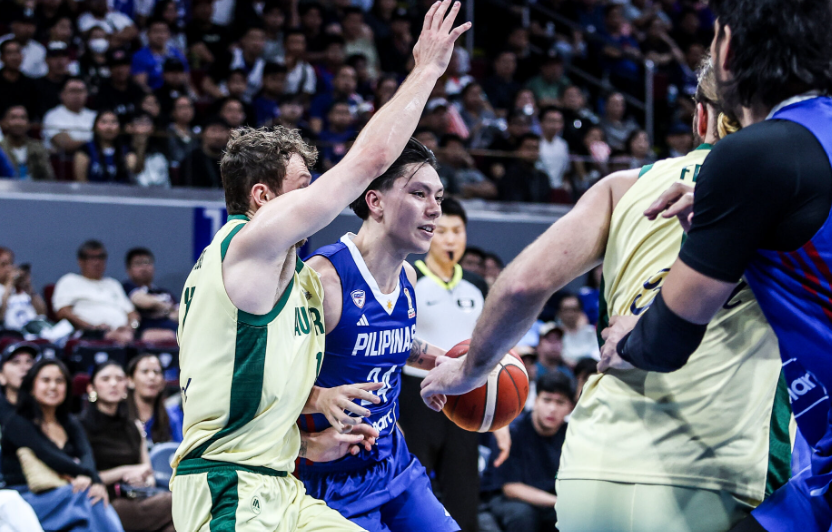
Australia delivered a commanding statement to conclude the first round of the 2027 FIBA Basketball World Cup Asian Qualifiers, dismantling Gilas Pilipinas with a lopsided 92-49 victory Monday at the RAC Arena in Perth. The Boomers showcased their trademark discipline, relentless defense, and balanced offense from start to finish, while the Philippines struggled to find any rhythm in one of its most difficult outings in recent international competition.
Playing before their home crowd, the Australians wasted no time imposing their superiority. From the opening tip, the Boomers dictated the pace on both ends of the floor, suffocating Gilas with relentless defensive pressure and converting defensive stops into easy transition baskets. Every attempt by the Filipinos to establish momentum was immediately countered by Australia’s organized execution, turning what was expected to be a competitive qualifier into a one-sided affair.
The challenge facing Gilas Pilipinas was already steep before the opening whistle. The absence of naturalized star Justin Brownlee, who was sidelined due to multiple injuries, left a massive void in both scoring and leadership. Without their veteran playmaker and offensive anchor, head coach Tim Cone was forced to rely on a shorthanded 11-man rotation against one of Asia-Oceania’s most formidable basketball programs.
READ MORE ARTICLES:
- Haaland Powers Norway Past Brazil to Stunning World Cup Knockout Victory Today
- Argentina Beats Cape Verde, Advances to World Cup Quarterfinals
- Gilas Pilipinas Faces Defining FIBA World Cup Qualifiers Against New Zealand and Australia
- World Cup 2026 Round of 16 Set After Stunning Knockout Upsets
Australia quickly exposed the lack of cohesion in the Philippine lineup. Crisp ball movement repeatedly broke down Gilas’ defense, creating open perimeter looks and high-percentage opportunities inside the paint. The Boomers also dominated the rebounding battle, limiting the Filipinos to very few second-chance opportunities while consistently generating extra possessions of their own.
For Gilas Pilipinas, offensive execution became an overwhelming challenge throughout the contest. Every possession seemed to require difficult shots against Australia’s physical and disciplined defense. The Nationals managed only 28 percent shooting from the field, a reflection of both Australia’s defensive excellence and the Philippines’ inability to generate quality scoring opportunities.
The struggles extended beyond poor shooting. Gilas committed 16 turnovers, many of which directly translated into Australian fast-break points. The Boomers capitalized on nearly every mistake, punishing careless passes and forcing rushed decisions with their relentless defensive pressure. The combination of missed shots and turnovers prevented the Filipinos from establishing any sustained offensive flow.
Australia’s depth was equally evident throughout the evening. Regardless of which lineup was on the floor, the Boomers maintained the same level of intensity and execution. Their bench contributed valuable minutes without any noticeable drop in production, highlighting the country’s deep talent pool and well-established basketball system. Multiple Australian players contributed offensively, making it nearly impossible for Gilas to focus its defensive efforts on a single scorer.
Coach Tim Cone attempted several lineup adjustments in hopes of slowing Australia’s momentum, rotating fresh bodies and experimenting with different defensive schemes. However, the Boomers consistently found answers. Whether attacking inside, knocking down perimeter shots, or creating scoring opportunities through patient ball movement, Australia maintained complete control of the contest from beginning to end.
Defensively, Gilas found little success containing Australia’s balanced attack. The Boomers repeatedly exploited mismatches, attacked the paint with confidence, and forced defensive rotations that opened clean shots around the perimeter. Even when the Philippines managed solid defensive possessions, Australia frequently secured offensive rebounds to extend possessions and wear down the already shorthanded Filipino squad.
Despite the difficult result, the game also served as a valuable learning experience for the younger members of the Philippine roster. Facing a world-class opponent on foreign soil exposed areas that require improvement, including ball security, offensive spacing, defensive communication, and consistency against elite international competition. The experience gained from competing against one of the region’s strongest programs could prove beneficial as the qualifiers continue.
The defeat underscores the significant impact of Brownlee’s absence. Beyond his scoring ability, the veteran naturalized forward has long served as the emotional leader and stabilizing force for Gilas Pilipinas. His ability to create offense in critical situations and elevate the play of his teammates was sorely missed against an Australian squad that allowed very little room for error.
For Australia, the emphatic victory further reinforced its status as one of the favorites in the Asian Qualifiers. The Boomers demonstrated why they remain among the world’s elite basketball nations, combining defensive discipline, offensive efficiency, physicality, and remarkable roster depth. Their dominant performance sends a strong message to the rest of the competition as the qualifying campaign progresses.
While the 43-point loss is undoubtedly a disappointing chapter for Gilas Pilipinas, it does not define the team’s overall campaign. The first round of the qualifiers has presented valuable opportunities to evaluate personnel, develop chemistry, and prepare for the tougher stages ahead. With key players expected to recover from injuries and additional adjustments likely to be made, the Philippines will aim to regroup and deliver stronger performances in the succeeding rounds.
The road to the 2027 FIBA Basketball World Cup remains long, but Australia’s overwhelming display in Perth served as a stark reminder of the level Gilas Pilipinas must consistently reach to compete with the region’s basketball elite. As the Nationals turn their attention to the next phase of the qualifiers, the focus will shift toward learning from the heavy defeat, rebuilding confidence, and finding the resilience necessary to remain competitive on the international stage.
🇦🇺 Australian Boomers (Official Jersey Numbers)
| Jersey # | Player Name | Position | Height | Primary Role / Arrangement Rule |
|---|---|---|---|---|
| 0 | Bryce Cotton | Point Guard | 6’0″ | Naturalized star backcourt scorer and playmaker. |
| 3 | Tyrese Proctor | Point Guard | 6’4″ | Transition pace creator and perimeter ball defender. |
| 4 | Taran Armstrong | SG / SF | 6’5″ | Big utility guard used to clamp smaller opposing ball handlers. |
| 5 | Ben Henshall | SG / SF | 6’5″ | Wing spacing depth and rotational perimeter scorer. |
| 7 | Wani Swaka Lo Buluk | Small Forward | 6’6″ | Lockdown wing defender tasked with disrupting Gilas creators. |
| 10 | Alex Condon | Center | 6’11” | Interior shot-blocker and drop-coverage center anchor. |
| 20 | Samson Froling | Center | 7’0″ | Main rim-running post target and glass cleaner. |
| 23 | Josh Bannan | Power Forward | 6’10” | High-post orchestrator and physical paint defender. |
| 24 | Angus Glover | Shooting Guard | 6’4″ | Perimeter catch-and-shoot outside marksman. |
| 40 | Elijah Pepper | PG / SG | 6’4″ | Lethal three-point floor stretcher and combo ball-handler. |
| 41 | Keanu Pinder | Center / PF | 6’11” | High-energy vertical spacing rim-runner. |
| 55 | Mitch Creek | SF / PF | 6’5″ | Veteran lane slasher and low-post physical presence. |
🇵🇭 Gilas Pilipinas (Official Jersey Numbers)
| Jersey # | Player Name | Position | Height | Primary Role / Arrangement Rule |
|---|---|---|---|---|
| 2 | Juan Gomez de Liaño | Shooting Guard | 5’11” | Quick backcourt scorer providing instant outside shooting. |
| 5 | Mike Phillips | Power Forward | 6’8″ | Starting high-energy engine, defensive rebounder, and inside presence. |
| 6 | RJ Abarrientos | Point Guard | 5’11” | Starting playmaker handling ball pressure and half-court sets. |
| 7 | Carl Tamayo | Power Forward | 6’8″ | Baseline pick-and-pop option stretching interior defenses. |
| 11 | Chris Newsome | PG / SG | 6’2″ | Lockdown perimeter defender and veteran backcourt stabilizer. |
| 15 | June Mar Fajardo | Center | 6’11” | Traditional low-post engine and primary paint option. |
| 18 | Kevin Quiambao | SF / PF | 6’4″ | Starting dynamic point-forward creation valve. |
| 19 | AJ Edu | Center | 6’10” | Starting physical vertical target and primary rim-protector. |
| 24 | Dwight Ramos | SG / SF | 6’4″ | Starting two-way floor engine and main perimeter stopper. |
| 28 | Justine Baltazar | Center / PF | 6’10” | Full-length frontcourt size adjustment to map Australian length. |
| 32 | Justin Brownlee | SF / PF | 6’7″ | DNP (Injury); Finalized to roster but sat out on the bench. |
| 33 | Troy Rosario | Power Forward | 6’7″ | Physical screen-setter used for high-post interior defense. |
Boomers Unleash Ruthless Basketball Masterclass to Crush Injury-Hit Gilas Pilipinas in Perth
Australia delivered a basketball clinic from opening tip to final buzzer, overwhelming an injury-ravaged Gilas Pilipinas side with suffocating defense, blistering perimeter shooting, and relentless transition offense to secure a dominant 92-49 victory at RAC Arena in Perth, concluding the first round of the 2027 FIBA Basketball World Cup Asian Qualifiers in emphatic fashion.
The Boomers entered the contest fully aware that the Philippines would be without its biggest offensive weapon after naturalized star Justin Brownlee was ruled out only hours before tipoff because of multiple lower-body injuries. Rather than simply taking advantage of the personnel loss, Australian head coach Dean Vickerman redesigned his defensive approach to exploit every consequence of Brownlee’s absence, creating one of the most one-sided performances of the qualifying campaign.
Without Brownlee serving as the focal point of the offense, Gilas struggled to generate quality scoring opportunities throughout the evening. Australia aggressively collapsed into the paint, crowded every driving lane, and forced the Filipino guards into difficult perimeter attempts. The strategy proved devastatingly effective, as the Philippines never established any offensive rhythm and finished the night shooting a miserable 18-of-64 from the field, an efficiency rate of just 28 percent.
Every possession became increasingly difficult for Gilas as Australia’s defenders anticipated passing lanes, contested nearly every shot, and refused to allow easy baskets around the rim. The Boomers transformed the Philippine offense into a series of rushed jumpers and forced attempts late in the shot clock, preventing Coach Tim Cone’s squad from finding any consistent momentum.
While Australia’s defense was dismantling Gilas on one end, Bryce Cotton ignited an offensive explosion that effectively decided the outcome before the first quarter had even ended.
The Boomers made Cotton the centerpiece of their opening offensive possessions, repeatedly freeing him through staggered off-ball screens and perfectly timed down-screen actions. The Philippine defenders struggled to navigate Australia’s physical screening, allowing Cotton to find daylight beyond the three-point line.
The veteran scorer immediately caught fire.
Cotton poured in 14 first-quarter points, burying three early three-pointers that energized the home crowd and sparked a devastating 16-0 Australian scoring run. Every made basket increased Australia’s confidence while simultaneously draining the energy from the Filipino bench.
By the conclusion of the opening quarter, the Boomers had established a commanding 33-14 advantage, placing Gilas in an enormous hole that would only deepen as the contest progressed.
Australia never eased its pressure after the explosive start.
Instead, the Boomers intensified their defensive aggression by applying relentless full-court pressure and switching seamlessly across nearly every screen. Their superior size, length, and athleticism consistently disrupted the Philippine backcourt, leaving Gilas unable to organize its half-court offense.
The defensive harassment resulted in 19 Philippine turnovers, each mistake becoming another opportunity for Australia to attack before the defense could recover.
The Boomers capitalized with remarkable efficiency.
Rather than slowing the pace after forcing turnovers, Australia sprinted into transition at every opportunity, converting live-ball steals into uncontested layups, fast-break dunks, and open perimeter shots. Those transition opportunities produced an astonishing 30 fast-break points, highlighting Australia’s commitment to turning defense into instant offense.
Every turnover became increasingly costly for Gilas as the Boomers relentlessly punished even the slightest mistake. Australia’s quick decision-making and exceptional floor spacing allowed them to score before the Philippines could organize defensively, creating an avalanche of points that steadily widened the gap.
The physical demands eventually overwhelmed the already depleted Philippine lineup.
With only an 11-man rotation available and several players already managing physical concerns, Coach Tim Cone had few opportunities to slow Australia’s relentless tempo. The Boomers, meanwhile, continuously deployed fresh bodies through a deep 12-man rotation that preserved their defensive intensity from beginning to end.
Coach Dean Vickerman masterfully utilized Australia’s depth, making regular substitutions without sacrificing speed, physicality, or execution. Every new player entered with the same aggressive mindset, ensuring there was never a decline in defensive pressure or offensive pace.
As fatigue accumulated for the Filipinos, Australia’s advantage became even more pronounced.
The second half brought additional concerns for Gilas as Mike Phillips and Juan Gomez de Liaño both experienced injury scares that temporarily forced them out of action. Although they eventually returned, the interruptions further illustrated the physical toll imposed by Australia’s relentless style of play.
By that stage, the Boomers had complete control of every statistical category.
Australia dominated defensively, dictated the pace offensively, controlled transition basketball, and consistently won the battle for loose balls and second-effort possessions. The disciplined execution reflected a team determined not merely to win, but to establish itself as one of the strongest contenders in the Asian qualifying campaign.
For Gilas Pilipinas, the defeat served as a harsh reminder of how indispensable Brownlee has become within the national team’s system. His absence removed not only the squad’s leading scorer but also its primary facilitator, floor spacer, and late-clock creator. Without his presence drawing defensive attention, Australia’s defenders freely collapsed into the paint, neutralizing the Philippines’ offensive structure from the opening minutes.
The 43-point defeat also underscored the challenge of competing against one of the region’s deepest basketball programs while operating without key personnel. Despite the disappointing result, the experience provides valuable lessons as Gilas prepares for the much tougher second-round crossover phase of the qualifiers.
Australia, meanwhile, leaves Perth with tremendous momentum after delivering one of its most complete performances in recent international competition. The Boomers combined elite perimeter shooting, disciplined execution, overwhelming defensive intensity, and exceptional depth into a near-flawless display that showcased why they remain among the premier basketball powers in the Asia-Oceania region.
For Gilas Pilipinas, attention now shifts toward recovery, reinforcements, and preparation for the next stage of the World Cup qualifiers, where healthier personnel and tactical adjustments will be essential against formidable opponents including Jordan, Syria, and Iran. If the Philippines hopes to rebound from one of its toughest defeats in recent memory, restoring its roster to full strength and rediscovering its offensive identity will be the first steps toward a far stronger showing in the decisive rounds ahead.
APTIKONS