Argentina produced one of the greatest comeback victories in FIFA World Cup history, rallying from two goals down to defeat Egypt, 3-2, in a dramatic Round of 16 showdown. Lionel Messi redeemed an earlier penalty miss, while Enzo Fernández scored the historic winning goal in stoppage time as the defending champions survived a spirited Egyptian challenge amid late VAR controversy.
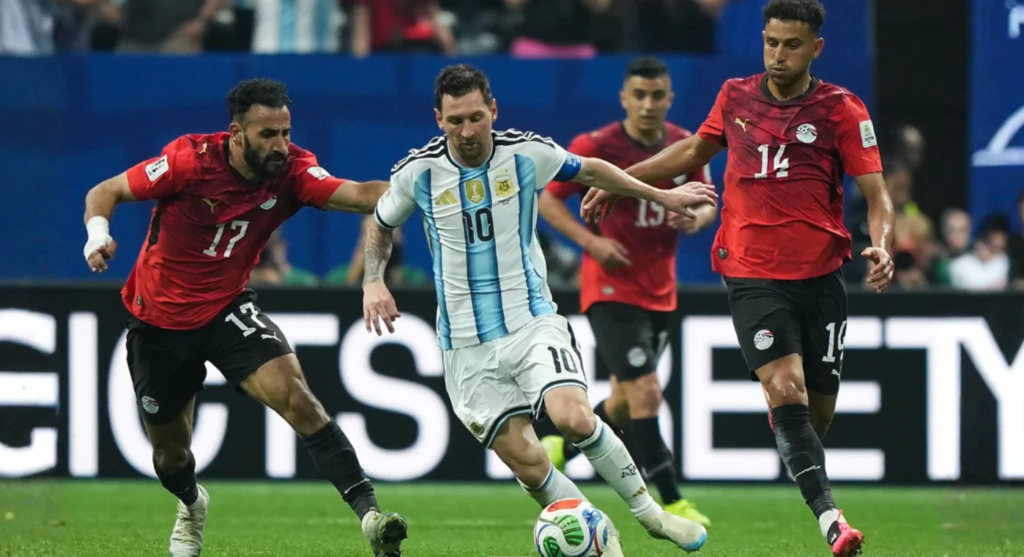
Argentina reminded the football world why champions are never defeated until the final whistle, producing one of the most remarkable comebacks in FIFA World Cup history with a breathtaking 3-2 victory over Egypt in the Round of 16 at Atlanta Stadium.
For more than an hour, it appeared that Egypt was on the verge of delivering one of the greatest upsets ever witnessed on football’s biggest stage. The Pharaohs stunned the defending champions with fearless attacking football and relentless determination, taking a commanding 2-0 advantage that left Argentina staring at an unthinkable early exit from the tournament.
Egypt struck first in the 15th minute when Yasser Ibrahim rose above the Argentine defense to power home a header, sending the Egyptian supporters into celebration. Just five minutes later, Argentina had the perfect opportunity to respond after being awarded a penalty. However, captain Lionel Messi suffered one of the rarest moments of his illustrious career as goalkeeper Mostafa Shobeir brilliantly denied his spot kick, preserving Egypt’s advantage and adding to the growing pressure on the world champions.
READ MORE ARTICLES :
- Ramos: Boomers’ Pressure Buried Gilas in Crushing Qualifier Defeat
- Alex Eala’s Historic Wimbledon Run Ends, Inspires Nation Despite Heartbreaking Loss
- Filipina Alexsandra Diaz Shatters Two Youth World Records in Colombia Championship
- Spain Breaks Portugal Hearts as Ronaldo Bids Farewell to World Cup
Argentina struggled to find their rhythm as Egypt defended with discipline while continuing to threaten on the counterattack. The pressure intensified in the 67th minute when Mostafa Zico finished off a well-worked move from the wing, doubling Egypt’s lead and bringing the African side within touching distance of a historic quarterfinal berth.
Yet football has always been a game capable of producing unforgettable twists, and Argentina once again proved why they possess the mentality of champions.
With just over ten minutes remaining, Cristian Romero ignited hope in the 79th minute by heading home a perfectly delivered cross from Messi. The goal injected belief into the Argentine squad and shifted the momentum entirely.
Only four minutes later, Messi erased the disappointment of his earlier penalty miss with a clinical half-volley that found the back of the net, leveling the score at 2-2. The equalizer not only revived Argentina’s title defense but also showcased the resilience of a captain determined to answer his critics on the biggest stage.
As stoppage time unfolded, Argentina completed the impossible. In the 92nd minute, Enzo Fernández powered in a thunderous header that not only secured a dramatic 3-2 victory but also etched his name into football history by scoring the 3,000th goal in FIFA World Cup history. The stadium erupted as Argentina completed an extraordinary comeback that will be remembered for generations.
The dramatic encounter, however, was not without controversy. Earlier in the second half, Egypt believed they had extended their advantage after finding the net once again, only for the Video Assistant Referee (VAR) to intervene and disallow the goal following a foul on Lisandro Martínez during the buildup. The decision became a major talking point after the match, with Egypt head coach Hossam Hassan expressing frustration over the officiating. Hassan claimed the refereeing decisions favored Argentina and suggested there was immense pressure to ensure both the defending champions and Lionel Messi remained in the competition.
While debate over the VAR ruling is likely to continue, it cannot overshadow the extraordinary resilience displayed by Argentina. From missing a penalty and trailing by two goals to producing three goals in just 13 minutes, the Albiceleste delivered a performance that embodied the spirit of champions never surrendering regardless of the circumstances.
For Egypt, the defeat will remain a heartbreaking memory after coming so close to eliminating one of football’s greatest nations. Their disciplined performance, tactical execution, and fearless approach deserved admiration, even if the result ultimately slipped away in devastating fashion.
For Argentina, however, the night will be remembered as another chapter in their rich World Cup legacy a reminder that in football, belief can be as powerful as talent. When the final whistle sounded, the defending champions had once again proven why no lead is ever truly safe against a team filled with world-class quality, relentless determination, and the unwavering desire to fight until the very last second.
Argentina (4-4-2 Formation)
Manager: Lionel Scaloni
Lionel Scaloni deployed a balanced 4-4-2 formation, emphasizing midfield control and defensive stability. The inclusion of Leandro Paredes alongside Enzo Fernández strengthened the team’s central midfield, while captain Lionel Messi partnered Julián Álvarez in attack.
                    Emiliano Martínez (GK)

Nahuel Molina   Cristian Romero   Lisandro Martínez   Nicolás Tagliafico

Rodrigo De Paul   Enzo Fernández   Leandro Paredes   Alexis Mac Allister

               Lionel Messi (C)      Julián Álvarez
Starting XI:
- Goalkeeper: Emiliano Martínez
- Defenders: Nahuel Molina, Cristian Romero, Lisandro Martínez, Nicolás Tagliafico
- Midfielders: Rodrigo De Paul, Enzo Fernández, Leandro Paredes, Alexis Mac Allister
- Forwards: Lionel Messi (Captain), Julián Álvarez
Egypt (4-2-3-1 Formation)
Manager: Hossam Hassan
Hossam Hassan opted for a disciplined 4-2-3-1 formation, built around defensive organization and quick counter-attacks. Mohamed Salah operated in the central attacking midfield role, serving as the team’s creative focal point behind lone striker Mostafa Hassan.
                     Mostafa Shobeir (GK)

Mohamed Hany    Yasser Ibrahim    Ramy Rabia    Karim Hafez

               Marawan Attia    Mohanad Lashin

Mostafa Zico      Mohamed Salah (C)      Haissem Hassan

                   Mostafa Hassan
Starting XI:
- Goalkeeper: Mostafa Shobeir
- Defenders: Mohamed Hany, Yasser Ibrahim, Ramy Rabia, Karim Hafez
- Defensive Midfielders: Marawan Attia, Mohanad Lashin
- Attacking Midfielders: Mostafa Zico, Mohamed Salah (Captain), Haissem Hassan
- Forward: Mostafa Hassan
Scaloni’s Tactical Masterclass Sparks Argentina’s Remarkable World Cup Comeback
Argentina’s dramatic 3-2 comeback victory over Egypt in the 2026 FIFA World Cup Round of 16 will be remembered for the goals, the emotion, and Lionel Messi’s heroics. Yet beyond the thrilling finish, the match also highlighted the tactical intelligence of head coach Lionel Scaloni, whose adjustments transformed a struggling Argentine side into a relentless attacking force.
For much of the contest, Egypt appeared to have the defending champions under control. Their disciplined defensive structure, built around a compact low block, frustrated Argentina’s attempts to penetrate the middle of the pitch. Every time La Albiceleste pushed forward, Egypt responded with organized defending and dangerous counter-attacks that exposed Argentina’s defensive vulnerabilities. The African side capitalized on those opportunities, racing to a shocking 2-0 advantage and placing the reigning world champions on the brink of elimination.
Rather than panic, Scaloni displayed the calmness that has become one of his defining qualities as a manager. Recognizing that Egypt had successfully congested the central areas, Argentina shifted their attacking approach by increasing width through overlapping fullbacks and encouraging quicker ball circulation. The midfield pushed higher up the field, while Messi was given greater freedom to roam between the lines, forcing Egypt’s defenders to abandon their compact shape.
The changes gradually tilted the momentum. Argentina began stretching Egypt’s defensive block from side to side, creating spaces that had been unavailable throughout most of the match. Increased pressure led to a series of dangerous set pieces and sustained attacks that eventually broke Egypt’s resistance.
Cristian Romero ignited the comeback with a powerful header before Lionel Messi produced the equalizer just minutes later, redeeming himself after an earlier missed penalty. As Egypt struggled to regain its defensive organization, Argentina continued to attack with confidence and urgency. Their persistence was rewarded deep into stoppage time when Enzo Fernández completed one of the tournament’s most memorable turnarounds, sending Argentina into the quarterfinals with a dramatic 3-2 victory.
Scaloni’s in-game management once again demonstrated why Argentina remains among the tournament favorites. While Messi’s brilliance understandably captured the headlines, the comeback was equally a triumph of tactical flexibility. Instead of remaining committed to a system that Egypt had effectively neutralized, Scaloni recognized the weaknesses in his team’s approach and adjusted before it was too late.
The victory also serves as a reminder that knockout football often hinges not only on individual talent but also on a manager’s ability to read the game under immense pressure. Argentina’s resilience was undeniable, but it was their willingness to evolve tactically that ultimately separated them from a determined Egyptian side that came within minutes of producing one of the greatest upsets in World Cup history.
As Argentina advances to the quarterfinals, the comeback against Egypt will stand as both a warning and a statement. The defending champions showed vulnerability, but they also proved they possess the adaptability, experience, and mental strength required to survive football’s biggest moments. If Scaloni continues making decisive tactical calls at the right time, Argentina’s dream of successfully defending the World Cup remains very much alive.
APTIKONS