A last-minute goal from Mikel Merino lifted Spain to a thrilling 1-0 victory over Portugal in the Round of 16, bringing an emotional end to Cristiano Ronaldo’s legendary World Cup career.
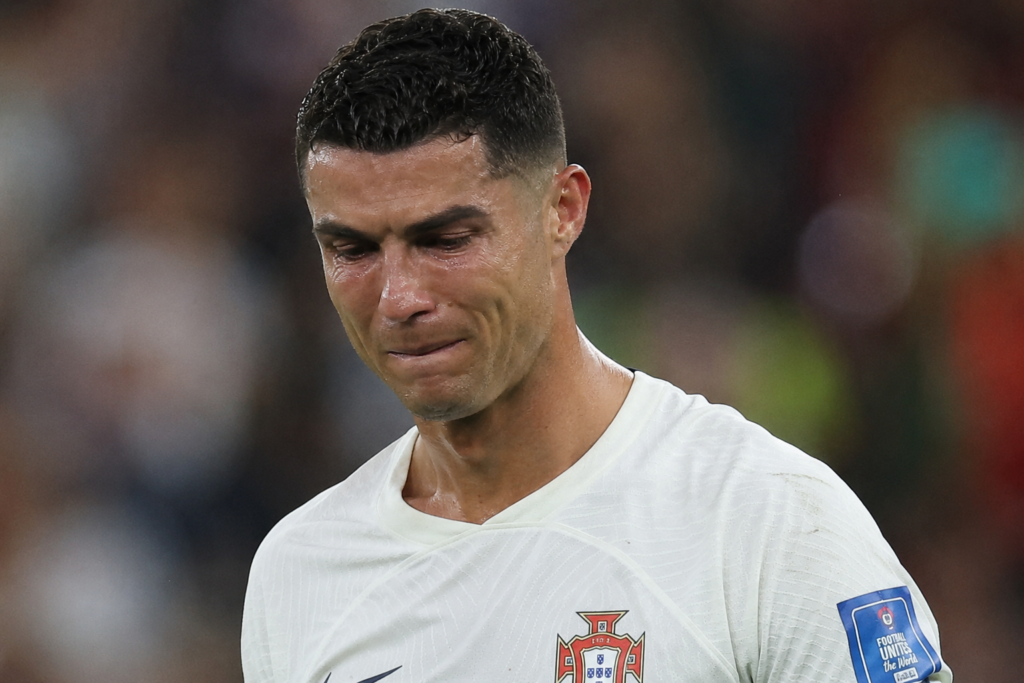
In one of the most emotional and unforgettable matches of the 2026 FIFA World Cup, Spain delivered a stunning late victory over Portugal, securing a 1-0 triumph in a fiercely contested Round of 16 encounter at Dallas Stadium. The match appeared destined for extra time until substitute Mikel Merino emerged as Spain’s unlikely hero, scoring a dramatic winning goal in the 90th minute of stoppage time to send La Roja into the quarterfinals while bringing an end to one of football’s greatest international careers.
For more than 90 minutes, the Iberian rivals engaged in a tactical battle worthy of the World Cup knockout stage. Spain dominated possession with their trademark passing style, patiently searching for openings against a disciplined Portuguese defense. Portugal, meanwhile, relied on swift counterattacks and organized defending, frustrating Spain throughout most of the contest while hoping to capitalize on the experience and leadership of Cristiano Ronaldo.
The encounter was defined by relentless intensity from the opening whistle. Every challenge carried enormous significance, every pass was contested, and every opportunity was met with desperate defending. Both goalkeepers produced outstanding performances, preserving the deadlock despite several dangerous chances created by each side.
READ MORE ARTICLES:
- Australia Demolishes Shorthanded Gilas, Completes Dominant World Cup Qualifiers First-Round Sweep
- Haaland Powers Norway Past Brazil to Stunning World Cup Knockout Victory Today
- Argentina Beats Cape Verde, Advances to World Cup Quarterfinals
As regulation time wound down, many believed the match was headed for extra time. Portugal’s defense had absorbed wave after wave of Spanish pressure, while Spain struggled to find the decisive breakthrough despite controlling much of the possession.
Then came the defining moment.
Deep into stoppage time, Spain launched one final attack that caught Portugal’s defense off balance. The ball found Mikel Merino, who had entered the match as a substitute, and the midfielder calmly delivered a clinical finish beyond the reach of the Portuguese goalkeeper. The stadium erupted in celebration as Spanish players rushed to embrace their unlikely match-winner, while Portugal’s players collapsed to the ground in disbelief.
Merino’s dramatic strike instantly became one of the tournament’s most memorable moments, not only because it secured Spain’s passage into the next round but also because it marked the closing chapter of Cristiano Ronaldo’s extraordinary FIFA World Cup career.
The 41-year-old Portuguese legend had already announced before the tournament that the 2026 FIFA World Cup would be his final appearance on football’s biggest stage. Although he entered the competition hoping to lead Portugal to another historic achievement, the heartbreaking defeat brought an emotional conclusion to a remarkable World Cup journey spanning two decades.
Ronaldo leaves the World Cup as one of the greatest players the sport has ever produced. Throughout his legendary international career, he inspired generations of football fans with his remarkable goal-scoring ability, unmatched professionalism, relentless determination, and extraordinary longevity. Across multiple World Cup tournaments, he consistently carried the expectations of an entire nation while cementing his place among football’s all-time icons.
As the final whistle sounded, Ronaldo was visibly emotional, acknowledging supporters who had stood behind him throughout his historic career. Many of his teammates embraced their captain, recognizing that they had witnessed the conclusion of an era that shaped Portuguese football for more than twenty years.
The emotional aftermath of Portugal’s elimination continued moments after the match when head coach Roberto Martínez announced that he would step down from his position. Martínez confirmed his departure following the heartbreaking defeat, signaling the beginning of a new chapter for Portuguese football after the disappointing World Cup exit.
His announcement underscored the magnitude of the loss, as Portugal now faces a significant period of transition. With Ronaldo retiring from World Cup competition and Martínez leaving the national team, the country will soon embark on rebuilding around a younger generation eager to continue Portugal’s tradition as one of Europe’s football powerhouses.
For Spain, however, the dramatic victory reinforced their credentials as serious contenders for the 2026 FIFA World Cup title. The team’s composure, patience, and resilience were rewarded in the most dramatic fashion possible, proving that persistence can make the difference in football’s biggest matches.
Head coach Luis de la Fuente praised his players for maintaining their belief until the final moments, emphasizing that knockout football often demands both mental strength and unwavering confidence. Spain’s ability to remain composed under immense pressure ultimately produced the decisive opportunity that sent them through to the quarterfinals.
The victory also showcased Spain’s impressive squad depth. While much attention naturally focused on established stars, it was substitute Mikel Merino who etched his name into World Cup history with a goal that will be remembered for years to come. His impact demonstrated the importance of every player in a championship campaign, regardless of whether they begin the match in the starting lineup.
As Spain celebrates its dramatic advancement, the football world pauses to reflect on the extraordinary legacy of Cristiano Ronaldo. His influence extends far beyond statistics, trophies, and individual awards. He transformed Portuguese football, inspired millions of aspiring athletes around the globe, and consistently redefined the standards of excellence through dedication and perseverance.
Although Portugal’s dream of lifting the 2026 FIFA World Cup has come to an end, Ronaldo departs the tournament having secured his place among the immortals of the game. His final World Cup may have ended in heartbreak, but his legacy remains untouchable.
Meanwhile, Spain marches forward with renewed confidence, carrying the momentum of one of the tournament’s most dramatic victories. With Mikel Merino’s unforgettable stoppage-time winner now part of World Cup folklore, La Roja continues its pursuit of global football glory, while Portugal begins the difficult task of embracing a future without the player who defined an entire generation.
Spain’s Tactical Masterclass Sinks Portugal as Late Mikel Merino Strike Seals Dramatic 1-0 Victory
Spain delivered a footballing exhibition built on discipline, patience, and tactical superiority as they edged Portugal, 1-0, in a fiercely contested encounter, with substitute Mikel Merino scoring the decisive goal in the 90th minute to send La Roja into celebration and eliminate their Iberian rivals in heartbreaking fashion.
In a match that demanded precision rather than spectacle, Spain showcased why they remain one of the world’s most technically gifted national teams. Every movement on the pitch reflected careful planning, from their structured build-up play to their relentless pressing and intelligent use of substitutions. The victory was not merely the result of a late goal but the culmination of 90 minutes of tactical dominance orchestrated by head coach Luis de la Fuente.
Spain entered the match employing a fluid 4-1-2-3 formation designed to maximize control in possession while limiting Portugal’s attacking opportunities. At the heart of the system was midfield anchor Rodri, whose calmness and exceptional vision dictated the rhythm of the contest. Stationed in front of the defense, Rodri served as the team’s metronome, distributing passes with remarkable efficiency and ensuring Spain maintained command of the ball throughout the evening.
That strategy proved highly effective as Spain controlled 56 percent of possession, completing an impressive 476 accurate passes. Rather than rushing forward in search of immediate breakthroughs, the Spaniards patiently circulated possession, forcing Portugal to chase shadows for extended periods. Every sequence of passes gradually drained Portugal’s energy while denying them opportunities to launch meaningful attacks.
The battle in midfield ultimately became the defining storyline of the contest. Spain’s trio of Rodri, Pedri, and Álex Baena established complete authority over the central areas, suffocating Portugal’s double-pivot partnership of Vitinha and João Neves. The Spanish midfielders consistently closed passing lanes, intercepted dangerous balls, and pressed aggressively whenever Portugal attempted to transition into attack.
As a result, Portugal struggled to establish any offensive rhythm. The lack of clean service left veteran captain Cristiano Ronaldo isolated for much of the match, while João Félix found little space to operate between the lines. With Spain dominating possession and closing down every available passing option, Portugal frequently found themselves forced into long balls or hurried clearances that rarely threatened the Spanish defense.
Spain’s defensive organization extended well beyond traditional defending. Whenever possession was lost, Luis de la Fuente’s players immediately launched an intense counter-press, swarming the ball carrier before Portugal could initiate dangerous counter-attacks. This aggressive approach repeatedly forced Portugal backward, limiting their attacks to isolated moments along the flanks while preventing them from exploiting open spaces in transition.
The effectiveness of Spain’s counter-press highlighted the collective understanding within the squad. Every player participated in regaining possession, allowing the team to maintain territorial dominance and keep Portugal pinned deep inside their own half for significant stretches of the encounter.
Despite Spain’s territorial control, Portugal’s defensive discipline initially appeared capable of frustrating their opponents. The Portuguese backline remained compact and organized, denying Spain clear-cut scoring opportunities while hoping to capitalize on a rare counter-attack or moment of individual brilliance.
However, as the match entered its closing stages, Luis de la Fuente demonstrated why in-game management is often as important as tactical preparation before kickoff. Recognizing that Portugal’s defenders were beginning to tire, the Spanish manager introduced fresh attacking options in Ferran Torres and Mikel Merino during the final quarter of the match.
Those substitutions proved decisive.
Torres immediately injected pace, directness, and renewed energy into Spain’s attack, stretching Portugal’s defensive line and creating spaces that had previously been unavailable. Merino, meanwhile, added physical presence and intelligent movement inside the penalty area, constantly searching for openings against increasingly fatigued defenders.
Their impact would define the match.
As regulation entered its final minute, Spain continued to circulate possession with patience rather than desperation. The breakthrough finally arrived in the 90th minute when Ferran Torres delivered a perfectly timed assist into the path of fellow substitute Mikel Merino. Displaying composure under immense pressure, Merino calmly finished past the Portuguese goalkeeper to score the match’s only goal.
The dramatic late strike sparked jubilant celebrations among the Spanish players and supporters, while Portugal could only watch in disbelief as their hopes disappeared moments before the final whistle.
The goal perfectly encapsulated Spain’s overall performance patient, methodical, and ultimately ruthless when the decisive opportunity presented itself. Rather than relying on moments of individual magic alone, Spain’s victory stemmed from collective organization, relentless pressing, technical superiority, and intelligent coaching decisions.
For Portugal, the defeat serves as a painful reminder of football’s unforgiving nature. Their defensive resilience kept them alive for nearly the entire contest, but the inability to establish midfield control ultimately prevented them from creating sustained attacking pressure. With Cristiano Ronaldo and João Félix largely neutralized, Portugal struggled to generate the offensive quality required to challenge one of Europe’s most disciplined sides.
Spain, meanwhile, once again demonstrated the enduring qualities that have defined their footballing philosophy for generations. Ball retention, positional intelligence, midfield dominance, and collective teamwork formed the foundation of a performance that showcased both tactical maturity and championship ambition.
As the final whistle echoed around the stadium, Spain walked away with more than just a narrow 1-0 victory. They delivered a statement of intent to the rest of the tournament, proving that controlling the tempo, mastering the midfield, and making decisive adjustments from the bench can be just as devastating as overwhelming attacking firepower.
With Rodri orchestrating the game, Pedri and Álex Baena suffocating Portugal’s midfield, and late substitutes Ferran Torres and Mikel Merino combining for the match-winning moment, Spain once again proved that patience, preparation, and tactical excellence remain among football’s most powerful weapons. Their dramatic triumph sends them confidently into the next stage, while Portugal is left to reflect on an opportunity that slipped away in the final minute.
🇪🇸 SPAIN
Formation: 4-3-3
Head Coach: Luis de la Fuente
                    Mikel Oyarzabal
                         (CF)

     Álex Baena                         Lamine Yamal
         (LW)                               (RW)

             Dani Olmo         Pedri
                (AM)            (CM)

                    Rodri (C)
                      (DM)

Marc Cucurella  Pau Cubarsí  Aymeric Laporte  Pedro Porro
      (LB)           (CB)          (CB)            (RB)

                  Unai Simón
                     (GK)
Starting XI
| Position | Player | Club |
|---|---|---|
| GK | Unai Simón | Athletic Bilbao |
| RB | Pedro Porro | Tottenham Hotspur |
| CB | Pau Cubarsí | FC Barcelona |
| CB | Aymeric Laporte | Al Nassr |
| LB | Marc Cucurella | Chelsea |
| DM | Rodri (Captain) | Manchester City |
| CM | Pedri | FC Barcelona |
| AM | Dani Olmo | FC Barcelona |
| RW | Lamine Yamal | FC Barcelona |
| LW | Álex Baena | Villarreal |
| CF | Mikel Oyarzabal | Real Sociedad |
Key Substitutes
- ⭐ Mikel Merino – Scored the winning goal (90’+1)
- ⭐ Ferran Torres – Assisted the winning goal
🇵🇹 PORTUGAL
Formation: 4-2-3-1
Head Coach: Roberto Martínez
                 Cristiano Ronaldo (C)
                         (ST)

 João Félix       Bruno Fernandes      Pedro Neto
    (LW)                 (CAM)             (RW)

            João Neves        Vitinha
                 (CM)            (CM)

Nuno Mendes  Renato Veiga  Rúben Dias  João Cancelo
     (LB)         (CB)         (CB)         (RB)

                  Diogo Costa
                     (GK)
Starting XI
| GK | Diogo Costa | FC Porto |
| RB | João Cancelo | FC Barcelona |
| CB | Rúben Dias | Manchester City |
| CB | Renato Veiga | Villarreal |
| LB | Nuno Mendes | Paris Saint-Germain |
| CM | Vitinha | Paris Saint-Germain |
| CM | João Neves | Paris Saint-Germain |
| RW | Pedro Neto | Chelsea |
| CAM | Bruno Fernandes | Manchester United |
| LW | João Félix | Al Nassr |
| ST | Cristiano Ronaldo (Captain) | Al Nassr |
Match Summary
| Category | Spain | Portugal |
|---|---|---|
| Formation | 4-3-3 | 4-2-3-1 |
| Head Coach | Luis de la Fuente | Roberto Martínez |
| Possession | 56% | 44% |
| Accurate Passes | 476 | — |
| Winning Goal | Mikel Merino (90’+1) | — |
| Assist | Ferran Torres | — |
| Final Score | Spain 1–0 Portugal | ❌ |
Result: 🇪🇸 Spain 1–0 Portugal
Match Winner: Mikel Merino (90’+1) (Assist: Ferran Torres)
APTIKONS