Donald Trump’s determination to bring Greenland under American control exposes a troubling reality in modern geopolitics, powerful nations increasingly invoke national security to justify ambitions over strategic territories, even when the people who call those territories home have made clear that their homeland is not for sale.
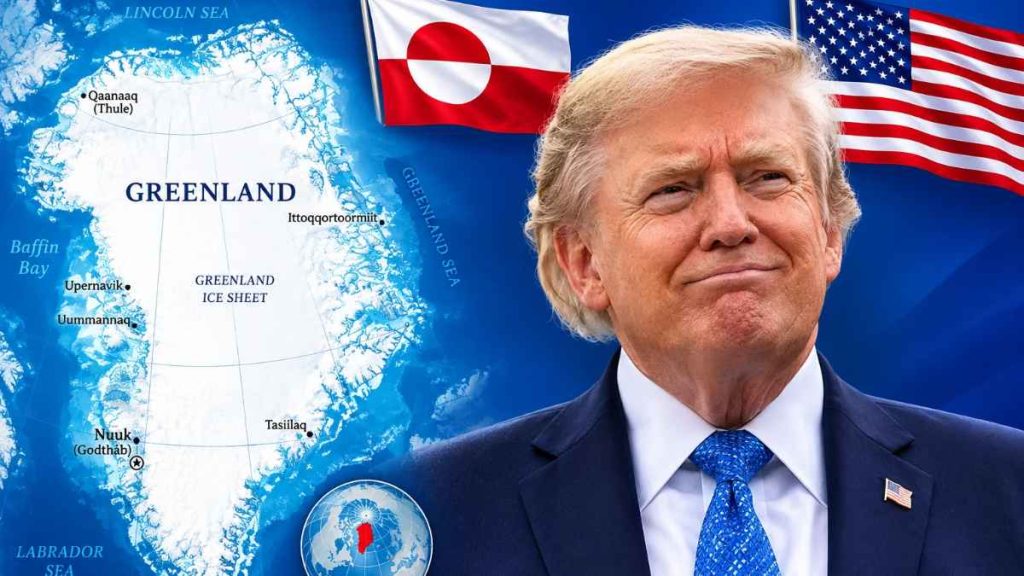
Greenland is far more than a vast island covered in ice. Its strategic position between North America and Europe makes it critical to Arctic defense, missile-warning systems, and surveillance across the North Atlantic. As climate change accelerates the retreat of Arctic ice, the region is also attracting greater attention for its potential mineral wealth and emerging maritime routes. Russia’s military capabilities in the Arctic and China’s interest in northern resources have intensified Washington’s strategic calculations.
But one principle must remain non-negotiable, a territory’s strategic value does not give a foreign power the right to claim it.
Trump’s argument follows a familiar geopolitical calculation: if Russia and China are expanding their influence, the United States must strengthen its position before its rivals gain the advantage. The security concerns deserve serious consideration. Washington has legitimate reasons to protect North America, monitor the Arctic, and strengthen the defense of the North Atlantic.
Yet the United States already operates Pituffik Space Base in Greenland under longstanding defense arrangements with Denmark. The question, therefore, is not whether America has legitimate security interests in Greenland. It is whether those interests justify the pressure to acquire territory belonging to another political community.
READ MORE:
- [OP-ED] Greenland Is Not for Sale: Trump’s Arctic Ambition Exposes the Limits of American Power
- [OP-ED] Lawsuit Before the Votes: Trump’s Alaska Gambit Destroys the Line Between Law and Power
National security is a legitimate responsibility, not a blank check for territorial ambition.
American interest in Greenland did not begin with Trump. In 1946, President Harry Truman’s administration offered Denmark $100 million in gold for the island. Denmark rejected the proposal, and the two countries continued to pursue defense cooperation instead. Trump revived the idea of purchasing Greenland in 2019 and renewed his push for control during his return to office.
This history demonstrates that Washington has long recognized Greenland’s strategic importance. But it also exposes the fundamental weakness in Trump’s approach: the assumption that because Greenland is valuable to America, America should be entitled to own it.
That is not how sovereignty should work.
Greenland’s leaders have repeatedly rejected the idea of selling the island. In July 2026, Greenland Prime Minister Jens-Frederik Nielsen reiterated that Greenland was not for sale after Trump renewed his demand for control. This was not merely a diplomatic objection or a negotiating position waiting for a sufficiently attractive offer. It was a clear assertion of political identity and self-determination.
Greenland has its own society, political institutions, culture, and aspirations. Its people are not pieces on a military chessboard to be moved according to the calculations of Washington, Moscow, or Beijing. They have a right to determine their future, including their relationship with Denmark and the terms under which foreign powers may operate on their land.
If Washington claims to defend democracy and freedom, it must respect those principles even when doing so limits American power. Otherwise, those ideals risk becoming convenient slogans invoked when they serve American interests and abandoned when they do not.
The stakes extend far beyond Greenland. Denmark is a NATO ally, bound to the United States and other members by a collective-defense commitment. Trump’s threats to take control of Greenland placed serious strain on relations within the alliance, prompting concern among European allies and Canada.
Imagine the consequences if Washington attempted to seize Greenland or coerce Denmark into surrendering its sovereignty. The damage would extend well beyond a bilateral dispute. Other NATO members would have reason to question whether their alliance with the United States rests on shared principles or simply on an imbalance of power.
If a powerful ally can pressure a smaller ally over its territory, what assurance does any member have that its own sovereignty will be respected when strategic interests collide?
Such a crisis would weaken the trust on which NATO depends. It would also hand Russia and China a propaganda opportunity, allowing them to portray the alliance as a partnership in which the strongest member expects others to submit. A campaign intended to strengthen American security could therefore undermine the very alliances that make American security more sustainable.
The legal and moral issues are equally serious. The United Nations Charter establishes rules against the threat or use of force against the territorial integrity or political independence of states. Greenland’s status and the legal rights of its people must be considered within that framework, including their recognized right to self-determination. A territorial transfer cannot be treated as legitimate simply because a powerful country wants it or offers money for it.
There is a difference between negotiating a mutually agreed arrangement and using threats, economic pressure, or military force to obtain another people’s homeland. Calling coercion a deal does not make it voluntary. Nor does a claim of national security automatically settle the legal questions surrounding sovereignty.
The economic argument for acquiring Greenland is no less complicated. The island contains mineral deposits that could be important to advanced manufacturing, clean-energy technologies, and defense industries. Its location may also become more commercially significant as Arctic conditions change. These factors help explain why the United States and other major powers are interested in the region.
But who should benefit from those resources? Who should determine the terms of investment? And who should bear the environmental and social costs of development?
The answer cannot simply be that the strongest country gets the greatest share.
Greenland’s government has authority over its mineral resources, and in 2021 it ended the issuance of new oil and gas exploration licences, citing environmental and climate concerns. The island’s future should not be reduced to a race among superpowers to extract as much as possible before their competitors arrive. Decisions about development must account for Greenlanders’ interests, their livelihoods, their environment, and their long-term economic future.
Climate change adds another bitter irony. The melting ice that threatens Arctic ecosystems is also making the region more attractive to governments and businesses seeking access to resources and shipping routes. An environmental crisis is creating new opportunities for geopolitical competition, potentially intensifying military activity in a region already facing profound ecological changes.
The danger is that the Arctic becomes another arena where strategic rivalry overwhelms environmental responsibility and local self-determination. More bases, more surveillance, and more military deployments may be presented as necessary responses to Russia and China. Yet a policy that treats every security concern as justification for expanding control risks deepening the tensions it claims to prevent.
There is, however, an important distinction between seeking military access and demanding territorial ownership.
On September 22, 2026, the United States, Denmark, and Greenland signed a new defense agreement at the United Nations in New York. The agreement updates the 1951 defense framework and permits an expanded American military presence, including the modernization of Pituffik Space Base and the establishment of additional defense areas. It reaffirms Denmark’s sovereignty and territorial integrity and recognizes the Greenlandic people’s right to self-determination. The agreement remains subject to the completion of the necessary parliamentary procedures before entering into force.
This agreement illustrates that security cooperation can be strengthened without transferring sovereignty to the United States. Washington can expand its defensive capabilities and work with its allies without insisting that Greenland become American territory.
Trump, however, has presented the agreement as giving the United States lasting control over Greenland’s security interests. The White House likewise described it as providing lasting American control over those interests. That characterization must be distinguished from the agreement’s explicit recognition of Denmark’s sovereignty and Greenlanders’ right to self-determination. Military access and security authority are not the same as ownership of a territory.
The agreement should therefore be judged not by the political victory claimed by any leader, but by how it is implemented. Greenlanders must have a meaningful voice in decisions affecting their communities, land, resources, and future. Security cooperation must be transparent, reciprocal, and consistent with the rights recognized in the agreement.
Supporters of Trump’s approach may argue that his pressure forced allies to negotiate a stronger Arctic defense arrangement. They may also contend that expanding American military access will deter Russia and China and protect North America against emerging threats. Those arguments deserve examination because Arctic security is a genuine concern.
But even if the agreement improves American defense capabilities, that does not prove that threatening to take Greenland was necessary, justified, or wise. A successful negotiation does not automatically vindicate every tactic used to reach it. The relevant question is whether the same security objectives could have been achieved through cooperation without creating a diplomatic crisis among allies.
The distinction matters. Diplomacy that produces stronger defense cooperation is a legitimate achievement. Coercion that undermines trust, threatens sovereignty, and leaves allies questioning American intentions carries costs that cannot be measured solely in military installations or strategic access.
The same principle must apply to every major power. Russia cannot claim a right to dominate the Arctic simply because it has substantial military capabilities there. China cannot demand privileged access to Greenland’s resources because it has economic interests in the region. And the United States cannot insist that its security concerns automatically outweigh the political rights of Greenlanders.
A world governed by that logic would be one in which smaller nations and territories survive only at the pleasure of powerful states. Sovereignty would become negotiable whenever a stronger country declared a strategic interest. Such a precedent would weaken international trust and encourage governments elsewhere to justify their own territorial ambitions in the language of security.
Greenland’s importance is undeniable. Its location matters, its resources require responsible stewardship, and the Arctic’s security challenges demand serious international cooperation. But strategic importance does not erase the rights of the people who call the island home.
Trump may seek a stronger American position in the Arctic, and Washington has legitimate reasons to protect North American security. Yet responsible leadership is not measured by how much territory a country can acquire or how forcefully it can impose its will. It is measured by whether a country can defend its interests while respecting the principles it claims to uphold.
Greenland is not a real-estate transaction, a military trophy, or a bargaining chip in a contest among superpowers. It is a homeland whose future belongs to its people.
If the United States wants to lead in the Arctic, it must prove that its leadership rests on cooperation rather than coercion, partnership rather than possession, and respect for self-determination rather than the assumption that power creates entitlement.
The lesson from the Greenland dispute is clear: diplomacy can strengthen security, but threats can destroy trust. America does not need to own Greenland to defend itself. It needs reliable allies, credible agreements, and a willingness to respect the sovereignty of others.
Otherwise, the campaign to secure Greenland risks exposing a profound contradiction in American foreign policy: claiming to defend freedom while pressuring another people over the future of their own land.
Sources
1. The White House — Agreement Between the United States, Denmark, and Greenland on the Defense of Greenland (September 22, 2026).Read the official defense agreement.
2. Government of Denmark — Agreement Between Greenland, Denmark and the United States (September 22, 2026).
Read the official government announcement.
3. Reuters — Greenland Is Not for Sale, Prime Minister Says After Trump Demand (July 8, 2026).
Read the Reuters report.
4. UK House of Commons Library — The New US–Denmark–Greenland Agreement (September 29, 2026).
Read the parliamentary research briefing.
5. The White House — President Trump Inks Historic Arctic Security Agreement (September 22, 2026).
Read the White House statement.
6. CBS News — Trump Signs Greenland Deal Giving U.S. Broad Military Authority on the Island (September 22, 2026).
Read the news report.
7. Government of Greenland, Mineral Resources Authority — Closure of the 2020 Open Door Procedure for Onshore Areas on Disko Island and the Nuussuaq Peninsula, West Greenland (September 30, 2022).
Read the official mineral resources announcement.
8. United Nations — United Nations Charter, Article 2.
Read the UN Charter. This is a primary source for the principles of sovereignty, peaceful dispute settlement, and restrictions on the use of force.
9. U.S. Space Force — 821st Space Base Group.
Read the official fact sheet. This source explains the military and strategic role of the U.S. installation in Greenland.
10. Associated Press (AP) — Trump’s Greenland Idea Isn’t New. The US Has Pursued It at Least 3 Times Before.
Read the AP report. This provides historical background on previous American efforts to acquire Greenland, including the 1946 proposal.
11. United Nations Treaty Collection — Agreement Between the United States and Denmark Concerning the Defense of Greenland (1951).
Read the treaty record. This is a primary source for the original U.S.–Denmark defense agreement.