The Federal Aviation Administration’s nationwide rollout of its $875 million artificial intelligence-powered air traffic management system has raised questions about aviation safety, reliability and human oversight, as experts warn against excessive dependence on technology that could generate inaccurate information.
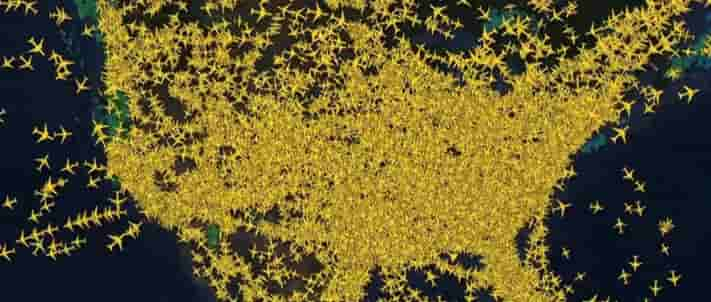
The nationwide flight disruption that began Friday was not caused by the Federal Aviation Administration’s new $875 million artificial intelligence system, according to U.S. government officials and the technology company that developed the program.
The timing of the disruption, however, has drawn attention because it happened as the FAA was expanding the nationwide use of its SMART system. The situation has renewed discussions about how the technology operates, how it works alongside human air traffic controllers, and what protections are in place if the system produces incorrect or potentially unsafe information.
U.S. officials and Air Space Intelligence, the company responsible for developing SMART, have denied that the new system was involved in the communications problems associated with the flight disruption.
Homeland Security Secretary Markwayne Mullin said Friday that officials had found no evidence connecting the communications problems to SMART. Officials from the Transportation Department and the FAA also maintained the same position the following day.
READ MORE ARTICLES:
- FAA Says New AI System Not Behind Major Flight Disruptions
- US FDA Warns Weight-Loss Drugs May Increase Risk of Blindness
- FAA Lifts Nationwide Ground Stop After Major Air Traffic
- US Democrats Target Tech Giants as AI Security Concerns Trigger Congressional Probe
- OpenAI Sued Over Deaths of Bowen Wan, Sam Nelson, Zane Shamblin, Adam Raine
- GLP-1 Costs Threaten Retirement Savings as Drug Use Continues Rising
Air Space Intelligence likewise rejected claims that its technology contributed to the incident. The company said the ground stop was not caused by SMART, any of its products, or its work integrating the system with the FAA and air traffic control operations.
The SMART system is part of the FAA’s broader effort to modernize how aviation officials monitor and respond to changing conditions across the country’s airspace. It operates from a centralized facility near Washington, where specialists analyze flight schedules, weather information and hundreds of other data sources.
The technology does not independently control aircraft. Instead, it processes large amounts of information and generates recommendations for aviation officials. These recommendations are forwarded through the FAA’s command center and made available to air traffic controllers across the country.
Human controllers continue to have the final responsibility for important air traffic decisions. SMART is intended to support their work by helping identify possible problems and analyzing information that could otherwise take significant time to review manually.
Still, questions about the system had already emerged before the latest flight disruption. Some lawmakers and aviation organizations have raised concerns about whether the FAA has established enough safeguards and whether aviation professionals have been sufficiently involved in developing and implementing the technology.
In October, House Democrats requested an investigation by the U.S. Government Accountability Office into the FAA’s AI-based air traffic software. They expressed concerns about the system’s reliability, safety protections and the possibility that AI-generated information could affect decisions made by experienced air traffic controllers.
Lawmakers also questioned whether aviation personnel had been given adequate training and information about SMART. They argued that workers directly responsible for aviation safety should have a stronger role in assessing technology that could eventually influence decisions affecting aircraft and passengers.
Another concern involves the possibility of AI “hallucinations,” a term used to describe situations in which an artificial intelligence system produces information that appears accurate but is actually incorrect. Such errors could become particularly serious in aviation, where decisions must be based on reliable and verified information.
For now, the FAA’s system is designed to keep people in control. SMART provides analysis and recommendations, but it does not independently direct aircraft or make final air traffic decisions.
The recent ground stop has nevertheless placed greater public attention on the FAA’s use of artificial intelligence. Officials and the technology company continue to maintain that the system was not responsible for the communications problems behind the disruption.
The incident also underscores the difficulties aviation authorities face as they introduce advanced computer technology into an industry where safety depends heavily on reliable communication, accurate information and human judgment.
The FAA must now continue investigating the communications problems that disrupted flights while also assuring the public that its new AI technology is dependable and subject to appropriate safeguards.
As SMART moves forward with its nationwide deployment, issues involving transparency, employee training, accountability and system reliability are expected to remain central to the discussion over the growing role of artificial intelligence in aviation.
FAA Expands AI System Nationwide to Manage Airspace
The Federal Aviation Administration has expanded a new artificial intelligence-supported system nationwide as part of an effort to improve air traffic management, reduce congestion and help aviation officials respond more quickly to weather and other disruptions.
Transportation Secretary Sean Duffy and FAA Administrator Bryan Bedford introduced the system in September, describing it as an advanced platform capable of bringing together about 200 different data streams. These include weather conditions, aircraft routes, traffic levels and information about air traffic controller staffing.
The system, known as SMART, stands for Strategic Management of Airspace, Routes and Trajectories. It was developed to give aviation specialists a more complete view of activity across the nation’s airspace and help them identify potential problems before they become major disruptions.
SMART uses an AI-supported system to combine information from different sources and produce what the FAA describes as a comprehensive picture of aircraft movements and airspace conditions. The platform can show where planes are headed, how much traffic different areas can accommodate and where congestion or severe weather could create difficulties.
The goal is to allow aviation specialists to respond before problems develop rather than waiting until air traffic becomes heavily congested or flights are significantly delayed.
The FAA said the technology produced encouraging results during an initial test conducted in the Washington area during the fall. According to the agency, SMART helped officials reroute 180 flights, with each affected flight saving an average of about 10 minutes and 80 gallons of fuel by avoiding weather-related problems and other obstacles.
In one example cited by the FAA, the system’s recommendations helped reduce the travel time of a flight from Tampa, Florida, to Dallas by 42 minutes.
Following the initial testing period, the FAA expanded SMART nationwide on November 10. The system was made available across the airspace covered by all 22 U.S. air traffic control centers, just three days before the nationwide ground stop that disrupted flights.
According to an FAA fact sheet, SMART is designed to forecast the movement of air traffic and identify alternative routes before particular areas become overcrowded. The system can also assist officials in reopening restricted airspace more quickly and improving the management of aircraft arriving at airports.
Weather management is another major part of the system’s intended purpose.
The FAA currently handles weather-related restrictions by closing portions of airspace using large rectangular areas. However, the agency acknowledges that this method does not always accurately represent the actual shape and movement of storms.
Thunderstorms and other weather systems can move quickly and often have irregular shapes, including narrow areas through which aircraft may be able to safely travel. As a result, closing a large section of airspace can sometimes prevent aircraft from using routes that remain operationally safe.
SMART is intended to provide aviation officials with a more detailed understanding of how weather conditions are expected to affect air traffic over time. With better information, controllers can potentially route aircraft around storms while continuing to use available portions of the airspace.
The system could therefore reduce the need to shut down large areas simply because severe weather is affecting part of a wider region.
Aviation experts say the technology represents a significant development in the use of artificial intelligence for managing airspace.
Michael McCormick, a former FAA airspace manager and an associate professor at Embry-Riddle Aeronautical University, said no other country currently has an operational AI air traffic management tool comparable to SMART.
Other aviation authorities are also exploring similar technology. Eurocontrol, the European organization responsible for coordinating air traffic management across Europe, has a comparable system undergoing testing, while several aviation manufacturers are developing and testing their own AI-based tools.
The FAA’s nationwide deployment of SMART marks a major step toward using advanced technology to support human decision-making in the U.S. aviation system. Rather than replacing air traffic controllers, the platform is intended to give them more information and better forecasting tools to help manage increasingly complex airspace conditions.
As the system continues to operate nationwide, aviation officials will be watching its performance closely, particularly its ability to manage congestion, weather disruptions and changing traffic patterns while maintaining safety and reliability.
Aviation Experts Question Heavy Dependence on AI for Flight Safety
The increasing adoption of artificial intelligence in the management of U.S. air traffic has sparked concerns among aviation professionals over the possible dangers of placing too much trust in automated technology. While government representatives and Air Space Intelligence (ASI), the company behind the FAA’s SMART platform, have explained that the system is intended to assist human personnel rather than take direct control of aircraft, its reliability and potential safety risks remain subjects of discussion.
A particular issue involves AI hallucinations, which occur when artificial intelligence generates inaccurate information but presents it as though it were factual. Aviation experts warn that this weakness could become dangerous in an industry where even minor errors may affect flight operations and put passengers and crew members at risk.
Mike O’Donnell, who previously served as an FAA official for 17 years and now works as an aviation safety consultant, stressed that artificial intelligence should only serve as an additional resource for aviation professionals. He warned that the technology must not become the main decision-making mechanism responsible for managing aircraft movements.
O’Donnell emphasized that the FAA must exercise extreme caution because mistakes involving aviation safety can have serious consequences. He said the agency needs effective protective measures to ensure that misleading or incorrect information produced by AI does not influence air traffic controllers.
He also pointed to the need for proper checking and assessment procedures to establish whether the system’s recommendations are accurate before they are used in actual operations. In his view, aviation authorities must have dependable ways of confirming the information generated by the technology.
The former FAA official further advised against placing complete confidence in artificial intelligence before its performance has been demonstrated consistently over time. He explained that proving the system’s dependability will require extensive evaluation and repeated successful results.
These developments are taking place while the United States continues to experience difficulties maintaining an adequate number of air traffic controllers. The staffing problem has been a longstanding challenge for the aviation industry, raising additional questions about whether advanced technology could help address operational demands.
The National Air Traffic Controllers Association has been calling attention to the shortage for more than a decade. During a congressional discussion in 2015, the organization warned that the situation had reached a critical point after the FAA reportedly failed to achieve its recruitment goals for five straight years.
The labor organization represents roughly 14,000 air traffic controllers nationwide, with approximately 3,000 still undergoing training. However, aviation specialists maintain that introducing artificial intelligence does not eliminate the need for qualified human professionals.
Controlling aircraft movements requires extensive technical knowledge, years of specialized training and the ability to respond quickly to unexpected developments. Human controllers play an essential role in maintaining safe distances between aircraft, coordinating flight movements and handling complicated situations that require sound judgment.
Phillip Buckendorf, the co-founder and chief executive officer of Air Space Intelligence, discussed the purpose of the SMART platform in an October interview with National Public Radio. He explained that the technology was developed to assist traffic managers overseeing the country’s entire airspace system.
According to Buckendorf, artificial intelligence handles complex calculations and processes information to generate possible solutions to air traffic challenges. Nevertheless, human operators retain the authority to determine whether the recommendations should be followed.
This means that decisions involving aircraft operations remain under human supervision, with SMART serving as a technological support system rather than an independent authority.
As the FAA continues expanding its use of artificial intelligence, ensuring proper human supervision remains a critical part of the modernization effort. Although the technology could help improve traffic coordination, identify potential disruptions and make aviation operations more efficient, its implementation must not compromise established safety standards.
The effectiveness of SMART will depend on more than its ability to analyze large amounts of information. Its recommendations must also prove accurate, dependable and suitable for use by aviation professionals responsible for the safety of millions of passengers and flight crews.
- Babae mula Naval, Biliran, nasawi sa aksidente sa motorsiklo
- Elon Musk Developing Two Philippine Islands
- PRC: CHELE RESULTS November 2026 Chemical Engineer Licensure Exam Passers
- Mga Bahagi ng Katawan ng Tao, Natagpuan sa Tubuhan sa Ormoc City
- DepEd kinondena ang pagpatay sa school principal sa Maguindanao del Sur