Indiana Fever guard Sophie Cunningham has become the center of a nationwide debate after publicly saying she wants to protect young girls in women’s sports and locker rooms from competing against biological males. Her remarks about transgender athletes quickly gained attention across the United States, earning support from the White House while also drawing criticism from many sports fans, advocacy groups, and commentators. The issue has once again placed women’s sports, fairness in competition, and transgender participation at the heart of an ongoing national discussion.
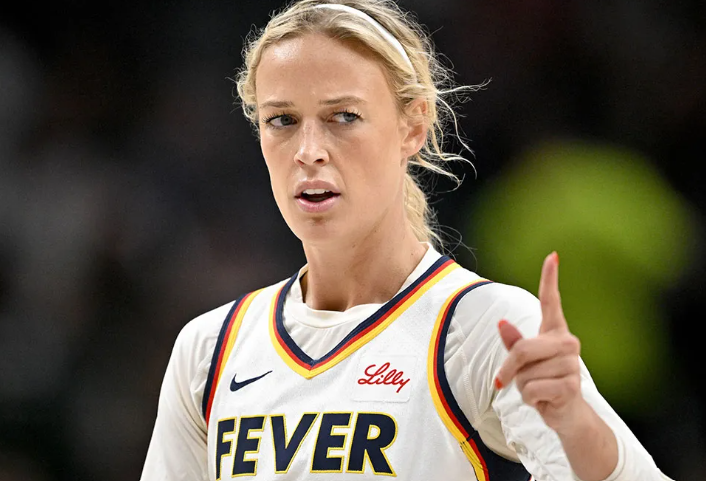
LOS ANGELES, United States — Indiana Fever guard Sophie Cunningham has found herself at the center of one of the biggest sports controversies in the United States after speaking publicly about transgender athletes competing in women’s sports. While Cunningham is widely recognized for her tough style of play in the Women’s National Basketball Association (WNBA), she is now making headlines for comments that have sparked a heated national conversation reaching beyond basketball courts and into politics, education, and society.
Cunningham, who has become one of the WNBA’s most recognizable personalities, said she believes it is important to protect young girls participating in sports. She explained that female athletes should not have to compete against biological males and that young girls deserve privacy and safety inside women’s locker rooms. According to Cunningham, her position is based on what she considers common sense rather than politics.
Her statements immediately attracted widespread attention across television networks, social media platforms, and news organizations. Supporters praised her for speaking openly about an issue they believe affects fairness in women’s sports, while critics accused her of making transgender athletes feel excluded and unwelcome.
READ MORE OTHER ARTICLES:
- Macau Giant Pandas Complete Stunning Comeback For First Governors Cup Victory

- Cebu Youth Champions Showcase Untapped Philippine Basketball Talent and Promise
- Philadelphia Welcomes LeBron James As Championship Dreams Rise For Franchise Again Today
- USA: WNBA Star Sophie Cunningham Sparks Fierce Debate Over Transgender Athletes Nationwide
- JRU Heavy Bombers Capture Historic First FilOil EcoOil Preseason Championship Title
- Young Filipino Baseball Stars Shock Powerful Japan With Historic Championship Victory Together






The debate quickly expanded beyond the sports community after the White House publicly expressed support for Cunningham’s comments. White House Press Secretary Karoline Leavitt defended the basketball player during a press briefing, describing the criticism directed at Cunningham as unfair. She also said President Donald Trump was closely following the issue because he strongly believes women’s sports should be protected from what his administration considers unfair competition.
President Trump has repeatedly voiced opposition to allowing transgender women to compete in women’s athletic competitions. Earlier, he signed an executive order intended to prevent transgender athletes from participating in women’s sports at schools and institutions receiving federal funding. His administration argued that such policies are necessary to preserve equal opportunities for female athletes.
The issue has become one of the most debated topics in American sports over the past several years. While some believe transgender women should be allowed to compete according to their gender identity, others argue that biological differences may create an unfair competitive advantage in certain sports.
Supporters of restrictions say women’s sports were created to ensure equal opportunities for female athletes and that allowing biological males to compete could undermine decades of progress. They often point to Title IX, the landmark 1972 federal law that greatly expanded opportunities for women and girls in education and athletics.
Cunningham herself referred to Title IX while explaining her views. She said the law helped create opportunities that allowed generations of female athletes to compete, earn scholarships, and build professional careers. She believes those protections should continue for future generations of girls.
According to Cunningham, her position is not driven by hatred toward transgender individuals. Instead, she said she believes there is room for everyone in society while also maintaining separate categories that protect fairness in women’s sports.
She emphasized that she is not a highly political person and considers herself someone whose opinions fall in the middle rather than on either political extreme. However, she said her experiences as a female athlete made her feel responsible for speaking about an issue she believes directly affects women in sports.
Cunningham’s comments came shortly before the Indiana Fever dominated the Connecticut Sun with a convincing 123-88 victory in Indianapolis. Although the team’s impressive performance received attention, much of the national conversation afterward centered on Cunningham’s remarks instead of the game’s final score.
The Indiana Fever later released a statement clarifying that the opinions expressed by Cunningham were her own and did not represent the organization. The team said its players are thoughtful adults who have the right to express their personal beliefs.
The WNBA itself has not adopted policies similar to those implemented by several other athletic organizations. Unlike some governing bodies that have restricted transgender participation in women’s sports, the league has continued allowing teams and players to follow its existing policies without announcing sweeping changes.
Outside the WNBA, however, the legal landscape has shifted significantly. The United States Supreme Court recently allowed laws in more than two dozen Republican-led states restricting transgender athletes from competing in girls’ and women’s school sports to remain in effect. Supporters viewed the ruling as a major victory for protecting competitive fairness, while opponents argued it unfairly targets a small and vulnerable group of students.
Advocacy organizations supporting transgender rights argue that these laws create unnecessary barriers and discrimination against young people who simply want to participate in school sports with their peers. They say very few transgender athletes compete in organized sports and that the issue has become politically charged beyond its actual impact.
Meanwhile, organizations supporting the restrictions maintain that biological differences remain important in many athletic competitions, particularly in sports requiring strength, speed, or endurance. They believe separate categories are necessary to preserve opportunities that women fought decades to obtain.
As the debate intensified, Cunningham continued to defend her position despite facing criticism online. Some fans praised her courage for speaking honestly about a controversial issue, while others expressed disappointment and accused her of contributing to discrimination against transgender people.
Sports broadcaster Chris Williamson was among those criticizing Cunningham, describing her comments as offensive on social media. Similar reactions appeared across numerous online platforms where discussions about transgender participation in sports remain highly emotional and deeply divided.
Despite the backlash, Cunningham said she remains confident in her beliefs and is not concerned about criticism from strangers. She stated that the people who know her personally understand her intentions and that she hopes to inspire young boys and girls by standing up for what she believes is right.
The controversy also reflects the growing intersection between sports and politics in the United States. Over recent years, athletes have increasingly become involved in discussions involving race, gender, social justice, and public policy. As a result, comments made by high-profile players often receive as much attention as their athletic performances.
Cunningham herself has become one of the league’s most recognizable figures, partly because of her aggressive style of play and loyalty to teammate Caitlin Clark. She gained widespread popularity after repeatedly defending Clark during physical games, earning a reputation as the team’s enforcer. Videos showing Cunningham standing her ground against opposing players have attracted millions of views online and turned her into an internet sensation.
One viral clip showing Cunningham staring down an opponent for several seconds after an on-court confrontation generated countless memes and further increased her popularity among basketball fans. That growing visibility has also meant that her opinions on issues beyond basketball now receive far greater public attention.
The debate surrounding transgender athletes remains one of the most divisive issues in American sports. Courts, lawmakers, athletic organizations, schools, and professional leagues continue searching for policies that balance fairness in competition with inclusion and equal treatment.
As discussions continue nationwide, Cunningham’s comments have placed her at the center of a conversation extending well beyond basketball. Whether viewed as a defender of women’s sports or as a controversial public figure, her remarks have added another chapter to an issue that continues shaping sports, politics, and public opinion across the United States. / aptikons