Former Qatar Father Emir Sheikh Hamad bin Khalifa Al Thani is being remembered for his unwavering support of the Palestinian people, highlighted by his historic 2012 visit to the Gaza Strip that broke years of political isolation and reinforced Qatar’s commitment to humanitarian aid and reconstruction efforts.
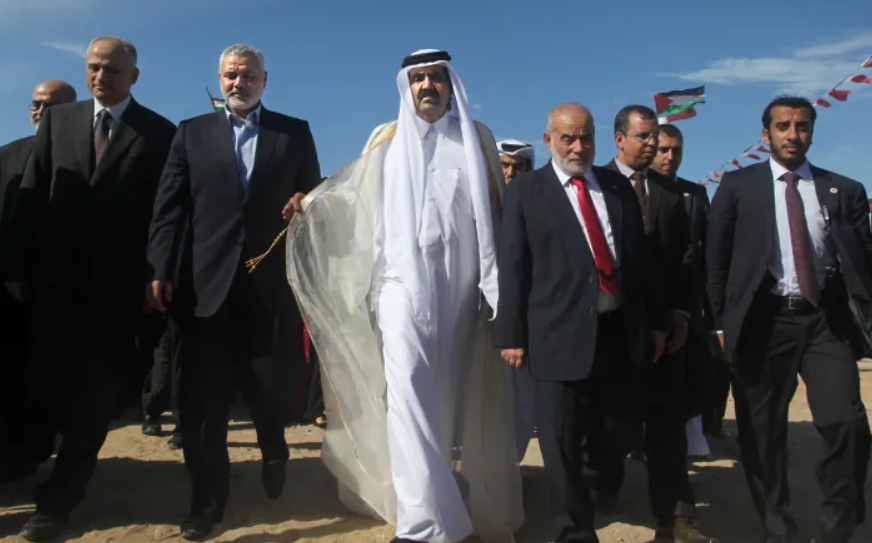
DOHA, Qatar — The passing of Qatar’s Father Emir, Sheikh Hamad bin Khalifa Al Thani, has prompted an outpouring of tributes from across the Middle East, with many remembering him as one of the strongest advocates for the Palestinian people and a leader whose actions reshaped regional diplomacy. Among the many milestones of his leadership, one moment stands above the rest in the eyes of Palestinians: his historic 2012 visit to the Gaza Strip, making him the first Arab head of state to enter the territory after the Israeli blockade was imposed.
For many Palestinians, Sheikh Hamad’s legacy extends far beyond his role as a statesman. He is remembered as a leader who transformed words of solidarity into concrete action at a time when Gaza faced deep political isolation, economic hardship, and an unprecedented humanitarian crisis. His decision to personally visit the enclave became one of the defining moments of modern Arab diplomacy and remains a powerful symbol of support for the Palestinian cause.
READ MORE ARTICLES
- Mali, Algeria Restore Diplomatic Relations, Ending Yearlong Airspace and Ambassador Dispute
- Leyte’s Energy Paradox Sparks Public Appeal to Malacañang Over High Power Costs
- INDIA: Deadly Kerala Landslide Leaves Three Dead, Five Missing as Rescue Operations Continue
- Malaysia, Thailand Resolve Fisheries Dispute, Strengthen Trade and Border Cooperation Together
- Thai Police Bust Birth Registration Syndicate Granting Citizenship Through Fake Fathers
- Kerala Landslide Tragedy Exposes India’s Growing Climate and Infrastructure Crisis
- China Landslide Death Toll Reaches 21 After Deadly Gansu Mountain Collapse
In October 2012, six years after Israel imposed a strict blockade on the Gaza Strip following the 2006 Palestinian elections, Sheikh Hamad undertook a visit that many regional observers considered politically bold and diplomatically unprecedented. Accompanied by his wife, Sheikha Moza bint Nasser, along with senior Qatari officials, the emir entered Gaza despite the political sensitivities surrounding the territory.
His arrival was met with an extraordinary reception. Thousands of Palestinians lined the streets to welcome the Qatari leader, viewing his presence as a rare demonstration of solidarity during one of the most challenging periods in Gaza’s history. The visit effectively challenged the political isolation that had surrounded the enclave and sent a powerful message that the Palestinian people had not been forgotten.
Beyond its symbolic significance, the visit produced tangible benefits for Gaza’s residents. During the trip, Sheikh Hamad announced that Qatar would increase its reconstruction assistance from $254 million to $400 million, funding major housing developments, road networks, healthcare facilities, and infrastructure projects aimed at rebuilding communities affected by years of conflict.
The expanded financial commitment became one of the largest reconstruction initiatives undertaken by an Arab nation in Gaza at the time. Thousands of Palestinian families ultimately benefited from housing projects, improved public infrastructure, and expanded public services made possible through Qatari assistance.
While addressing students and academics at the Islamic University of Gaza>, Sheikh Hamad praised the resilience of the Palestinian people, emphasizing their determination despite years of conflict and hardship. During the ceremony, both he and Sheikha Moza received honorary doctorates in recognition of their humanitarian contributions and support for education and reconstruction efforts in Gaza.
His speech also highlighted concerns over what he described as unequal treatment of the Palestinian issue by the international community. He urged greater global responsibility in addressing humanitarian challenges facing Palestinians while reaffirming Qatar’s commitment to supporting reconstruction and development.
Following news of his passing, numerous Palestinian leaders and commentators reflected on the lasting impact of Sheikh Hamad’s leadership.
Khaled Meshaal, speaking to Al Jazeera, described the late emir as a courageous and principled leader whose historic visit would forever remain etched in Palestinian memory.
According to Meshaal, Sheikh Hamad was “the first Arab and Muslim leader to visit Gaza,” describing the trip as an act that symbolically broke the siege during one of the enclave’s darkest chapters. He praised the former emir as an intelligent, brave, and principled statesman whose commitment extended beyond political rhetoric.
Veteran Arab affairs analyst Ahmed al-Sheikh likewise reflected on Sheikh Hamad’s unique relationship with Palestine, noting that few regional leaders demonstrated the same level of direct engagement.
Al-Sheikh observed that no other Arab leader had undertaken a comparable visit during that period, arguing that Sheikh Hamad acted because he believed Gaza had been abandoned by much of the region. His willingness to visit personally, despite political risks, distinguished him from many of his contemporaries and reinforced Qatar’s growing diplomatic influence.
Throughout his years in office, Sheikh Hamad positioned Qatar as an increasingly active regional mediator while expanding the country’s humanitarian assistance across conflict-affected areas. His administration pursued diplomatic engagement with multiple parties across the Middle East, often taking positions that differed from those of larger regional powers.
For Palestinians, however, his 2012 journey to Gaza remains one of the most enduring symbols of that foreign policy. It represented not only diplomatic outreach but also a public demonstration of solidarity with civilians living under blockade, offering both political recognition and substantial humanitarian assistance.
More than a decade after that historic visit, many of the infrastructure projects initiated through Qatar’s reconstruction funding continue to serve communities across the Gaza Strip. The homes, roads, hospitals, and public facilities built under those programs stand as lasting reminders of a visit that many Palestinians regard as a turning point during one of the enclave’s most difficult periods.
As tributes continue following the death of Sheikh Hamad bin Khalifa Al Thani, his legacy is being remembered through the lens of humanitarian leadership, regional diplomacy, and steadfast support for the Palestinian people. For many across Palestine and the wider Arab world, his decision to stand with Gaza during its years of isolation remains one of the defining chapters of his public life, ensuring that his name will continue to be associated with solidarity, courage, and a commitment to helping those facing adversity.
Sheikh Hamad bin Khalifa Al Thani’s Enduring Commitment to Palestine Shaped a Legacy of Solidarity and Regional Leadership
Long before the Gaza Strip became the focus of international humanitarian concern, Qatar’s late Father Emir, Sheikh Hamad bin Khalifa Al Thani, had already established himself as one of the Arab world’s most vocal supporters of the Palestinian cause. His commitment to Palestine was not defined by a single moment or political statement but by decades of consistent engagement, humanitarian advocacy, and diplomatic initiatives that left a lasting mark on the region.
As tributes continue to pour in following his passing, political analysts, historians, and Palestinian leaders have highlighted that Sheikh Hamad’s support for Palestine extended well beyond his widely remembered 2012 visit to the Gaza Strip. His dedication, they note, began years earlier and reflected a deeply held conviction that the Palestinian people deserved dignity, self-determination, and sustained support from the Arab world.
One of the earliest demonstrations of that commitment came in 1999, when Sheikh Hamad became the first Gulf leader to visit the Palestinian territories since 1967. The visit was regarded as a significant diplomatic milestone, occurring during a period of political uncertainty and stalled peace efforts.
During the historic trip, the Qatari leader met with the late Palestinian President Yasser Arafat, reaffirming Qatar’s support for the Palestinian leadership at a time when the peace process faced mounting obstacles. His decision to travel to the Palestinian territories carried considerable political significance, signaling that Qatar intended to play a more active role in regional diplomacy while expressing solidarity with the Palestinian people.
Observers viewed the visit as more than a ceremonial engagement. It underscored Sheikh Hamad’s willingness to engage directly with one of the region’s most complex political issues rather than limiting Qatar’s role to diplomatic statements from afar.
Veteran Arab affairs commentator Ahmed al-Sheikh has described the former emir’s connection to Palestine as deeply personal rather than merely political. According to al-Sheikh, Sheikh Hamad regarded the Palestinian struggle as a matter that touched the broader Arab identity and conscience.
That emotional bond became especially evident during one of the most difficult periods of the Palestinian leadership. When former Israeli Prime Minister Ariel Sharon ordered the siege of Yasser Arafat’s headquarters, known as the Muqata’a, in Ramallah, Sheikh Hamad was said to have been profoundly affected by the developments.
According to al-Sheikh, the Qatari emir expressed his deep sorrow to close aides, saying that the assault felt as though Qatar itself had come under attack. The remark reflected the extent to which he identified with the Palestinian struggle, viewing attacks against Palestinian institutions not simply as political events but as injuries to the broader Arab community.
Sheikh Hamad’s Enduring Legacy in Gaza Lives On Despite the Destruction of War
The late Sheikh Hamad bin Khalifa Al Thani left behind a legacy in Gaza that continues to resonate despite years of conflict and widespread destruction. Long before the world’s attention shifted to the humanitarian crisis in the Palestinian territory, the former Emir of Qatar had already positioned himself as one of the region’s most steadfast supporters of the Palestinian people, often taking positions that differed from those of other Arab leaders.
His unwavering commitment frequently placed him at odds with the prevailing regional consensus, particularly during periods of heightened conflict between Israel and Palestinian factions. One of the most defining moments of his leadership came during Israel’s 2008–2009 military offensive on Gaza, when divisions among members of the Gulf Cooperation Council (GCC) became increasingly evident over how the Arab world should respond.
While several regional governments struggled to agree on a unified approach, Sheikh Hamad pushed for decisive collective action. He called for an emergency Arab summit in Doha, hoping to rally leaders behind immediate humanitarian assistance and reconstruction efforts for Gaza. During the proposed summit, he introduced an ambitious plan that included a $250 million reconstruction fund and the creation of a maritime corridor designed to bypass the blockade and facilitate the delivery of humanitarian aid and essential supplies into the besieged enclave.
However, the emergency summit failed to secure the attendance of enough Arab leaders to form the required quorum. The disappointment was evident as Sheikh Hamad addressed the situation during a live television broadcast. In a moment that would later become symbolic of his frustration over the lack of regional unity, he declared, “God is sufficient for us and He is the best disposer of affairs,” expressing sorrow that political divisions had overshadowed the urgent humanitarian needs of the Palestinian people.
Despite the diplomatic setbacks, Qatar continued investing heavily in Gaza’s recovery and development throughout Sheikh Hamad’s leadership. His administration financed numerous infrastructure projects aimed at improving living conditions for residents living under difficult economic and humanitarian circumstances.
Among the most significant of these initiatives was the construction of Sheikh Hamad City in Khan Younis, one of Gaza’s largest housing developments. Valued at approximately $58 million, the ambitious public housing project consisted of 53 modern apartment buildings designed to provide safe and affordable homes for thousands of low-income Palestinian families. The project became a symbol of hope and resilience for residents seeking stability after repeated cycles of conflict.
Qatar also funded the rehabilitation of several key highways and transportation networks across the Gaza Strip, improving connectivity between communities and facilitating the movement of people, goods, and humanitarian assistance. These investments represented one of the largest foreign-funded reconstruction programs in Gaza during that period.
Another lasting contribution was the establishment of the Sheikh Hamad Hospital for Rehabilitation and Prosthetics, which officially opened its doors in April 2019. The specialized medical facility quickly became Gaza’s leading center for rehabilitation services, particularly for amputees injured during conflicts and for children suffering from hearing impairments. Equipped with advanced medical technology, the hospital provided treatments that were previously difficult or impossible to access within the territory.
The outbreak of the latest Israel-Gaza war in October 2023 brought unprecedented devastation across the enclave, severely impacting much of the infrastructure that Qatar had helped build under Sheikh Hamad’s vision. Entire residential neighborhoods, roads, public facilities, and development projects suffered extensive damage or were completely destroyed amid months of intense military operations.
Satellite imagery released in May reportedly showed that Hamad City and several surrounding areas in southern Gaza had sustained catastrophic destruction, with many buildings reduced to rubble. The images underscored the enormous humanitarian cost of the conflict and highlighted the scale of reconstruction that would eventually be required.
Yet amid the destruction, the Sheikh Hamad Hospital has continued to serve as one of Gaza’s most vital healthcare institutions. Despite direct attacks, chronic shortages of medicines and medical supplies, repeated power outages, and the broader collapse of Gaza’s healthcare infrastructure, the hospital managed to resume essential operations in December.
Medical staff have continued providing life-saving rehabilitation services under extraordinarily difficult conditions. The hospital currently operates the only functioning CT scanner in northern Gaza, making it indispensable for diagnosing patients suffering from severe injuries and other critical illnesses. Responding to the dramatic rise in casualties, hospital administrators also established a new branch in southern Gaza to accommodate the overwhelming number of patients.
Healthcare officials have reported that amputation cases have increased by approximately 225 percent since the conflict intensified, creating an urgent demand for prosthetic services, physical rehabilitation, and long-term medical care. The Sheikh Hamad Hospital has become a crucial lifeline for thousands of injured civilians facing life-altering disabilities.
For many Palestinians, the continued operation of the hospital stands as one of the most enduring symbols of Sheikh Hamad’s humanitarian vision. While many of the physical structures financed by Qatar have been damaged or destroyed, the institution continues to embody the values of compassion, resilience, and solidarity that defined the former emir’s approach toward Gaza.
His investments were not limited to buildings and infrastructure alone but reflected a broader commitment to supporting the welfare and dignity of Palestinian civilians during some of the most difficult periods in their history.
Years after leaving office and following his passing, Sheikh Hamad’s contributions remain deeply embedded in Gaza’s collective memory. Although war has erased many of the landmarks associated with his leadership, the lives improved through housing, healthcare, and reconstruction projects continue to reflect the lasting impact of his policies.
As Gaza faces the enormous challenge of rebuilding once again, many of Sheikh Hamad’s initiatives remain enduring reminders that humanitarian assistance and long-term development can leave a legacy that survives even the devastation of war. His commitment to supporting the Palestinian people continues to be remembered by many as one of the defining aspects of his leadership, ensuring that his legacy in Gaza will be recognized for generations to come.