
U.S. Senate election will take place on Tuesday, November 3, 2026. Voters will weigh in on 35 Senate seats in total: this includes 33 regularly scheduled Class 2 seats, plus two special elections in Ohio and Oklahoma to fill remaining terms for vacant seats.
Control of the Senate is expected to be closely contested, with the outcome likely decided by competitive races in key swing states. Top battlegrounds to watch include Georgia, North Carolina, and Michigan — states where recent elections have been decided by narrow margins and where party support is nearly evenly split. Results in these races will be critical in determining which political party holds the majority and sets the Senate’s legislative agenda. State-level primary contests will be held between March and September 2026. Each state sets its own date to select party nominees who will advance to the general election ballot.
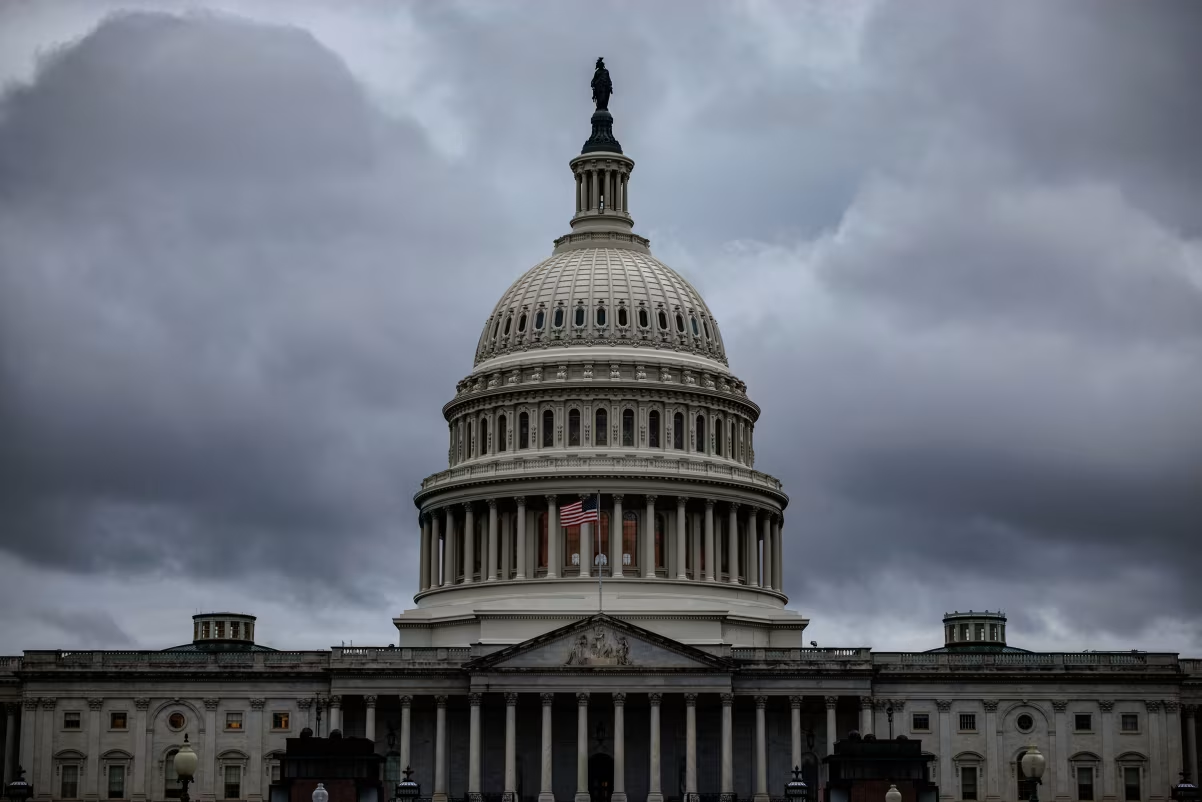
USA Election — As we barrel toward a crowded primary season, the fight for control of the U.S. Senate is shifting from abstract speculation to raw, high-stakes combat and the contours of this battle reveal a political environment far more volatile than either party would like. What we are witnessing now is not just a contest for 51 seats, but a test of whether the Republican Party can defend its majority amid deepening public discontent, economic strain, and a foreign policy crisis that is weighing heavily on every ballot box in the country.
The clearest sign of how seriously the GOP views the threat came this week, when the Senate Leadership Fund (SLF)—aligned closely with Senate Majority Leader John Thune unveiled a staggering $342 million investment across eight key states. This is not just a large number; it is a declaration of vulnerability. Of that sum, $236 million is earmarked simply to defend seats the party already holds: Ohio, North Carolina, Maine, Iowa, and Alaska. Only $106 million is targeted at going on offense against Democratic-held seats in Michigan, Georgia, and New Hampshire. When a majority party spends more than twice as much protecting its own turf as it does trying to expand its map, it is admitting that the political wind is blowing against it.
READ MORE ARTICLES:
- Donald Trump & Xi Jinping Shake Hands as World Holds Its Breath: “We Don’t Need Another War,” Says Trump
- Cole Allen, Suspect in Alleged Donald Trump Assassination Attempt at Washington Gala, Agrees to Remain in Custody
- Trump Cancels Envoys’ Pakistan Trip for Iran Peace Mission as Israel Escalates Lebanon Strikes Amid Stalled Talks
- Donald Trump Calls Nominee Dr. Erica Schwartz a “STAR” as She’s Tapped for CDC Chief
Equally telling is what was left off that list: Texas. The absence of funding for the Lone Star State is not an oversight it is a reflection of chaos. The bitter, divisive primary between incumbent Senator John Cornyn and firebrand Attorney General Ken Paxton has turned what should be a safe Republican stronghold into a potential liability. It exposes a deep internal rift within the GOP: between establishment figures focused on governance and electability, and the MAGA wing driven by loyalty and ideological purity. With pro-Trump super PAC MAGA Inc. sitting on over $300 million more than enough to reshape races anywhere the risk of outside interference and further division is higher than ever. Money alone won’t fix a fractured party, and the Texas mess proves that.
Democrats, naturally, are framing this massive spending plan as a sign of panic. “This announcement is a sign Republicans are nervous, plain and simple,” said Senate Majority PAC spokesperson Lauren French. And looking at the broader landscape, it is easy to see why. While the GOP boasts massive war chests, their political capital is draining fast. Two dominant issues are defining the 2026 election and both are working against them: the war with Iran and the economy.
A recent CNN poll tells the story in stark numbers: 66% of Americans disapprove of the ongoing conflict, and barely one-third believe President Trump has a clear strategy to manage it. Meanwhile, approval of his handling of the economy has crashed to just 31%—a career low. These aren’t just bad numbers; they are electoral poison. Voters already anxious about global instability are now feeling the pain at the pump, with average gas prices surging to $4.16 per gallon a nearly 40% jump since the war began. Even the GOP’s strongest talking point tax cuts from the administration’s signature legislation is struggling to cut through, overshadowed by rising costs and uncertainty. When voters are worried about paying for groceries or filling their tanks, a larger tax refund matters less than the day-to-day reality of their bills.
Yet, let’s not mistake Republican trouble for inevitable Democratic victory. The current landscape gives Democrats an undeniable edge: registered voters prefer their candidates by a six-point margin, and recent special election wins have fueled optimism. But the math remains brutally hard. To take the majority, Democrats must flip four seats a task that requires winning in states that lean red or have deep Republican roots. The map is their biggest obstacle; they have to win in places where voters still lean conservative on cultural and legal issues, even if they are unhappy with the current direction of the country.
Furthermore, while Americans are deeply unhappy with the GOP, they hold negative views of both parties. This is not an election where voters are rushing to embrace one side; it is an election where they are desperate to reject the one currently in charge. That creates a volatile, unpredictable environment where turnout, messaging, and the quality of candidates will determine everything.
As the primaries heat up in Georgia, Maine, Michigan, and beyond, the real story isn’t just how much money is being spent it’s whether the Republican Party can unite behind candidates who can appeal to swing voters, and whether Democrats can turn widespread dissatisfaction into durable support in states where they historically struggle. With the shadow of war lengthening and economic anxiety rising, every ad bought, every debate held, and every vote cast between now and November will matter more than ever. The Senate majority is up for grabs but right now, the GOP is playing defense, and the political ground is shifting beneath their feet.
Maine’s Brutal Primary Will Decide Democrats’ Best Shot at Senate Control
Of all the Senate battlegrounds unfolding across the country, nowhere is the contrast between ideology, electability, and political strategy sharper than in Maine. What was once seen as a straightforward opportunity for Democrats to unseat long-serving Republican Senator Susan Collins has transformed into one of the cycle’s most bitter and consequential primaries a fight that will likely determine whether the party can actually flip this seat and move closer to a Senate majority. The choice facing Democratic voters here is not just between two candidates; it is a choice between two very different theories of how to win in a polarized era.
On one side stands Governor Janet Mills, the establishment favorite backed by Senate Minority Leader Chuck Schumer and the traditional Democratic apparatus. Her strategy is clear and uncompromising: define her opponent as too flawed and too risky to run against Collins, betting that moderate and female voters in particular will reject Graham Platner based on his past. Her campaign has launched a barrage of ads highlighting Platner’s history of controversial online comments most notably remarks downplaying sexual assault in the military framing them not just as mistakes, but as disqualifying character failures. Mills is gambling that in a state that prizes decency and pragmatism, experience and a clean public record will outweigh ideological enthusiasm.
On the other side is Graham Platner: an oyster farmer, military veteran, and progressive insurgent endorsed by Senator Elizabeth Warren. Platner represents the energy of the party’s left wing, and his numbers so far have been formidable. He held a massive 30-point lead in a February poll, outraised the governor by nearly $2 million in the last quarter of 2025, and perhaps most importantly, he polls significantly better against Collins than Mills does leading the incumbent by 11 points in hypothetical matchups, whereas Mills trails within the margin of error. Platner’s defense that voters should judge the person he is today, not the worst thing he said online 14 years ago is a plea for redemption and focus on future policies rather than past words. It is also a challenge to the idea that only conventional politicians can win competitive races.
This divide establishment pragmatism versus progressive populism has split the party and created a chaotic dynamic just two months before ballots are cast. We do not yet know if Mills’ attacks have moved the needle; no independent polling has been released since the ad war began. But the stakes could not be higher, and Republicans are already acting as if they know exactly which outcome they prefer.
The GOP has made no secret of the fact that they view Mills as the safer opponent. To protect Collins—widely regarded as the most vulnerable Republican incumbent this cycle—groups aligned with Senate Majority Leader John Thune are pouring historic sums into the state. One Nation has already spent $17 million boosting Collins, framing her as a bipartisan fighter for healthcare research, while the Senate Leadership Fund has reserved another $42 million for the general election. The message is unambiguous: if Platner wins, Republicans plan to unleash a firestorm of negative advertising attempting to paint him as an extreme radical. If Mills wins, they will run a race about experience and stability, betting they can hold the center ground.
Democrats are right to believe Maine is fertile territory. It has voted Democratic in every presidential election since 1992, and the national environment marked by economic anxiety and discontent with the status quo—strongly favors challengers. But history also shows Susan Collins is a survivor, skilled at positioning herself above partisan fights and appealing to independent voters. She cannot be beaten with a campaign that is merely “good enough”; she needs a candidate who can consolidate the base and win over swing voters, while resisting millions of dollars of incoming attacks.
That is the heart of the dilemma here. Mills argues Platner carries too much baggage to survive the GOP’s inevitable onslaught. Platner argues he is the only candidate with the momentum and populist appeal to actually defeat Collins, pointing to his stronger polling numbers and grassroots fundraising. Both sides have a point, and neither can afford to be wrong.
When Maine Democrats head to the polls in June, they will be deciding far more than just their nominee. They will be deciding whether their best chance to take back the Senate lies in a tested, moderate leader, or in a bold outsider who captures the energy of the party’s base. For Democrats nationwide, there may be no primary result more important than the one coming out of Maine.
Michigan’s Senate Race – A Three-Way Fight That Could Shape the Majority
Michigan has emerged as perhaps the most critical battleground of the 2026 Senate cycle, and for good reason. With the seat left open by retiring Democratic Senator Gary Peters, Republicans see their clearest path to expanding their majority right here. The Senate Leadership Fund has reserved a staggering $45 million for this state alone, marking the single largest investment the GOP super PAC has committed to any offensive opportunity this year. This number sends a clear message. Republicans believe they can win Michigan, and they are prepared to spend whatever it takes to make it happen. Standing in their way is a fiercely competitive three-way Democratic primary that is exposing deep fractures within the party, fractures that could determine whether the seat stays blue or turns red in November.
The contest features Abdul El-Sayed, state Senator Mallory McMorrow, and U.S. Representative Haley Stevens. Each candidate represents a different lane within the Democratic Party, and the endorsements they have earned tell the story of the party’s internal divide. McMorrow, backed by progressive leader Elizabeth Warren, is running as a champion of working families and social justice, raising over $3 million in the first quarter to prove her broad support. Stevens, endorsed by moderate Senator Catherine Cortez Masto, positions herself as the pragmatic choice best suited to win over swing voters. El-Sayed, a progressive activist and former health official, brings strong grassroots energy and raised an impressive $2.25 million in the same period. The race is so fluid and so close that even at high-profile events like the Detroit Tigers’ Opening Day, all three candidates were side by side, fighting for every handshake and every vote.
Yet, policy differences are not the only factor defining this race. The campaign has become a battleground over one of the most volatile issues in American politics: U.S. policy toward Israel and the conflict in the Middle East. Michigan is a state where these issues carry unique weight. The 2024 election revealed deep divisions here, particularly among Arab American, Muslim, and younger voters who have grown increasingly critical of U.S. support for Israel’s military actions. El-Sayed has leaned heavily into this energy, recently holding a rally with Hasan Piker, a popular left-wing streamer with millions of followers.
This single decision has ignited a firestorm. Piker has a long history of extreme and controversial statements. He once said America deserved the September 11 attacks, described Hamas as far superior to Israel, and argued that reports of sexual violence by Hamas fighters on October 7 did not matter to his view of the conflict. He has repeatedly labeled Israel’s military campaign in Gaza a genocide. When pressed to reject these views, El-Sayed refused. He framed the criticism as political theater. “I’m not here to disavow people’s views,” El-Sayed said. “This whole gotcha game, platform policing, cancel culture – I thought we were over it.”
That stance has alarmed critics within his own party, including McMorrow and Stevens, who have both spoken out against Piker’s rhetoric. Centrist groups like Third Way are demanding clear answers, arguing that associating with figures who promote antisemitic or hateful views is dangerous and unacceptable. Republicans are watching this unfold with delight. They know that views like Piker’s are deeply unpopular with the broader general election electorate. They are already mapping out a general election strategy that paints the Democratic Party as extreme, divided, and out of step with mainstream values. If El-Sayed becomes the nominee, the GOP will spend millions tying him directly to those controversial statements and the figures who make them.
Still, Democrats have powerful weapons of their own. Their likely Republican opponent is Mike Rogers, a former congressman who lost this same Senate race in 2024. Rogers is trying to mount a comeback, but recent comments have given Democrats exactly the ammunition they need to define him as out of touch. In a recently leaked audio clip, Rogers dismissed concerns about rising energy prices driven by the war with Iran. “We’re gonna be fine, we got plenty of oil,” he said.
To voters in Michigan, these words sound completely disconnected from reality. Gas prices have surged nearly 40% since the conflict began, hitting $4.16 per gallon statewide. Meanwhile, tariffs and global instability are putting immense pressure on the auto industry, the backbone of Michigan’s economy. Families here are paying more at the pump and worrying about factory jobs. Rogers’ casual dismissal of their struggles is a gift to his opponents. Democrats are already hammering home the message that Rogers does not understand or care about the economic pain people are feeling right now.
This race is a test. It tests whether Democrats can unite behind a nominee who can satisfy the party’s energized progressive wing while also appealing to the independent voters who decide elections in the suburbs and rural areas. It tests whether the GOP can finally close the deal in a state that has trended blue in federal elections, or whether their candidates remain too tied to national priorities that do not match local needs.
With the primary not until early August, the fight is far from over. The choice Democrats make this summer will have national consequences. If they nominate a candidate weighed down by divisive associations, they risk handing Republicans the majority on a silver platter. If they unite around a candidate who can effectively contrast their vision with Rogers’ perceived indifference, they hold one of the best chances in the country to hold the line. Michigan is ground zero, and every move between now and November will be watched closely by the entire nation.
Georgia’s Senate Race – Ossoff’s Strength and the GOP’s Chaotic Search for a Challenger
Georgia stands out as the most critical defensive line for Senate Democrats this cycle. Incumbent Jon Ossoff holds a unique position as the only Democrat seeking reelection in a state that voted for Donald Trump in 2024. For Republicans, this seat represents their single best opportunity to go on offense and shrink the Democratic path to a majority. Yet despite the favorable map on paper, the party faces a growing crisis of unity and strategy that threatens to turn a prime pickup opportunity into a lost cause.
National Republicans have made their intentions clear. The Senate Leadership Fund has reserved 44 million dollars specifically to flip this seat, treating Georgia as a top priority. However, private assessments from party strategists reveal deep unease. Many now view Michigan as a more realistic target, simply because the chaos there is happening within the Democratic primary. In Georgia, the chaos is entirely their own. The race to face Ossoff has devolved into a three-way scramble involving Representatives Mike Collins and Buddy Carter, along with former college football coach Derek Dooley. Dooley carries the endorsement of outgoing Governor Brian Kemp, a popular figure whose decision to stay out of the race left the GOP searching for a standard bearer.
Worst of all for Republican hopes, there is no clear frontrunner. President Trump has so far refused to weigh in. His endorsement remains the single most powerful tool available to unify the party, but his silence allows the infighting to continue and damage the eventual nominee before the general election even begins. Every day spent fighting among themselves is a day Jon Ossoff gets stronger and richer in resources.
The contrast in readiness could not be starker. Ossoff has built a political operation that is the envy of Democrats nationwide. He raised 12 million dollars in the final quarter of 2025 alone and currently holds more than 25 million dollars in cash reserves. That is five times the amount held by Buddy Carter, who leads the Republican field in fundraising. Carter admits to Ossoff’s skill, calling him articulate and sharp, but argues that the senator is out of step with Georgia values. Still, money is the fuel of modern campaigns, and Ossoff’s massive war chest allows him to define the race on his own terms while his opponents remain broke and divided.
Republicans are desperate for any opening to change the narrative. Recently, the long delays and security line issues at Atlanta’s Hartsfield-Jackson International Airport became their newest weapon. Caused by the congressional stalemate over Department of Homeland Security funding, the chaos at the airport affects thousands of voters daily. GOP groups have launched ads blaming Ossoff and Senate Democrats for the gridlock, trying to tie the inconvenience directly to the incumbent. It is a classic attack strategy, taking a visible frustration and pinning it on the person in power.
This issue may give Republicans a temporary boost, but it cannot fix their fundamental problem. To defeat Ossoff, they need a candidate who can unite both the Trump base and suburban voters in the Atlanta area. They need someone who can match Ossoff’s discipline and communication skills. Right now, they do not have that person. The primary remains wide open, the field remains fractured, and the clock is ticking. Ossoff is sitting comfortably with a massive bank account and the advantages of incumbency, while Republicans are still searching for someone capable of taking him down. If they do not resolve this mess soon, Georgia will slip from a prime opportunity into another painful disappointment.
Texas GOP’s Civil War Risks Throwing Away a Safe Senate Seat
The Republican battle for Texas’s Senate seat has evolved from a standard primary contest into a bitter, costly fight that threatens to upend the state’s political status quo. The showdown between incumbent Senator John Cornyn and former state Attorney General Ken Paxton is now the most expensive Senate primary in American history, and it is only getting uglier. What should have been a routine defense of a reliably red seat has turned into a seven-week bloodletting, with no end in sight and no clear resolution in view.
The most striking element of this race is the silence of the one person who could end it instantly. Former President Donald Trump initially signaled he would choose a side quickly, yet he has remained on the sidelines even as the May 26 runoff deadline approaches. The candidate withdrawal date has passed, meaning this fight is locked in and will continue to drain resources and divide the party right up until early summer. Trump’s hesitation speaks volumes. He likely sees risks in backing either man. Supporting Cornyn alienates the MAGA loyalists who stand firmly behind Paxton. Endorsing Paxton, meanwhile, means embracing a figure with a long and controversial legal history, something that could hurt the party’s broader image in swing suburbs.
The numbers tell a story of a race that is essentially a tie. In the March primary, Cornyn took 42% while Paxton followed closely at 40.5%. No new public polling has emerged since then, leaving both campaigns to claim momentum. What we do know is that Cornyn is dominating the money race. He raised nearly $9 million in the first quarter of 2026, including $3.4 million immediately after the primary, and he enters the runoff with over $8 million in cash reserves. Paxton has yet to release his latest figures, a silence that often signals financial struggles or reliance on outside groups rather than direct fundraising.
Policy and politics have merged in their attacks, with both men fighting to prove who is the truest ally of the former president. The central point of debate has been the SAVE America Act, a strict voter ID bill favored by Trump. Paxton attempts to frame Cornyn as insufficiently loyal, pointing to his absence from a recent CPAC event in Grapevine and positioning himself as the only candidate truly aligned with the MAGA movement. Paxton met personally with Trump at Mar-a-Lago last month, a meeting he uses constantly to imply he holds the president’s favor.
Cornyn and his allies are taking a different approach entirely. They are not trying to outflank Paxton on the right. Instead, they are sounding the alarm on electability. Their core argument is simple and damaging: Paxton’s career is defined by scandals, including impeachment and legal troubles, and nominating him would turn a safe Republican seat into a winnable race for Democrats. For decades, Texas has been out of reach for Democratic candidates, but that reality is shifting. This year, they have nominated State Representative James Talarico, a young, energetic candidate who has shown strong appeal to independent voters and growing diverse populations in the state.
Democrats see an opening they have not had in a generation. If Paxton wins the runoff, he carries enough baggage to make suburban Republicans stay home or even vote against their party. If Cornyn wins, he faces the challenge of unifying a base that clearly prefers the more confrontational style of his opponent. The risk is so real that the Senate Leadership Fund intentionally left Texas off its initial $342 million investment list. The group is waiting to see the outcome of this internal war before committing funds, a clear signal that they view the general election viability of the Republican nominee as an open question.
The GOP is playing with fire here. Texas has been the bedrock of Republican power nationally, but changing demographics and voter fatigue are already eroding that advantage. By engaging in a brutal, months-long fight that highlights the party’s internal divisions and questions of character, Republicans are handing Democrats their best opportunity in decades to compete. The winner of the May runoff will carry scars, depleted resources, and a faction of angry voters who backed the loser. Unless the party can quickly reunite after the vote, they may find that the fight for the Senate majority runs straight through Texas—and that they have already lost the advantage before the general election even begins.
North Carolina – A Defining Battle for Senate Control
North Carolina has quickly emerged as the ultimate battleground of the 2026 Senate cycle. The path is now clear following the March 3 primaries where former Democratic Governor Roy Cooper and former Republican National Committee Chair Michael Whatley secured their respective nominations without serious opposition. This sets up a high-stakes contest that both sides view as essential to their hopes of controlling the Senate. With Republican Senator Thom Tillis stepping down, the seat is open for the first time in years. Democrats see this as one of their best opportunities to flip a seat, while Republicans are determined to hold ground in a state they have dominated federally for the last decade.
This race will be defined by money and organization. Both candidates are proven fundraisers with deep connections to the national party machinery. Whatley has already shown financial strength, announcing he raised $5 million in the first quarter of 2026 alone. Outside groups are pouring in resources at a historic scale. The Senate Leadership Fund has reserved $71 million to defend this seat, marking their second largest investment nationwide. Conservative advocacy group Americans for Prosperity has already spent over $5 million to boost Whatley. Cooper, while yet to release his latest figures, is expected to match this pace given his broad popularity and fundraising success during his two terms as governor. The total cost of this campaign is certain to rank among the highest in the country.
The campaign is already turning local events into proxy wars over national policy. The tragic killing of Ukrainian refugee Iryna Zarutska on a Charlotte bus last year has become a central point of conflict. Republicans have seized on the incident to argue that Democratic policies fail to ensure public safety, framing Cooper and his allies as too soft on crime and disorder. This line of attack is designed to tap into voter anxiety about urban safety and law enforcement. Democrats have responded aggressively by targeting Whatley’s associations. They are highlighting his ties to a state GOP official convicted of sexual offenses, trying to paint his circle as morally compromised and unfit for public office. These sharp exchanges show that neither side intends to run a clean or issues-only campaign.
Ideologically, Whatley represents a full embrace of the modern Republican agenda. As the former head of the RNC, he is running as a loyal ally of the Trump administration. He strongly supports the One, Big, Beautiful Bill Act passed last summer and is campaigning heavily on the proposed SAVE America Act. He also emphasizes his work on election integrity measures during his time leading the national party. This strategy aims to energize the conservative base and position him as a reliable partner for the Republican leadership in Washington. He is effectively asking voters to endorse the party’s record over the last two years.
Cooper offers a stark alternative. He enters the race with a unique profile. He won two terms as governor in a state that consistently votes Republican in presidential elections. His success came from positioning himself as a pragmatic, centrist leader capable of working across party lines. He will argue that his style of leadership is exactly what is needed in the Senate to get things done. He plans to run on his record of expanding education funding, improving healthcare access, and managing the state’s economy effectively. His greatest strength lies in his proven ability to win over independent voters and split tickets, a skill that will be decisive in this race.
North Carolina is the perfect reflection of the country’s political divide. It is a state that has voted for every Republican presidential candidate since 2000, yet elected a Democratic governor for eight years. The outcome here will send a powerful signal about the national mood. If Cooper wins, it confirms that the political environment is deeply hostile to the GOP and that voters are seeking change. If Whatley prevails, it proves that the Republican coalition remains strong and that national issues like crime and immigration outweigh local achievements. Every ad, every debate, and every policy debate between now and November will matter. Control of the Senate could very well depend on who wins in North Carolina.
Iowa Primary Puts Democratic Identity to the Test
Iowa’s upcoming June 2 primary is about much more than deciding which Democrat will face Republican Representative Ashley Hinson in November. This contest has become a microcosm of the biggest debate facing the national party right now. It asks a fundamental question. What kind of candidate can actually win in states that have drifted firmly toward the Republican Party? The choice between State Representative Josh Turek and State Senator Zach Wahls offers two very different answers, and the result will send a clear message about how Democrats plan to rebuild their strength across the American heartland.
Josh Turek is running as the pragmatic choice. A two-time Paralympic gold medalist, he positions himself as a moderate and common-sense leader who can appeal to independent voters and rural communities. His profile is unique and compelling. He was born with spina bifida, a condition he links to his father’s exposure to Agent Orange during the Vietnam War. This personal story of sacrifice and service resonates deeply in Iowa. It explains why VoteVets, a group that usually backs military veterans, has invested $825,000 in ads supporting him. They see in Turek the embodiment of public service, even without a uniform. His campaign is endorsed by centrist Senate figures like Tammy Duckworth, Maggie Hassan, and Cortez Masto. These are leaders who have won in tough terrain and believe the path to victory requires meeting voters where they are.
Zach Wahls represents the other wing of the party. He rose to national fame over a decade ago after a powerful speech defending marriage equality went viral. He is a proud progressive backed by Senator Elizabeth Warren. His campaign is built on bold ideas and energizing the base. He argues that Democrats do not win by moving toward the center but by offering a clear, inspiring vision that motivates people to turn out. The fundraising numbers show just how competitive this race truly is. Both candidates raised exactly $1.1 million in the first quarter. However, Wahls holds a structural advantage. He entered this year with nearly twice as much cash on hand as Turek, giving him more resources to sustain his campaign through the final stretch of the primary and beyond.
Whoever emerges victorious will face one of the strongest Republican incumbents in the country. Ashley Hinson is a former television journalist with high name recognition and the full backing of former President Trump. Privately, many Republicans view her as a stronger political asset than retiring Senator Joni Ernst. Her financial dominance tells the whole story. She raised over $3 million in the first quarter alone and now has $6.5 million readily available for her campaign. On top of that, the Senate Leadership Fund plans to pour $29 million into the state to defend this seat. The GOP is treating Iowa as a priority and they are determined to keep it red.
The political map makes their job easier. Trump has carried Iowa comfortably in his three runs for the White House. The state has evolved from a political bellwether into a solidly conservative stronghold. National Democrats admit this is difficult territory. They do not rank it alongside top tier battlegrounds like Alaska or Ohio. Yet, they also insist Iowa could be the sleeper race of 2026. Economic anxiety is rising everywhere. Gas prices have surged and household costs remain high. These issues hit Iowa’s working and middle class families especially hard. If voters channel their frustration toward the party in power, even deep red states become competitive.
This primary will determine if Democrats can capitalize on that frustration. If Turek wins, the party will bet that moderation and personal biography are the keys to flipping seats here. If Wahls wins, they will bet that progressive energy and bold policy are the better strategy. Both sides have credible arguments, but the margin for error is zero. Iowa is not just another state. It is the testing ground for the Democratic Party’s future. The winner must bridge deep internal divides and convince voters that change is necessary. If they fail here, it will be a clear sign that the party still has not found the right formula to win back the Midwest.
Ohio Will Be Democrats’ Toughest Test in the Fight for Senate Control
Ohio stands as the ultimate battleground in the battle for Senate control, and it represents the steepest challenge facing Democrats this cycle. Winning back this seat is essential to their path to the majority, yet the state’s political landscape has shifted decisively to the right during the Trump era. What was once a true swing state now leans reliably Republican in federal contests, giving the GOP a natural advantage from the start. The numbers and the history both suggest Ohio is an uphill climb, but Democrats believe they have found the right candidate to defy the trend.
The scale of the Republican commitment here leaves no doubt about how high the stakes are. The Senate Leadership Fund has reserved a staggering $79 million to defend appointed Senator Jon Husted. This is the largest budget allocated to any single state in the country this year. That investment sends a clear message. Republicans view Ohio as their defensive linchpin, and they are prepared to spend whatever it takes to keep the seat once held by former Vice President JD Vance in their column. They know losing Ohio would mean their majority is effectively gone.
Husted enters the race with significant institutional advantages. His recent appointment to the powerful Senate Appropriations Committee changes the dynamic of his campaign entirely. This role allows him to directly influence federal spending and bring tangible resources back to Ohio voters. He can now campaign not just on policy ideas, but on concrete results and funding secured for local projects. This mirrors the successful playbook used by Senator Susan Collins in Maine. Holding sway over government spending is one of the most powerful tools an incumbent can possess, and Husted will use it to frame himself as a hardworking advocate for his state rather than just another partisan politician.
Democrats are countering with a familiar name and a proven fighter. Former Senator Sherrod Brown is stepping up to run again, just two years after losing his seat in 2024. That defeat was painful, but it came with a silver lining. Brown significantly outperformed the Democratic presidential ticket across the state, proving he retains a unique connection with voters who have abandoned the party at the national level. He has backed up that popularity with financial strength, raising $12.5 million in the first quarter alone and holding $16.5 million in cash on hand. He will have the resources to compete fully with the GOP machine.
The core argument of Brown’s campaign is built on identity and economics. He has spent decades defining himself as the champion of the blue-collar worker, a message that once made him unbeatable in Ohio. Those voters have drifted away from Democrats in recent years, drawn to the Republican Party’s cultural and economic nationalism. Brown’s task is to win them back by reminding them of his record and pointing to current struggles. He is aggressively highlighting the economic fallout from the war with Iran, specifically the sharp rise in gas prices and the pressure it places on family budgets. He aims to frame the election as a choice between a government that works for corporate interests versus one that fights for the worker.
This race will not be decided by independents or wealthy suburbs. It will be decided in the factories, farms, and small towns where working-class voters now hold the balance of power. Husted will argue that Republican policies and his new role on the Appropriations Committee deliver security and investment. Brown will argue that those same policies have left regular people behind while costs skyrocket.
Ohio is the clearest example of the challenge facing both parties in 2026. Republicans must prove their hold on formerly Democratic states is permanent. Democrats must prove they can reconnect with the voters who built their party for generations. If Sherrod Brown can reverse the state’s rightward shift, he will not only win his seat but also provide a blueprint for how Democrats can compete across the industrial Midwest. If Jon Husted prevails, it will confirm that Ohio has solidified its place in the modern Republican coalition. No other race this year carries more weight or tells us more about the future of American politics.
Mary Peltola’s Bid Turns Alaska Into the Senate’s Most Surprising Battleground
Alaska has long been viewed as a Republican stronghold, a state where Democratic candidates typically face steep odds and long electoral odds. That conventional wisdom has been completely upended since former U.S. Rep. Mary Peltola entered the Senate race in January. What once looked like a safe hold for incumbent Republican Sen. Dan Sullivan has transformed into one of the most competitive and closely watched contests in the country. Peltola’s campaign is not just a strong regional effort. It represents a bold test of whether Democrats can expand their electoral map and erode the GOP majority in places where they were previously written off.
Peltola brings a unique profile that makes her arguably the strongest candidate Democrats could have recruited here. She has already proven she can win statewide office, securing a historic victory in the 2022 special election and then winning a full term later that year. Even in a difficult national environment for her party in 2024, she lost her reelection bid by less than 3 points. That performance stood out sharply when compared to Kamala Harris, who lost Alaska by 13 points in the presidential race. Peltola does not just carry the Democratic label. She has shown an ability to attract independent voters and cross-party support, a skill essential to winning in a state where party loyalty is often secondary to local identity and priorities.
The energy surrounding her candidacy is undeniable. Her campaign raised over $1.5 million in the first 24 hours after she announced her run, a staggering sum for a state with a relatively small population and media market. National figures are lining up behind her as well. Rep. Alexandria Ocasio-Cortez, a leading progressive voice, has actively helped raise funds, signaling that Peltola has become a national priority for Democrats. This enthusiasm is visible in the spending race too. Outside groups have already poured $6 million into advertising here, with Democratic-aligned groups holding a roughly two-to-one advantage. This level of early investment confirms that allies believe Peltola can win, and they are willing to spend heavily to make it happen.
Senator Dan Sullivan clearly feels the pressure. For years, he has been viewed as a secure incumbent, but this cycle has forced him to play defense. The central line of attack against him centers on his vote for President Trump’s sweeping domestic policy bill last year. Democrats have aggressively argued that the law includes deep cuts to health care programs, framing Sullivan as someone who put partisan priorities above the needs of Alaskans. This message resonates deeply in a vast state where access to medical services is already a major challenge, especially in remote rural communities.
Republicans are responding with a coordinated effort to reframe that narrative. A new group called Last Frontier Action launched ads last month defending Sullivan’s record. They highlight his role in securing the $50 billion Rural Health Transformation Program included in that same legislation, casting him as a champion for improved medical access rather than a threat to it. The Senate Leadership Fund is also committing $15 million to support his campaign, a massive investment intended to stabilize his standing and counter Peltola’s momentum.
This race is about much more than just two candidates. It is a clash over what kind of representation Alaska wants in Washington. Sullivan leans on his record of delivering federal funds and his alignment with GOP leadership. Peltola runs as an independent-minded leader who has outperformed her party’s top of the ticket and understands the unique challenges of life in the Last Frontier.
If Peltola wins in November, the ripple effects will be felt across the country. It would prove that the Democratic path to the Senate majority runs not only through swing states like Michigan and Pennsylvania, but also deep into traditionally red territory. For Republicans, holding this seat is now essential. Losing it would make their path to retaining control significantly harder. Alaska is no longer a footnote in the national election story. It is now ground zero for the fight for the Senate.
A Crucial Test of Brand and Legacy in the Fight for Senate Control
The retirement of Senator Jeanne Shaheen has created one of the most significant opportunities and risks in the entire 2026 Senate map. For Democrats, her departure removes a proven vote winner from the field but also opens the door for a fresh face to carry their standard. For Republicans, it represents perhaps their best chance to reclaim a seat in a state that has steadily drifted toward the Democratic column over the last two decades. What happens in New Hampshire will offer a clear indication of whether political legacy and moderate appeal can overcome a national environment that currently favors the opposition party.
Democrats enter this race with a high degree of confidence, and their optimism is rooted in hard trends. New Hampshire has voted Democratic in every presidential election since 2004. The state’s electorate prizes pragmatism and consistency, values that have kept it reliably blue at the federal level in recent years. Their chosen candidate, U.S. Representative Chris Pappas, fits the profile perfectly. He has built a strong record in the House, understands the unique temperament of New Hampshire voters, and has already proven he can win competitive races. With the overall political climate marked by voter dissatisfaction with the status quo and economic uncertainty, party strategists believe Pappas is ideally positioned to hold this seat.
This confidence is visible in the level of support Pappas is attracting from national figures. High-profile Democrats are flocking to the Granite State to stand by him, turning this Senate contest into an early testing ground for future presidential ambitions. Former Transportation Secretary Pete Buttigieg and Arizona Senator Mark Kelly have already campaigned alongside Pappas. Their presence does more than raise money or visibility. It frames this race as a battle for the soul of the party’s moderate wing and signals that New Hampshire remains a top national priority. Democrats are not just defending a seat here. They are working to cement a regional advantage.
Republicans know the odds are against them, which explains why they have set their sights on a familiar name. The party’s hopes rest almost entirely on former Senator John E. Sununu. He brings a unique combination of assets that few other candidates could offer. His family name is synonymous with New Hampshire politics. His history of electoral success is well established, and his moderate profile is designed specifically to match the independent streak of the state’s voters. In a year where hardline conservatives are struggling in swing states, Sununu represents the GOP’s best bet to bridge the gap between the party base and the broader electorate.
The path to his nomination is effectively clear despite a September primary against former Massachusetts Senator Scott Brown. The dynamic shifted decisively the moment former President Donald Trump endorsed Sununu. In the current political landscape, that backing serves as a decisive seal of approval, neutralizing potential challengers and uniting the party apparatus behind him. The financial commitment follows the same logic. The Senate Leadership Fund has allocated an initial $17 million to support Sununu, a massive investment that underscores just how badly Republicans want this seat and how seriously they view Sununu as their only viable path to victory.
This race ultimately comes down to a clash of identities. Democrats are banking on the idea that New Hampshire has evolved into a solidly blue state where their message on economic security and stability resonates deeply. They believe Pappas’s track record and alignment with the state’s modern values will be enough to keep the seat. Republicans are betting on the power of legacy and personality. They argue that Sununu’s history, name recognition, and ability to appeal to independents can disrupt the state’s recent voting patterns.
There is a lot more at stake here than just one Senate seat. New Hampshire has long served as an early indicator of national political trends. If Sununu can win, it proves that Republicans can still compete in traditionally blue states by recruiting the right kind of candidate. If Pappas holds the line, it confirms that the Democratic lean in the Northeast has become structural and difficult to reverse. For both parties, the Granite State is not just another battle. It is a test of whether ideology or identity will define the future of American politics.
Full List of Senate Seats Up for Election in 2026
erified & Updated Full List – Class 2 Senate Seats (2026 Election)
Election Date: November 3, 2026 | Term: Jan 3, 2027 – Jan 3, 2033
| State | Incumbent / Seat Status | Party | Notes |
|---|---|---|---|
| Alabama | Tommy Tuberville | R | Retiring → running for Governor |
| Alaska | Dan Sullivan | R | Running for re-election |
| Arkansas | Tom Cotton | R | Running for re-election |
| Colorado | John Hickenlooper | D | Running for re-election |
| Delaware | Chris Coons | D | Running for re-election |
| Georgia | Jon Ossoff | D | Running for re-election |
| Idaho | Jim Risch | R | Running for re-election |
| Illinois | Dick Durbin | D | Running for re-election |
| Iowa | Joni Ernst | R | Running for re-election |
| Kansas | Roger Marshall | R | Running for re-election |
| Kentucky | Mitch McConnell | R | Retiring |
| Louisiana | Bill Cassidy | R | Running for re-election |
| Maine | Susan Collins | R | Running for re-election |
| Massachusetts | Ed Markey | D | Running for re-election |
| Michigan | Gary Peters | D | Retiring |
| Minnesota | Tina Smith | D | Retiring |
| Mississippi | Cindy Hyde-Smith | R | Running for re-election |
| Montana | Steve Daines | R | Retiring |
| Nebraska | Pete Ricketts | R | Appointed 2025, running for full term (replaced Ben Sasse) |
| New Hampshire | Jeanne Shaheen | D | Retiring |
| New Jersey | Cory Booker | D | Running for re-election |
| New Mexico | Ben Ray Luján | D | Running for re-election |
| North Carolina | Thom Tillis | R | Running for re-election |
| Oklahoma | Markwayne Mullin | R | Correction: your list had Alan Armstrong (incorrect) – elected 2022, running for full term |
| Oregon | Jeff Merkley | D | Running for re-election |
| Rhode Island | Jack Reed | D | Running for re-election |
| South Carolina | Lindsey Graham | R | Running for re-election |
| South Dakota | Mike Rounds | R | Running for re-election |
| Tennessee | Bill Hagerty | R | Running for re-election |
| Texas | John Cornyn | R | Running for re-election |
| Virginia | Mark Warner | D | Running for re-election |
| West Virginia | Shelley Moore Capito | R | Running for re-election |
| Wyoming | Cynthia Lummis | R | Running for re-election |
Total: 33 seats → 20 Republican, 13 Democratic
- All Eyes on Sara Duterte as Senate Launches Explosive Impeachment Trial
- Europe’s Relentless Heatwaves Signal a New Climate Reality
- PH New Curriculum Raises Questions About Teacher Workloads, School Leadership Nationwide
- China Activates Level-IV Emergency Response Ahead of Approaching Typhoon
- Southern China, Typhoon Maysak Forces Evacuations Ahead Of Second Landfall
- LET Room Assignments September 2026 Licensure Exam for Teachers Secondary Level
- MPLE Room Assignments July 2026 Master Plumbers Licensure Exam
- Argentina Beats Cape Verde, Advances to World Cup Quarterfinals
- Ferdinand Marcos Met by Filipino Protesters in Canada, Driven Away from Rally
- THAILAND: 10 Monks Killed, Multiple Injured as 11-Year-Old Boy Drives Truck
- Connecticut Mansion Trail Raises Questions Martin Romualdez Wealth, Linked to Andrew Casiño
- BINI Named Philippine Tourism Ambassadors to Showcase Filipino Culture Worldwide
- DOLE Releases ₱9.88 Million Wages for 1,040 Fisherfolk Beneficiaries
- Kapwa Pulis, Binaril at Napatay ang Opisyal sa Zamboanga Sur
- Police corporal nasawi sa pamamaril sa Zamboanga del Sur
- SC Nagpasya: Ilegal ang PhilHealth Fund Transfer sa Budget Law
- 21,000 Join Visayas Job Fairs for Skills and Careers
- Ombudsman Files Non-Bailable Plunder Case Against Sen. Rodante Marcoleta
- Cebu Schools Tighten Security Amid Shooting Threat Concerns
- PH, Canada Sign Historic Labor Pact for OFW Protection