
BEIJING, China — In a world shaken by wars, rising tensions, and economic uncertainty, the meeting between Donald Trump and Xi Jinping in Beijing may become one of the most important political moments in recent history.
After years of bitter tensions between the United States and China, both leaders suddenly appeared calm, respectful, and even friendly toward each other. For ordinary people watching around the world, this was more than just politics it was about preventing another global crisis.
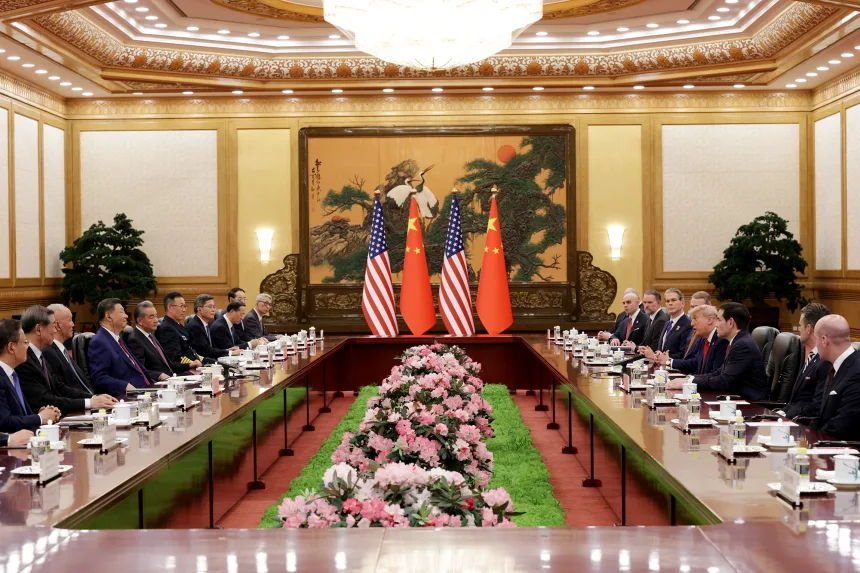
Trump described the talks as “a great moment of respect,” saying the relationship between the two superpowers is now “very strong.” While many expected heated arguments and threats, the meeting instead became a show of diplomacy and power.
But behind the smiles and handshakes, serious issues remain unresolved.
The biggest concern is Taiwan the self-ruled island China considers part of its territory. China has repeatedly warned the US against sending weapons to Taiwan. Trump revealed that he and Xi discussed Taiwan and American arms sales “in great detail.”
Then came Trump’s strongest statement: “I think the last thing we need right now is a war that’s 9,500 miles away.”
READ MORE ARTICLES:
- Cole Allen, Suspect in Alleged Donald Trump Assassination Attempt at Washington Gala, Agrees to Remain in Custody
- Trump Cancels Envoys’ Pakistan Trip for Iran Peace Mission as Israel Escalates Lebanon Strikes Amid Stalled Talks
- Donald Trump Calls Nominee Dr. Erica Schwartz a “STAR” as She’s Tapped for CDC Chief
- Justin Fairfax Former Virginia Lt. Governor, Dies in Apparent Murder-Suicide That Killed Wife Dr. Cerina Fairfax
- US Commander Claims Sea Blockade Halts 90% of Iran’s Economy Amidst Peace Talks
- Donald Trump Turns on Ally PM Giorgia Meloni After Public Clash Over Pope and Iran Policy
- Dave Chappelle Supports Revival of Ohio Radio Station, Preserving Hometown Roots Through Building Restoration
That message was clear and simple for everyday people to understand: America does not want another costly foreign war, especially while the world is already dealing with conflicts in the Middle East and economic instability.
When reporters directly asked Trump if America would defend Taiwan if China attacks, he avoided giving a clear answer. That silence spoke loudly. It signaled that Washington may now be trying to avoid directly provoking Beijing.
For many analysts, China appeared to gain an advantage during the talks. Xi showed confidence and strength, while Trump focused on keeping relations stable instead of escalating tensions. Some experts believe Beijing now sees an opportunity to push its interests further without immediate confrontation from the United States.
At the same time, the ongoing conflict involving Israel and Iran added pressure to the summit. The world economy is already under stress from wars, rising oil prices, and fears of wider instability. Global markets were watching closely to see whether China and the US could at least cooperate enough to prevent the situation from becoming worse.
Despite Trump’s promises of major trade agreements, no concrete details were immediately announced. Big statements were made, but many of the supposed deals remain unclear and unconfirmed by China. Critics say this raises questions about whether the summit produced real results or mainly political optics.
Still, the meeting itself matters.
For nearly a decade, the relationship between Washington and Beijing has been dominated by trade wars, military tensions, technology battles, and harsh rhetoric. The fact that both leaders now publicly speak about “respect” and “strong relations” marks a dramatic shift in tone.
The world today is exhausted from conflict. From Ukraine to the Middle East, people are worried about rising prices, economic uncertainty, and the possibility of wider wars. That is why even a temporary easing of tensions between the world’s two biggest powers is being watched carefully.
Whether this summit truly changes the future or simply delays another confrontation remains uncertain.
How much power does China actually have to influence events in the Middle East — and are they willing to use it?
As tensions continue to rise in the Middle East, many people are now asking an important question: How much power does China really have in the region?
The answer is simple China has massive influence economically and diplomatically, but far less military power compared to the United States.
Unlike America, China does not control the region with military bases or deployed troops. Instead, Beijing uses money, trade, diplomacy, and global influence to protect its interests and shape events behind the scenes.
Today, China is the biggest trading partner for many Middle Eastern countries. It buys huge amounts of oil and gas from nations like Saudi Arabia, Iran, Iraq, and the United Arab Emirates. In fact, more than half of Middle Eastern oil exports go to China.
That gives Beijing enormous leverage. Many countries in the region depend heavily on Chinese markets, investments, infrastructure projects, and business partnerships. When China speaks, leaders listen not because of military threats, but because their economies are closely tied to Beijing.
China has also proven that it can play the role of a diplomatic power broker.
In 2023, Beijing shocked the world by helping restore diplomatic relations between Saudi Arabia and Iran after years of hostility. Many experts believed such an agreement was nearly impossible. Yet China succeeded quietly, without military intervention or public pressure.
That achievement showed the world something important: China can talk to nearly every side in the Middle East.
It maintains relationships with Iran, Saudi Arabia, Syria, Israel, the Palestinians, Turkey, and other regional powers. Few global powers have access to all sides at once.
China also uses its voice internationally. Through the United Nations and global forums, Beijing often calls for ceasefires, negotiations, and peaceful solutions. It presents itself as a defender of stability and a voice for developing nations frustrated with Western dominance.
But despite its growing influence, China still has major limits.
It does not have large military forces stationed across the Middle East. It cannot force countries to stop fighting. It cannot physically enforce peace agreements or stop missile strikes and attacks.
Its power is strong but mostly indirect. China can encourage talks, reduce tensions, and pressure countries economically or diplomatically. However, it cannot single-handedly end wars or impose settlements the way military superpowers sometimes attempt to do.
The bigger question now is whether China is willing to use even more of its influence.
So far, the answer appears to be yes but only carefully and only when it benefits Beijing itself.
China wants stability because instability threatens its economy. Wars disrupt oil supplies, increase energy prices, and damage global trade routes that Beijing depends on. Peace is good for Chinese business and economic growth.
That is why Chinese officials continue calling for ceasefires and dialogue. Beijing is comfortable presenting itself as a “peacemaker” on the world stage because it strengthens China’s global image.
But China also avoids taking major risks. It will not openly side against close partners like Iran. It will not send troops into conflicts. It will not damage its relationships by pressuring allies too aggressively. Most importantly, China does not want to become trapped inside complicated regional wars.
Its priority is not solving every global conflict its priority is protecting Chinese interests.
This became even more noticeable after the recent summit between Donald Trump and Xi Jinping in Beijing.
Trump confirmed that the Middle East conflict was discussed during the talks, but he offered almost no details afterward. No major announcements were made. No concrete peace plan was revealed.
That silence speaks volumes.
It suggests China is likely working quietly behind closed doors, using diplomacy carefully while avoiding dramatic public commitments. Beijing may help encourage calm and support negotiations, but it does not want to fully own the conflict or carry responsibility if peace efforts fail.
The reality is clear: China is willing to help lower tensions but only up to a certain point, and always on its own terms.
For now, Beijing’s strategy remains cautious, calculated, and focused on protecting its growing global influence without becoming directly entangled in war.
Is a “stable” relationship between the US and China good enough for the rest of the world, or do we need them to work together to solve big problems?
After years of rising tensions, trade wars, and dangerous political clashes, the improving relationship between the United States and China is being welcomed around the world. But many experts now say one important truth remains clear: stability alone is not enough.
The world does not just need the two superpowers to stop fighting it needs them to actually cooperate.
For years, the relationship between the US and China looked like a nonstop power struggle. Both sides exchanged threats, raised tariffs, competed economically, and blamed each other for global problems. That conflict created fear across international markets, disrupted businesses, and left smaller countries caught in the middle of the rivalry.
Now, after recent talks between Donald Trump and Xi Jinping, tensions appear to have cooled at least for now.
That alone is already a major relief for the world. When the two largest economies stop escalating conflicts and continue talking peacefully, it lowers the risk of accidental war, helps stabilize global trade, and gives financial markets more confidence. Businesses can plan again, investors feel less nervous, and countries dependent on both powers can breathe easier.
In simple terms, stability prevents chaos. But stability only means the two sides are not openly fighting. It does not mean the world’s biggest problems are being solved.
That is where the real concern begins.
Today’s global crises are simply too large for any one country to fix alone. Wars in the Middle East continue to threaten energy supplies and global security. Climate change is causing stronger disasters, rising temperatures, and food insecurity. Many developing nations are drowning in debt and economic hardship. Global health threats remain a serious risk after the lessons of the pandemic.
None of these problems stop at national borders. And none of them can be solved if the US and China merely avoid conflict while refusing to work side by side.
For example, the global economy depends heavily on both countries agreeing on fair and stable trade policies. If they continue competing aggressively behind closed doors, prices could rise, supply chains could weaken, and ordinary people worldwide would pay the price through inflation and economic uncertainty.
Climate change is another major example. The United States and China are among the world’s largest polluters. If both governments fail to cooperate on reducing emissions and developing cleaner technologies, efforts to slow global warming could collapse. One country acting alone is simply not enough.
The same applies to international conflicts.
Both Washington and Beijing have influence over different parts of the world. If they use that influence together, they can pressure rival groups toward negotiations and reduce the chances of larger wars. But if each side only protects its own interests, peace efforts become weaker and slower.
Many analysts say the current situation can be compared to two drivers on the same road.
For years, both drivers were speeding toward each other dangerously, risking a massive crash that could hurt everyone around them. Today, they appear to have stopped trying to collide. That is important and necessary.
But the road is still full of traffic, obstacles, and dangers. Real progress happens only when both drivers agree to follow common rules, coordinate movements, and help clear the path for everyone else.
That is the challenge now facing the world. The improved tone between Trump and Xi may reduce immediate fears of confrontation, but lasting global stability will require something much deeper than polite diplomacy and temporary calm.
It will require real cooperation. Without it, the world may avoid disaster in the short term while still remaining trapped in long-term crises that continue growing more dangerous every year.
Stability can stop the world from falling apart. But only genuine cooperation between the world’s biggest powers can build a safer and more secure future for everyone.
If the United States refuses to clearly say it will defend Taiwan, does that make war more likely or less likely?
Strategic Ambiguity and Taiwan’s Security: Does a Lack of Clear U.S. Commitment Raise or Lower War Risks?
The question of whether the United States will defend Taiwan in the event of an armed conflict has long been one of the most sensitive and consequential issues in global geopolitics. At the heart of this debate lies a core dilemma, if Washington refuses to make an explicit, public promise to come to Taiwan’s aid, does that choice make war more probable, or less? The answer is not a simple “yes” or “no” it carries two opposing, yet equally plausible, outcomes, rooted in how different actors interpret and respond to U.S. policy.
From one perspective, avoiding a definitive pledge to defend Taiwan can act as a brake on escalation. The United States has long operated under a framework known as “strategic ambiguity”: it has formal diplomatic relations with the People’s Republic of China, while maintaining deep unofficial ties and arms sales to Taiwan. By stopping short of a formal defense guarantee, U.S. leaders have sought to avoid turning Taiwan into a flashpoint that drags the nation into a major military conflict thousands of miles from its shores.
For example, former President Donald Trump once remarked that “the last thing we need right now is a war 9,500 miles away.” Statements like this send a deliberate signal to Beijing that the United States is not eager to intervene in cross-strait tensions. To China’s leadership, such words may be interpreted as a sign of caution and restraint. They suggest that Washington respects China’s core interests and is not seeking to provoke or encircle it. This can reduce immediate friction, giving both sides room to manage disputes through diplomacy rather than force. Supporters of this approach argue that a rigid, public promise to defend Taiwan could create a dangerous trap: if the United States were ever unable or unwilling to follow through, its global credibility would collapse, but if it did intervene, the world could face a direct military clash between two nuclear-armed powers.
On the other hand, critics of strategic ambiguity warn that uncertainty is itself a major danger. For decades, Taiwan’s security has rested heavily on the belief that U.S. support acts as a powerful deterrent. China claims Taiwan as an inseparable part of its territory and has refused to rule out the use of force to achieve reunification. From Beijing’s perspective, any sign of hesitation or wavering from Washington could be misread as weakness or disengagement.
If Chinese leaders come to believe that the United States would stay out of a conflict, they may feel emboldened to increase pressure on Taiwan, whether through military exercises near the island, economic coercion, or more aggressive political actions. History shows that clear, credible commitments often prevent conflict, when adversaries know the cost of an attack will be too high, they are less likely to launch one. Conversely, when intentions are unclear, rivals may be tempted to test boundaries, miscalculate risks, or act on assumptions that turn out to be wrong. For Taiwan, the absence of a firm U.S. promise can also create internal uncertainty, potentially weakening its ability to prepare its defenses or undermining public confidence in its security.
The effect of U.S. ambiguity comes down to how all parties interpret and act upon it. A lack of clear commitment may ease tensions in the short term, by lowering the risk of accidental escalation or provocation. But over time, peace and stability in the Taiwan Strait depend on something deeper: whether both China and Taiwan, as well as the United States, respect the unwritten rules and boundaries that have kept the peace for decades.
Strategic ambiguity is a delicate balancing act. It seeks to avoid war by keeping all options open but it also carries the risk that miscalculation, misinterpretation, or shifting political circumstances could tip the balance toward conflict. As long as the status quo remains in place, the debate will continue: whether clarity or caution offers the surer path to preventing war.
Why is Taiwan such a powerful bargaining chip in US–China relations?
Taiwan is far more than a mountainous island of 23 million people lying roughly 180 kilometers off the coast of mainland China. In the complex, high-stakes relationship between the world’s two largest economies and military powers, it has become one of the most valuable, sensitive, and influential bargaining chips available. Its unique status rooted in history, politics, security, and economics means it sits at the intersection of every major issue dividing Washington and Beijing.
To understand Taiwan’s weight in negotiations, one must first see it through the eyes of China’s leadership and its people. For decades, Beijing has maintained that Taiwan is an inseparable part of its territory, and its reunification with the mainland is framed not just as a political goal, but as a historic mission and a matter of national pride. Losing ground on this issue is seen as unacceptable; any move that suggests Taiwan is gaining formal independence or international recognition is viewed as a direct threat to China’s sovereignty and its standing in the world.
Because the issue carries such deep emotional and historical significance, Taiwan becomes a powerful point of leverage. For China, progress in its relationship with the United States is often tied to how Washington handles Taiwan. Restricting official contacts, limiting arms sales, or refraining from statements that elevate Taiwan’s status are seen as gestures of respect. Conversely, U.S. actions that support Taiwan’s autonomy are treated as provocations, often prompting retaliation in trade, diplomacy, or military posturing. In short, Taiwan is a red line and because it is a red line, it is also a lever.
For the United States, Taiwan’s value comes from two critical areas: security and technology. Geopolitically, the island sits at a key position in the First Island Chain a line of territories that runs from Japan through Taiwan and the Philippines down to Southeast Asia. Controlling or having strong influence over Taiwan allows the United States to monitor and shape activity in the Taiwan Strait and the broader Indo-Pacific region. It is seen as a vital part of U.S. efforts to maintain a balance of power, protect its allies, and ensure freedom of navigation in international waters.
Economically, Taiwan’s importance is even more striking. It is the world’s leading producer of advanced semiconductors the tiny chips that power everything from smartphones and cars to military equipment and artificial intelligence systems. Taiwan’s dominance in this sector means that any disruption across the Taiwan Strait would send shockwaves through global supply chains, affecting businesses, consumers, and economies worldwide. This makes Taiwan not just a security partner, but a core node in the global economy that both Washington and Beijing cannot afford to ignore.
This combination of factors explains why, when leaders like former U.S. President Donald Trump and Chinese President Xi Jinping met, they reportedly discussed Taiwan and U.S. arms sales to the island “in great detail.” Taiwan touches on every part of the bilateral relationship:
- Military strategy: Decisions about arms sales, naval deployments, or joint exercises signal strength or restraint, and can be traded or negotiated to manage tensions.
- Trade and economics: Concessions or agreements in trade talks are often linked to how each side behaves regarding sensitive issues like Taiwan.
- Global influence: Supporting or limiting Taiwan’s international space is a way for both powers to demonstrate which model democratic or authoritarian holds more weight in the world.
Every statement, policy shift, or military move involving Taiwan sends a message. A single speech, a shipment of weapons, or an invitation to an international meeting can move financial markets, strengthen or weaken alliances, or either calm tensions or trigger escalation.
Ultimately, Taiwan is powerful as a bargaining chip because it encapsulates the entire nature of U.S.–China competition. It is about territory, identity, military power, technological leadership, and global order. How Washington and Beijing handle this issue will not only define their own relationship it will shape whether the coming years bring stability or conflict in one of the world’s most critical regions. Taiwan is not just an island; it is the heartbeat of the most important geopolitical relationship of our time.
Iran Conflict Looms Large, but Trump-Xi Summit Yields Little New Momentum
When news broke that U.S. President Donald Trump and Chinese leader Xi Jinping would hold high-level talks, all eyes were on one key issue: Iran. With the threat of war hanging over the Middle East, hopes were high that the meeting could produce a breakthrough. The United States has long wanted China Iran’s top diplomatic partner and largest oil customer to use its influence to steer Tehran toward a deal. Yet after more than two hours of discussion, the outcome is clear: while both sides found areas of common ground, the summit did not move the needle on the conflict. What emerged was a picture of carefully managed expectations, familiar positions, and limited willingness to shift course.
The logic behind U.S. hopes was straightforward. China’s ties with Iran run deep; it buys a large share of Iran’s oil and has positioned itself as a neutral, peace-oriented player throughout the crisis. Washington believed this relationship gave Beijing unique leverage to press Iran to address U.S. concerns. Going into the meeting, the expectation was that China might be persuaded to take a more active role in de-escalation or to encourage Tehran to compromise.
Instead, what followed was a repetition of well-known stances. China has long said it opposes the spread of weapons, supports peace talks, and believes the conflict “should have never happened.” Its Foreign Ministry made that clear again in its post-meeting statement, emphasizing that its position remains “very clear” and unchanged. Xi Jinping reiterated that the Strait of Hormuz the world’s most critical oil chokepoint must remain open, that it should not be militarized, and that no country should charge tolls for passage. These are constructive principles, but they are not new, nor do they amount to new pressure on Iran.
The immediate takeaways from both sides revealed a gap between what was said and what was actually agreed. President Trump told media that Xi had offered to help resolve the conflict and pledged not to supply military equipment to Iran a point consistent with China’s long-stated policy. Yet in the next breath, Secretary of State Marco Rubio noted that the United States had not formally asked for China’s help, framing the conversation more as an exchange of views than a request for action.
Both sides did find common ground on two core points: that Iran must never acquire a nuclear weapon, and that the Strait of Hormuz must remain free and open to all. These are significant areas of alignment, reflecting shared interest in regional stability and global energy security. But they are also baseline positions, not new commitments that will alter the trajectory of the war.
Perhaps the most tangible outcome discussed was in energy trade. With China as the top buyer of Iranian oil, a potential shift is underway: Beijing signaled it could purchase more oil from the United States instead. Such a deal would serve both countries’ economic interests, but its impact on Iran remains ambiguous. It could reduce China’s economic leverage over Tehran, or it could simply rebalance trade flows without changing Beijing’s diplomatic stance. For now, it is an economic arrangement, not a geopolitical strategy aimed at ending the conflict.
The most revealing moment came in Trump’s own assessment. Asked whether Xi would push Iran hard enough to change its behavior, the president acknowledged the limits of Beijing’s role: “He’s not coming in with guns … not coming in shooting.” That admission captures the reality of the relationship. China will not act as an enforcer for U.S. policy, nor will it abandon a long-term ally. It sees itself as a mediator, not a participant in pressure campaigns, and it will not risk its regional standing or its interests to satisfy Washington’s demands.
For its part, China continues to balance its relationships carefully. It backs Iran’s right to peaceful nuclear energy while supporting its commitment not to build weapons. It calls for dialogue while criticizing the conditions that led to the conflict in the first place. Throughout, it frames itself as a consistent, principled advocate for peace a position that resonates globally but offers little of the active intervention the United States was hoping for.
The summit showed that while the United States and China can agree on the dangers of a nuclear-armed Iran or a closed Strait of Hormuz, they remain far apart on how to solve the crisis. China will not pressure Tehran in the way Washington wants, and the United States will not give up its demands. The war still looms, and the risks of escalation remain high.
What the meeting did produce was a reminder of how complex great-power competition is. Even on issues as urgent as Iran, neither side is willing to trade away core interests. The energy talks may move forward, and shared principles may prevent further misunderstanding but for those hoping for a clear path out of the crisis, this summit offered more of the same: stability in the relationship, but little progress toward peace.
Taiwan Stands as the Critical Fault Line in US-China Relations
The meeting between Chinese President Xi Jinping and US President Donald Trump has laid bare a stark reality: while both sides speak of cooperation and stability, the Taiwan issue remains the single greatest threat to peace between the two global powers. Xi’s direct warning during the talks leaves no room for ambiguity Beijing views its claim over the self-governing island as non-negotiable, and it has framed the matter as the ultimate test for the future of US-China ties.
By describing Taiwan as the “most important” issue in the relationship, and explicitly stating that mismanagement could lead to “clashes and even conflicts,” Xi has drawn a clear line in the sand. This language is notably sharper than the optimistic rhetoric about “strategic stability” that China has promoted in recent times. The message is calculated: Beijing is open to improved relations, but only on the condition that Washington respects what it defines as its core interests. For the Chinese government, Taiwan is not merely a regional dispute but a matter of national sovereignty and territorial integrity, with the Communist Party vowing reunification by force if necessary. Its long-standing grievances center on the United States’ deep unofficial ties with Taipei and continued arms sales, policies Beijing sees as direct interference and support for separation.
There had been widespread speculation ahead of the meeting about how Trump might approach the issue whether he might seek to use Taiwan as leverage in trade or geopolitical negotiations, or whether he could be pressed into shifting longstanding US policy. However, US officials, including Senator Marco Rubio, have moved quickly to reassure observers that America’s stance remains consistent. Rubio confirmed that while differences were aired, the United States has not altered its position, emphasizing that any forced change to the current status quo would be unacceptable. Significantly, arms sales often the flashpoint for tensionswere not a central point of contention in this dialogue, suggesting both sides may have sought to avoid immediate escalation.
Still, the underlying friction remains unresolved. The United States adheres to its longstanding policy of strategic ambiguity: it recognizes the One-China principle but also maintains commitments under the Taiwan Relations Act to help the island defend itself. This balancing act has preserved peace for decades, yet Xi’s latest warning underscores that Beijing’s patience is limited and its demands are growing louder.
This meeting has clarified one key point: while dialogue continues, the risk of miscalculation is higher than ever. Taiwan remains a thriving, self-ruling democracy of 23 million people, with its own government, military, and way of life a reality Beijing refuses to acknowledge. For the international community, the message is clear: peace and stability in the Taiwan Strait depend on both sides respecting the status quo. But as Xi’s warning shows, Beijing is increasingly determined to press its claim, making Taiwan the fault line that could determine whether the world’s two largest powers coexist or collide.
Promised Economic Gains: Big Announcements, Big Questions
Following his high-profile trip, President Trump has returned to the United States touting significant economic breakthroughs with China, framing the outcomes as major victories for American farmers, manufacturers, and exporters. From agricultural purchases to large-scale aviation deals, the administration has laid out an ambitious list of commitments, painting a picture of renewed economic partnership and market access. However, a closer look at the details and the notable silence from Beijing reveals that these wins remain, for now, more promise than proven reality.
The headline announcement came from US Trade Representative Jamieson Greer, who stated that China is expected to commit to buying “double-digit billion” worth of US agricultural goods annually over the next three years. If realized, this would represent a substantial boost for American producers, securing long-term demand in a market that has historically been volatile and politically sensitive. Yet, even within this optimistic outlook, there are inconsistencies that raise eyebrows. Treasury Secretary Scott Bessent clarified that soybean purchases long the cornerstone of US farm exports to China are effectively complete under previous agreements, suggesting the new deal may not bring new business for that key sector. This hints that while the total numbers sound impressive, the actual value added for some industries may be more limited or already accounted for in prior arrangements.
Progress was also claimed in the beef industry, where Greer confirmed China had “reupped” export licenses for American facilities. This addresses a major point of tension, as permissions for over 400 US plants had lapsed over the past year, effectively cutting off access. Still, the lack of specificity matters: without knowing exactly how many licenses were renewed or under what conditions, it remains difficult to gauge how quickly or fully US producers will regain their footing in the Chinese market.
Perhaps the most striking claim is the agreement for China to purchase 200 Boeing jets. With the company’s CEO part of the delegation, the symbolism is clear, restoring Chinese demand for American aerospace manufacturing, a sector vital to US employment and industrial strength. Such an order would be significant, but here too, the details remain unconfirmed.
The most important factor holding these announcements back from being concrete achievements is the absence of formal confirmation from Beijing. While US officials have been specific about numbers and sectors, China’s official readout was far more general, calling broadly for expanded cooperation across trade, health, agriculture, and tourism without mentioning specific purchase amounts or contracts. This gap between what Washington says was agreed and what Beijing acknowledges leaves the deals in a gray area.
This pattern where one side declares major progress while the other speaks only of general cooperation has defined US-China trade relations for years. It allows for political wins at home while leaving the actual implementation to be negotiated later. For American industries waiting for relief or growth, the message is clear: the potential is there, but until these agreements are formalized, signed, and acted upon, they remain aspirations rather than guaranteed results. The true test of this trip’s economic legacy will not be the announcements made upon return, but whether the deals actually materialize in the months ahead.
Stagecraft and Diplomacy: How China’s Careful Choreography Won Over Trump
Diplomacy is often as much about performance and perception as it is about policy, and the recent summit between Donald Trump and Xi Jinping stands as a masterclass in how carefully managed optics can shape the narrative of a high-stakes meeting. Trump, a figure forged in the world of reality television, understands better than most leaders the power of a good scene, a warm welcome, and the symbolism of respect. Xi Jinping, seemingly fully aware of how his counterpart operates, played his part perfectly delivering a visit rich in ceremony, courtesy, and exclusivity, and in doing so, securing exactly the impression he wanted: that relations between the world’s two largest powers are stable, respectful, and back on track.
From the moment Trump touched down in Beijing, the choreography was clear. Sending Vice President Han Zheng—Xi’s trusted diplomatic envoy and a witness to Trump’s return to office was not merely protocol; it was a deliberate signal of high regard. For Trump, who views international relations through the lens of how much respect is shown to the United States, this mattered deeply. His comment that being met on the tarmac meant “our country is respected” reveals just how central these gestures are to his assessment of success. That sentiment was amplified the following day with a full ceremonial welcome at the Great Hall of the People: military bands, marching troops, and crowds waving flags. To the casual observer, and certainly to Trump himself, this was not just a meeting it was a state visit, complete with all the honors due a major power.
But the stagecraft went beyond parades and greetings. Throughout the trip, Trump displayed a striking level of restraint and deference that contrasts sharply with his usual public persona. At the Temple of Heaven, where reporters pressed him on sensitive issues like Taiwan, he chose silence over confrontation, offering only pleasantries. Even more notable was the gesture of raising a glass of champagne at the state banquet a small but meaningful act from a man who does not drink, done explicitly to honor his host. These were not random choices; they were signs that the atmosphere created by Beijing had set the tone for how Trump chose to engage.
Perhaps the most powerful symbolic moment came at Zhongnanhai, the secretive leadership compound steeped in centuries of history and power. By inviting Trump into this exclusive space an area rarely opened to foreign leaders and framing it as a reciprocal gesture for his own stay at Mar-a-Lago, Xi blurred the lines between official diplomacy and personal rapport. He wrapped the meeting in history and tradition, subtly positioning the relationship as one between two experienced, powerful leaders who understand each other.
The payoff for Xi’s careful handling was evident in Trump’s own remarks. He described Xi as “all business,” “cool,” and straightforward qualities he explicitly admires. Where other leaders might be criticized as rigid or distant, Xi’s demeanor came across to Trump as strength and seriousness. By creating an environment free of what Trump calls “games,” Xi won his guest’s confidence and praise, regardless of the concrete outcomes still to be confirmed.
This summit proves that in diplomacy, the setting often frames the story. China used every tool at its disposal protocol, history, hospitality, and exclusivity to project an image of stability and partnership. While big questions remain over what was actually agreed upon regarding trade, Taiwan, or security, the immediate narrative has been shaped. Trump left Beijing feeling respected and impressed, and Xi succeeded in showing the world that, for now, the relationship remains on a predictable, stable course. Whether that harmony survives the return to hard geopolitical realities is a question for the future; for now, the stagecraft has carried the day.
- All Eyes on Sara Duterte as Senate Launches Explosive Impeachment Trial
- Europe’s Relentless Heatwaves Signal a New Climate Reality
- PH New Curriculum Raises Questions About Teacher Workloads, School Leadership Nationwide
- China Activates Level-IV Emergency Response Ahead of Approaching Typhoon
- Southern China, Typhoon Maysak Forces Evacuations Ahead Of Second Landfall
- LET Room Assignments September 2026 Licensure Exam for Teachers Secondary Level
- MPLE Room Assignments July 2026 Master Plumbers Licensure Exam
- Argentina Beats Cape Verde, Advances to World Cup Quarterfinals
- Ferdinand Marcos Met by Filipino Protesters in Canada, Driven Away from Rally
- THAILAND: 10 Monks Killed, Multiple Injured as 11-Year-Old Boy Drives Truck
- Connecticut Mansion Trail Raises Questions Martin Romualdez Wealth, Linked to Andrew Casiño
- BINI Named Philippine Tourism Ambassadors to Showcase Filipino Culture Worldwide
- DOLE Releases ₱9.88 Million Wages for 1,040 Fisherfolk Beneficiaries
- Kapwa Pulis, Binaril at Napatay ang Opisyal sa Zamboanga Sur
- Police corporal nasawi sa pamamaril sa Zamboanga del Sur