Mohamed bin Zayed Al Nahyan, widely known by the initials MBZ, is the third President of the United Arab Emirates and the Ruler of Abu Dhabi, positions he officially assumed in 2022 following the death of his brother, Sheikh Khalifa bin Zayed Al Nahyan. Long before formally becoming president, however, Mohamed had already emerged as the country’s principal decision-maker. After Sheikh Khalifa suffered a stroke in 2014, MBZ effectively guided the UAE’s domestic governance, foreign policy, and national security, establishing himself as one of the Middle East’s most influential political leaders.
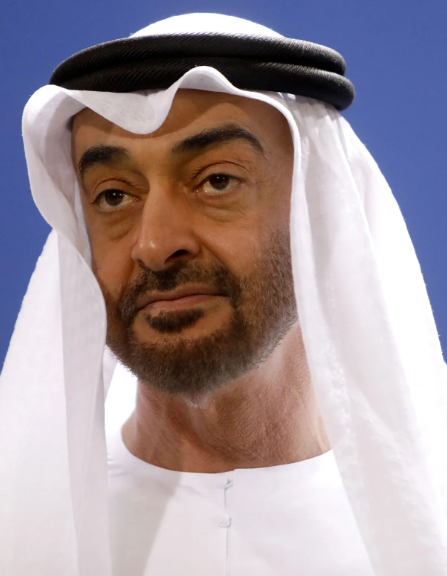
Born on March 11, 1961, Mohamed is the third son of the UAE’s founding president, Sheikh Zayed bin Sultan Al Nahyan. He received his early education in Abu Dhabi and Al Ain before continuing his military training at the prestigious Royal Military Academy Sandhurst in the United Kingdom, graduating in 1979. Upon returning to the UAE, he embarked on a distinguished military career within the UAE Armed Forces, serving in a variety of command positions and later becoming a pilot in the UAE Air Force. His military experience culminated in his promotion to the rank of general in 2005, reinforcing his reputation as a leader with strong defense and security credentials.
Following the passing of Sheikh Zayed in 2004, Mohamed was appointed Crown Prince of Abu Dhabi while his elder brother, Sheikh Khalifa, assumed the presidency of the UAE. Over the following decade, Mohamed steadily expanded his influence within the federation, particularly after Sheikh Khalifa’s health deteriorated. As de facto leader from 2014 onward, he oversaw significant economic modernization, defense reforms, and an increasingly assertive foreign policy that elevated the UAE’s profile on the international stage.
- Hustisya ang Panawagan ng Pamilya ng Grade 4 Student sa Cavite na Pumanaw Matapos ang School Deworming
- Class Suspensions sa Hulyo 13, 2026: Listahan ng mga Lugar na Walang Pasok
- 16-anyos na Estudyante, Nahulihan ng Glock 17 at 32 Bala Bago Pumasok sa Paaralan sa South Cotabato
- Jaz Valdez Natagpuang Patay sa Basey, Samar; Hinihinalang Nasawi sa Aksidente sa Motorsiklo
- Inaasahang Lilikha ng Daan-Daang Libong Trabaho sa Pamamagitan ng AI Industrial Hub sa Ilalim ng Pax Silica Initiative
After Sheikh Khalifa’s death in May 2022, the UAE Supreme Council unanimously selected Mohamed as the nation’s third president and the new ruler of Abu Dhabi. In March 2023, he further consolidated the country’s leadership transition by appointing his eldest son, Sheikh Khalid bin Mohamed bin Zayed Al Nahyan, as Crown Prince of Abu Dhabi, positioning him as the future successor to the emirate’s leadership.
Under Mohamed’s presidency, the UAE has continued pursuing economic diversification beyond oil by investing heavily in technology, renewable energy, finance, infrastructure, artificial intelligence, and advanced industries. His administration has sought to strengthen the country’s position as a global investment hub while expanding diplomatic and economic partnerships across Asia, Europe, Africa, and North America. At the same time, scholars frequently describe the UAE as an authoritarian state characterized by centralized political authority, with significant influence exercised by the federal leadership over national policymaking.
On the international stage, MBZ has earned recognition as one of the Arab world’s most powerful leaders. His influence has been acknowledged by several global publications, including Time magazine, which named him among the world’s 100 most influential people, while The New York Times described him as one of the most powerful rulers in the Arab world. His leadership style has been defined by a focus on national security, regional stability, economic modernization, and strategic diplomacy.
Mohamed has consistently taken a firm stance against Islamist political movements, particularly the Muslim Brotherhood, which the UAE considers a threat to regional stability. He has also maintained a hardline position toward Iran and Tehran-backed armed groups operating throughout the Middle East. During his years as the UAE’s de facto leader, the country participated in the international coalition against the Islamic State (ISIS) in Iraq and Syria, supported various regional security initiatives, and played an active role in several major conflicts, including the Saudi-led intervention in Yemen. Although the UAE later reduced its direct military involvement in Yemen, it continued supporting the Southern Transitional Council while diverging from some aspects of Saudi Arabia’s strategy in the conflict.
The UAE has also been linked to broader regional geopolitical developments under Mohamed’s leadership, including its support for various political and military actors in conflicts across the Middle East and Africa. His administration has maintained a close security partnership with the United States while advocating a tougher approach toward Iran. During Donald Trump’s presidency, MBZ developed a strong working relationship with Washington, particularly on issues involving regional security, counterterrorism, and diplomatic normalization.
One of the defining moments of Mohamed’s foreign policy came in 2020 when the UAE joined Bahrain, Morocco, and Sudan in signing the Abraham Accords, a U.S.-brokered agreement that normalized diplomatic relations with Israel. The accords marked a historic shift in Middle Eastern diplomacy and positioned the UAE as a central player in efforts to reshape regional alliances through economic cooperation, investment, and security partnerships.
Beyond diplomacy and security, Mohamed has overseen an ambitious agenda aimed at transforming the UAE into one of the world’s leading centers for innovation, commerce, tourism, and sustainable development. While his leadership has attracted both praise for advancing economic growth and criticism over political freedoms and governance, there is broad recognition that he has played a pivotal role in shaping the modern UAE and expanding its influence in regional and global affairs.
Family and Early Life of UAE in Sheikh Mohamed bin Zayed Al Nahyan
Sheikh Mohamed bin Zayed Al Nahyan, widely recognized around the world as MBZ, was born on March 11, 1961, at Oasis Hospital in Al Ain, a city that would later become one of the United Arab Emirates’ most historically significant cultural centers. At the time of his birth, the region was still known as the Trucial States, a collection of British-protected sheikhdoms that had yet to unite into the modern UAE. Just a decade later, these emirates would form the United Arab Emirates, fundamentally reshaping the political landscape of the Arabian Gulf.
Mohamed was born into one of the Middle East’s most influential ruling families. He is the third son of Sheikh Zayed bin Sultan Al Nahyan, the visionary leader who founded the United Arab Emirates in 1971 and became its first president. Sheikh Zayed is widely celebrated for transforming a group of small desert emirates into a prosperous and internationally respected federation through his emphasis on national unity, economic modernization, infrastructure development, education, and diplomacy. His legacy has continued to shape the country’s direction long after his passing.
Mohamed’s mother, Sheikha Fatima bint Mubarak Al Ketbi, has also played an extraordinary role in the UAE’s development. Often referred to as the “Mother of the Nation,” she has spent decades championing women’s empowerment, education, social welfare, family development, and humanitarian initiatives. Her influence has extended beyond the royal family, helping advance opportunities for Emirati women while promoting charitable and educational programs across the country.
Growing up under the guidance of both Sheikh Zayed and Sheikha Fatima, Mohamed experienced an upbringing deeply rooted in traditional Emirati values while also being exposed to his father’s vision of building a modern nation capable of engaging with the global community. His childhood was shaped by lessons emphasizing leadership, discipline, public service, national unity, and responsibility toward the welfare of citizens. These principles would later become defining characteristics of his leadership style.
Mohamed belongs to one of the largest royal families in the Gulf region. He has 18 brothers, including Sheikh Khalifa bin Zayed Al Nahyan, who later became the UAE’s second president, along with Sheikh Hamdan, Sheikh Hazza, Sheikh Issa, Sheikh Nahyan, Sheikh Saif, Sheikh Tahnoun, Sheikh Hamed, Sheikh Mansour, Sheikh Falah, Sheikh Theyab, Sheikh Abdullah, Sheikh Omar, Sheikh Khalid, and several brothers who have since passed away, including Sheikh Sultan, Sheikh Saeed, Sheikh Nasser, and Sheikh Ahmed. He also has 11 sisters, making the Al Nahyan family one of the most prominent and influential ruling dynasties in the Arab world.
Among his siblings, Mohamed shares a particularly close bond with his five younger full brothers Sheikh Hamdan, Sheikh Hazza, Sheikh Tahnoun, Sheikh Mansour, and Sheikh Abdullah all born to Sheikha Fatima bint Mubarak. Together they are widely known throughout the UAE as Bani Fatima, meaning “the Sons of Fatima.” The group has long occupied key positions in government, national security, economic development, and public administration, collectively playing a significant role in shaping the country’s modern institutions and strategic policies.
Throughout his formative years, Mohamed witnessed firsthand the rapid transformation of the UAE from a sparsely populated desert federation into one of the world’s fastest-growing economies. As oil revenues fueled unprecedented development, the country invested heavily in infrastructure, healthcare, education, and public services under the leadership of Sheikh Zayed. Living through this historic period gave Mohamed a unique perspective on nation-building and reinforced the importance of long-term planning, political stability, and sustainable development.
His family’s emphasis on public service and national responsibility inspired him to pursue military training at an early age, laying the foundation for a career that would eventually see him rise through the ranks of the UAE Armed Forces before assuming leadership of the nation. The combination of a deeply rooted family legacy, exposure to statecraft from childhood, and close relationships with his influential siblings helped prepare Mohamed for the responsibilities he would later undertake as Crown Prince of Abu Dhabi, de facto leader of the UAE, and ultimately President of the United Arab Emirates.
Today, Sheikh Mohamed bin Zayed’s family background remains central to understanding both his leadership philosophy and the political continuity that has characterized the UAE for decades. His upbringing within the Al Nahyan dynasty, guided by the vision of the nation’s founding generation, continues to influence his approach to governance, economic modernization, regional diplomacy, and national security.
Education and Military Training Shaped Mohamed bin Zayed’s Path to National Leadership
The leadership journey of United Arab Emirates President Sheikh Mohamed bin Zayed Al Nahyan began long before he entered public office, with an education that combined academic learning, military discipline, and personal experiences that would later influence both his domestic governance and international outlook. From his early years in the UAE to elite military training in the United Kingdom, Mohamed’s formative years laid the foundation for the leadership style that has defined his presidency.
Born into the ruling Al Nahyan family, Mohamed spent his childhood attending schools in Al Ain and Abu Dhabi, where he received his primary and secondary education until the age of 18. His upbringing reflected a balance between traditional Emirati values and an increasingly global perspective as the young United Arab Emirates sought to establish itself on the world stage following its formation in 1971.
As part of his early education, Mohamed also spent a summer studying at Gordonstoun School in Scotland, an institution internationally recognized for emphasizing leadership, resilience, physical endurance, and character development. The experience exposed him to a multicultural academic environment and introduced him to educational philosophies that complemented the values instilled by his family.
A significant influence during Mohamed’s youth was the guidance of Egyptian Islamic scholar Izzedine Ibrahim, whom his father, the UAE’s founding president Sheikh Zayed bin Sultan Al Nahyan, entrusted with overseeing part of his education. Ibrahim was widely respected for his scholarship and intellectual contributions, helping shape Mohamed’s understanding of religion, ethics, and public responsibility during his formative years.
Seeking to prepare him for future national service, Sheikh Zayed later encouraged his son to pursue formal military education abroad. Mohamed enrolled at the prestigious Royal Military Academy Sandhurst in the United Kingdom, one of the world’s most respected military institutions and a training ground for generations of military officers and heads of state. He graduated in April 1979, marking the beginning of a lifelong connection with the armed forces.
During his time at Sandhurst, Mohamed underwent rigorous military instruction designed to develop leadership under pressure, strategic thinking, and operational decision-making. His education extended well beyond classroom instruction, encompassing intensive practical training across multiple military disciplines.
He successfully completed a fundamental armored warfare course, learned the principles of military aviation through a basic flying program, and underwent parachute training that emphasized physical endurance and operational readiness. Mohamed also received specialized instruction on tactical aircraft and military helicopters, including training involving the Gazelle helicopter squadron, providing him with firsthand operational experience in aviation that would later prove valuable during his military career.
Sandhurst also introduced Mohamed to future international leaders. Among his fellow officer cadets was Abdullah of Pahang, who would later ascend to the Malaysian throne as the country’s 16th Yang di-Pertuan Agong. Their friendship reflected the academy’s role in fostering lifelong relationships among future political and military leaders from around the world, connections that often contribute to diplomatic understanding decades later.
Following his graduation, Mohamed returned to the United Arab Emirates equipped with advanced military knowledge and leadership skills at a time when the young federation was investing heavily in strengthening its national defense capabilities. Rather than immediately assuming a ceremonial leadership position because of his royal status, he began his career by serving in operational military assignments, gaining practical experience within the armed forces.
Over the following years, Mohamed held several important positions within the UAE military. He initially served as an officer in the Amiri Guard, now known as the Presidential Guard, where he developed expertise in elite military operations and national security. He later qualified as a pilot in the United Arab Emirates Air Force, allowing him to combine his aviation training with active military service. His steady progression through the ranks reflected both his military education and his commitment to professional service within the armed forces.
Beyond military instruction, one personal experience during the 1980s profoundly influenced Mohamed’s worldview. While vacationing in Tanzania as a young military officer, he spent time with members of the Maasai community and witnessed firsthand the poverty and hardships faced by many local residents. The experience left a lasting impression and prompted a memorable conversation with his father upon his return.
When Sheikh Zayed asked what assistance Mohamed had provided to the people he had encountered, the young officer admitted that he had done nothing, explaining that they were not Muslims. According to Mohamed’s own recollection, his father responded firmly by taking his arm and reminding him of a principle that would remain with him throughout his life: “We are all God’s creatures.”
That lesson transcended religion and nationality, reinforcing Sheikh Zayed’s belief that compassion and humanitarian responsibility should extend to all people regardless of faith or background. The exchange became one of the defining personal moments in Mohamed’s early life, shaping his understanding of leadership not merely as the exercise of authority, but as a commitment to service, empathy, and shared human dignity.
Today, Sheikh Mohamed bin Zayed’s educational journey is widely regarded as one of the pillars of his leadership. His combination of traditional upbringing, international education, advanced military training, and formative life experiences helped prepare him to lead one of the Middle East’s most influential nations. Those experiences continue to shape his approach to national security, governance, diplomacy, and humanitarian engagement as the United Arab Emirates expands its role on the global stage. / aptikons