More than 14,000 people have been evacuated in Taiwan as Typhoon Bavi battered the island with strong winds, torrential rain, and massive waves, causing widespread power outages and forcing businesses to close while the storm moves toward an expected landfall in China.
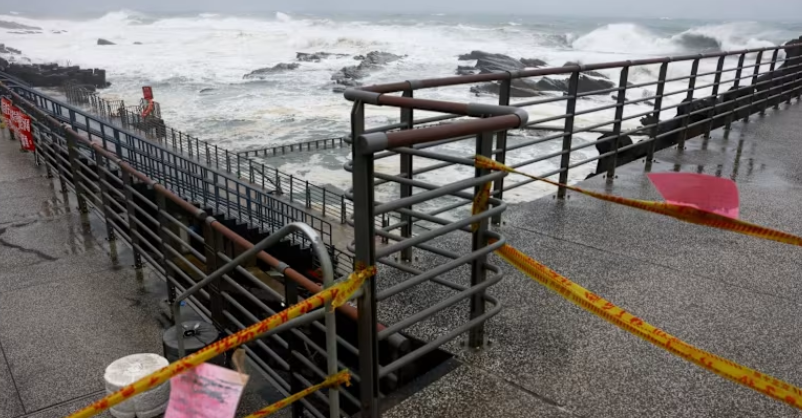
KEELUNG, Taiwan — More than 14,000 residents across Taiwan have been forced to evacuate their homes as Typhoon Bavi battered the island with fierce winds, torrential rain, and dangerous coastal waves on Saturday, leaving thousands of households without electricity and bringing daily life to a near standstill. The powerful storm, which previously swept across Japan’s southwestern islands, is now moving westward toward China, where authorities expect it to make landfall early Sunday.
The approaching typhoon has prompted widespread emergency measures throughout northern Taiwan, particularly in the port city of Keelung, where deserted streets, shuttered businesses, and relentless rainfall painted a picture of a community bracing for one of the strongest storms of the season. Authorities urged residents to remain indoors as worsening weather conditions threatened flooding, landslides, and hazardous sea conditions.
Keelung, one of the areas forecast to receive the brunt of the storm’s impact, experienced strong winds that whipped through neighborhoods while sheets of rain reduced visibility and made travel increasingly dangerous. Many commercial establishments suspended operations, while schools and several public services remained closed as officials prioritized public safety.
READ MORE ARTICLES:
- Typhoon Bavi Forces Mass Evacuations in Taiwan as Storm Advances Toward China
- Humihinang Bagyong Inday, Pinalalakas ang Habagat at Malalakas na Ulan
- Typhoon Bavi Nears Taiwan, Land Warning Raised as Heavy Rains Loom
- Super Typhoon Bavi, Papasok na sa PAR Bilang ‘Inday’
- Bagyong Domeng (Jangmi) Lalong Lumakas, Posibleng Maging Typhoon sa Sabado; Lalabas ng PAR sa Lunes
Despite the dangerous conditions, some essential workers continued to serve their communities. Among them was a 50-year-old breakfast shop owner identified only by his surname, Tsai, who continued delivering meals to customers reporting for duty during the storm.
“Everyone is afraid of the severe weather and staying indoors, but I only came out because I have orders,” Tsai said. “Some people are on duty and wouldn’t have anything to eat so I still need to deliver food to them.”
He added that he intended to return home as soon as weather conditions deteriorated further.
“If the wind and rain start picking up in a bit, I’ll be heading home early,” he said.
Taiwan’s Central Weather Administration (CWA) reported that Typhoon Bavi had weakened slightly compared with its earlier strength after crossing the Pacific Ocean. The system had struck Guam and the Northern Mariana Islands earlier in the week as a super typhoon before gradually losing intensity over open waters.
As of Saturday, the CWA said Bavi was sustaining maximum winds of around 144 kilometers per hour, with gusts reaching approximately 180 kilometers per hour. Although classified as a weaker typhoon than before, forecasters warned that it still possessed enough strength to produce destructive weather across northern Taiwan.
Meteorologists issued warnings for extremely torrential rainfall capable of triggering flash floods and landslides in mountainous regions, while coastal communities were advised to stay away from shorelines due to dangerous waves forecast to reach heights of up to 10 meters. Maritime operations were significantly disrupted, and authorities cautioned fishermen and shipping operators against venturing into rough seas.
The storm also caused widespread power outages, with more than 27,000 households losing electricity as strong winds damaged utility infrastructure. Emergency crews have been placed on standby to restore power as soon as weather conditions allow safe access to affected areas.
Officials continued monitoring rivers, reservoirs, and vulnerable mountain slopes as prolonged rainfall increased the risk of flooding and debris flows. Emergency shelters were opened for evacuees, while local governments coordinated rescue teams and disaster response units in anticipation of further deterioration in weather conditions.
According to CWA forecaster Jason Cheng, the most severe impacts were expected during the daytime hours on Saturday.
“The typhoon’s impact will be more significant during the daytime today,” Cheng said.
He added that the period from around noon through the afternoon was expected to bring the strongest winds and heaviest rainfall before the storm gradually moved away from Taiwan toward mainland China.
While Taiwan endured the immediate effects of the cyclone, Chinese authorities also prepared for its arrival. Coastal provinces were placed on heightened alert as emergency agencies implemented precautionary measures, including possible evacuations, suspension of maritime activities, and reinforcement of flood control systems ahead of the expected landfall.
Typhoon Bavi is the latest powerful tropical cyclone to affect the western Pacific this season, underscoring the region’s vulnerability to severe weather during the annual typhoon period. Such storms frequently bring destructive winds, widespread flooding, infrastructure damage, and prolonged disruptions to transportation and public services across East Asia.
As the storm continues its path toward China, emergency officials in Taiwan have urged residents to remain vigilant, avoid unnecessary travel, monitor official weather advisories, and cooperate with evacuation orders where necessary until the threat has fully passed.
Typhoon Bavi Leaves Trail of Destruction Across East Asia as Japan, Philippines, and China Brace for Worsening Impacts
Typhoon Bavi continued its destructive march across East Asia on Saturday, leaving widespread power outages, transportation disruptions, deadly landslides, and mass evacuations as the powerful storm swept from Japan’s southwestern islands toward China’s eastern coastline. Although the typhoon has gradually weakened from its earlier super typhoon status, authorities across the region remain on high alert, warning that the system still carries the potential to unleash life-threatening winds, torrential rainfall, flooding, and landslides.
Japan’s remote Okinawa Prefecture bore the brunt of the storm’s fury as fierce winds and relentless rain battered the island chain. More than 18,000 households and public facilities lost electricity after powerful gusts damaged power infrastructure, while emergency crews worked under dangerous conditions to restore essential services. The Miyako region experienced some of the most severe weather, with strong winds causing extensive disruptions and forcing residents to remain indoors as authorities monitored the situation.
Transportation across the affected islands was heavily impacted as Japanese airlines cancelled dozens of domestic flights, disrupting travel plans for more than 26,000 passengers. Airport operations were significantly reduced as airlines prioritized passenger safety amid dangerous weather conditions, while travelers faced lengthy delays and cancellations throughout the region.
Professional storm chaser James Reynolds, reporting from Ishigaki Island, described the severe conditions as the typhoon moved through the area.
“Miyako is taking the worst of Typhoon Bavi,” Reynolds posted on X, formerly known as Twitter.
He added that weather conditions on Ishigaki remained dangerous, with gale-force winds and overnight gusts reaching typhoon strength, underscoring the intensity of the storm despite signs that it had begun to weaken.
The devastating effects of Bavi extended far beyond Japan. In the Philippines, authorities confirmed that at least 15 people were killed after two landslides struck communities on the southern island of Mindanao. The landslides were triggered by days of intense rainfall brought by the typhoon’s outer rainbands, burying homes and cutting off access to several affected areas.
Emergency responders continued search and rescue operations as officials assessed the extent of the damage and monitored additional communities vulnerable to landslides and flash flooding. The Philippine government also maintained heightened disaster preparedness across several provinces as unstable weather conditions persisted.
Maritime operations throughout the archipelago were severely disrupted as rough seas and powerful waves made navigation unsafe. Dozens of ports remained closed, leaving hundreds of vessels stranded in sheltered areas. According to authorities, 313 ships stayed anchored to avoid the dangerous weather, affecting cargo deliveries, passenger travel, and fishing activities across multiple regions.
As Bavi continued moving westward, attention shifted toward eastern China, where authorities prepared for the typhoon’s expected landfall during the early hours of Sunday. Weather officials warned that the storm could bring exceptionally heavy rainfall capable of triggering widespread flooding and landslides in several coastal provinces.
State broadcaster CCTV reported that eastern Zhejiang Province and northeastern Fujian Province are expected to receive the heaviest rainfall, prompting emergency agencies to implement precautionary measures before the storm’s arrival. Local governments mobilized rescue teams, reinforced flood defenses, and issued warnings urging residents to avoid unnecessary travel and remain vigilant.
One of the most significant precautionary measures took place in Xiaguan Town in Zhejiang Province, where officials ordered the evacuation of the town’s entire population of more than 10,000 residents due to the threat posed by strong winds and potential flooding. Residents were moved to safer shelters while emergency personnel prepared for the storm’s arrival.
China’s emergency response comes after a week of already devastating weather across southern and central parts of the country. Powerful storms and persistent rainfall have claimed at least 39 lives, overwhelmed rivers, inundated communities, and caused a reservoir dam to burst, leaving thousands of residents displaced and causing extensive damage to homes, infrastructure, and agricultural land.
The latest arrival of Typhoon Bavi threatens to worsen an already dire situation, with saturated ground increasing the likelihood of additional floods and landslides. Disaster management authorities remain on standby as they prepare for potential rescue operations and rapid evacuations should conditions deteriorate further.
Meteorologists warned that although Bavi has weakened since reaching super typhoon intensity earlier in the week, it remains a dangerous tropical cyclone capable of producing destructive winds, widespread flooding, and hazardous sea conditions across multiple countries. Officials throughout East Asia continue urging residents in vulnerable areas to follow evacuation orders, monitor official weather advisories, and take all necessary precautions until the storm has completely passed.
The storm’s sweeping impact across Japan, the Philippines, Taiwan, and China highlights the growing challenges posed by powerful tropical cyclones in the western Pacific, where millions of people face recurring threats from extreme weather during the annual typhoon season. As Bavi approaches the Chinese mainland, emergency agencies across the region remain focused on protecting lives and minimizing damage from one of the season’s most significant storms. / reuters/ afp /aptikons