Canada, the second-largest country on Earth, has long been defined by its immense geography and the unique national identity it has fostered. From the seemingly endless forests that captivated early explorers like Anna Brownell Jameson in 1837, to the vast, untamed wilderness that still defines much of its landscape, Canada’s sheer size has intrinsically shaped its people and their sense of self. This grandeur, however, belies a surprisingly sparse population, a characteristic that has contributed to a distinct Canadian spirit, one that embraces both the quietude of nature and the vibrant tapestry of human experience.
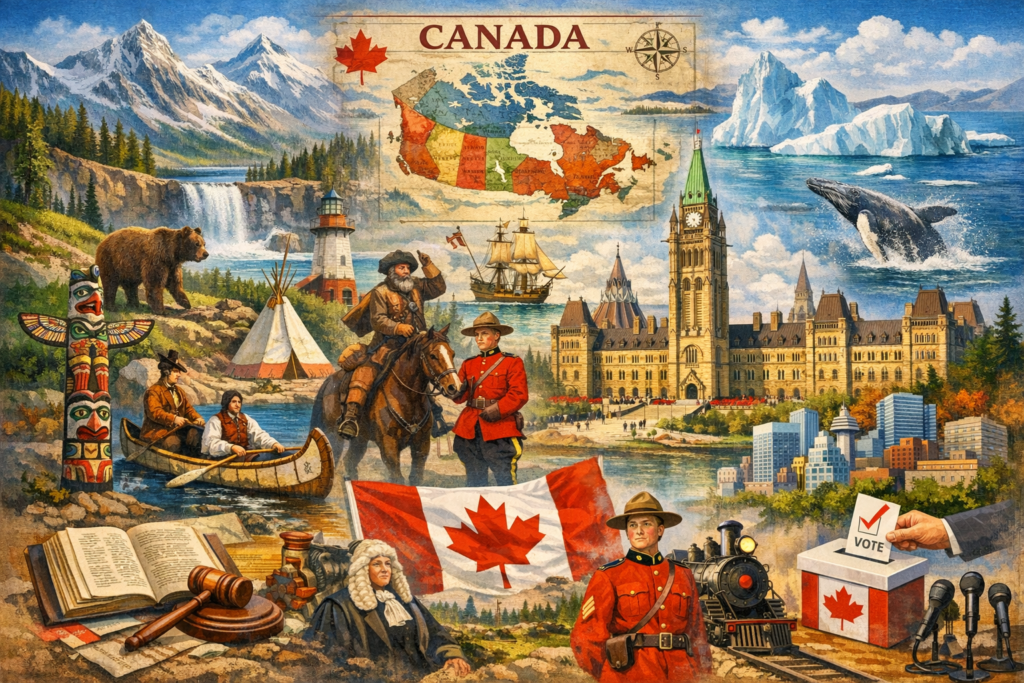
Despite its relatively small population, Canada has emerged as a global leader in multiculturalism, a testament to its deliberate and ongoing effort to welcome immigrants from every corner of the globe. This commitment to diversity has created a rich social fabric, where a multitude of traditions, languages, and perspectives coexist and enrich the national identity. Beyond its people, Canada’s influence extends globally through its abundant natural resources and a thriving intellectual capital, making it a nation of significant international standing.
The official bilingualism of Canada, in English and French, is a direct legacy of its complex history, a land once claimed and contested by two of Europe’s most powerful nations. The very name “Canada” traces its roots to the Huron-Iroquois word “kanata,” meaning a village or settlement. French explorer Jacques Cartier’s use of the term in the 16th century to describe the area around present-day Quebec City marked the beginning of its geographical association. Over time, “Canada” became synonymous with New France, encompassing French territories along the St. Lawrence River and the Great Lakes.
Following the British conquest, the name Quebec was sometimes used interchangeably with Canada. However, the name Canada was fully re-established after 1791 when the British divided Quebec into Upper and Lower Canada. These provinces were later renamed Canada West and Canada East in 1841, and the collective term “Canada” persisted. The pivotal moment in Canada’s modern formation came in 1867 with the British North America Act, which united three colonies—Nova Scotia, New Brunswick, and Canada—into the Dominion of Canada. This act also saw the division of the old colony of Canada into the distinct provinces of Ontario and Quebec.
Towards Self-Governance: A Journey to Independence
While Dominion status granted Canada significant self-rule, crucial aspects of international diplomacy and military affairs remained under the purview of the British Crown. The journey towards complete autonomy was a gradual one, with Canada achieving full self-governance within the British Empire in 1931. However, it wasn’t until 1982, with the patriation of its constitution, that Canada secured complete legislative independence, including the right to amend its own foundational laws. This long and evolving process has culminated in the sovereign, multicultural, and officially bilingual nation that Canada is today.
A Tale of Two Nations: Understanding the Profound Differences Between Canada and the U.S.
The ribbon of land that separates Canada and the United States, stretching an astonishing 5,525 miles, is more than just a geographical line; it’s a boundary that, despite the shared cultural currents and proximity, delineates two nations with profoundly different identities. While the popular culture of both countries often appears indistinguishable, a closer look reveals a complex tapestry of temperamental and material distinctions that shape Canadian society.
At the heart of these differences lies a historical divergence, famously articulated by literary critic Northrop Frye: “The central fact of Canadian history is the rejection of the American Revolution.” This foundational moment has, over centuries, cultivated a distinct national ethos. Unlike their southern neighbors, who often champion individualism, contemporary Canadians tend to lean towards an “orderly central government and a sense of community.” This inclination manifests in various aspects of national life, from a preference for collective well-being to a more measured approach to international relations.
Where the United States might often be seen as a global “warrior,” Canada is more inclined to embrace the role of a “peacemaker.” This tendency towards diplomacy and multilateralism is a hallmark of its foreign policy, reflecting a broader pluralistic worldview that permeates both domestic and international affairs. Canadians, whether at home or abroad, often approach the world with a nuanced perspective, valuing dialogue and cooperation.
Furthermore, the societal fabric of Canada, particularly in its English-speaking regions, bears a strong resemblance to Britain, especially in legal and official matters. This historical connection has instilled a sense of tradition and a respect for established institutions. However, this is not to say Canada is monolithic. The province of Quebec stands as a vibrant testament to a different cultural heritage, with over three-fourths of its population speaking French as their primary language. This linguistic and cultural duality is a defining characteristic of Canada, adding another layer of complexity to its national identity.
In essence, while the shared border and a common media landscape may foster a sense of familiarity, Canada and the United States are distinct nations, each shaped by unique historical trajectories, societal values, and cultural influences. Understanding these profound differences is key to appreciating the rich and diverse character of the North American continent.
Canada: A Tapestry of Cultures and Global Engagement
Canada, a nation renowned for its vast landscapes and welcoming spirit, is a vibrant mosaic woven from diverse cultural threads. While the echoes of French and British colonialism are most pronounced in Quebec, their influence extends across the nation, shaping everything from place names to public signage. Beyond these foundational European influences, Canada is profoundly shaped by the rich heritage of its Indigenous peoples, the First Nations and Inuit, whose ancestral lands form the very fabric of the country. The Inuit, in particular, hold a unique position with their semiautonomous governance in the territory of Nunavut, a testament to Canada’s commitment to recognizing Indigenous self-determination.
This intricate cultural landscape is further enriched by a continuous influx of immigrants from across Europe, Southeast Asia, and Latin America. This ongoing demographic evolution has cemented Canada’s status as a truly multicultural society, a dynamic blend of traditions and perspectives that fosters innovation and understanding.
Canada’s global footprint is as significant as its internal diversity. As an influential member of the Commonwealth, it actively participates in fostering international cooperation. Its leadership role within La Francophonie, an organization dedicated to promoting French language and culture worldwide, underscores its unique bicultural identity.
A founding member of the United Nations, Canada has consistently championed multilateralism and played an active role in numerous UN agencies and global initiatives. Its commitment to international engagement was further solidified with its accession to the Organization of American States in 1989, the same year it signed a pivotal free trade agreement with the United States. This economic partnership evolved into the North American Free Trade Agreement (NAFTA) in 1992, a comprehensive pact that also includes Mexico, further integrating North America into a global economic framework.
Canada’s economic standing is recognized through its membership in the Organisation for Economic Co-operation and Development (OECD), founded in 1961, and its prominent position within the Group of Seven (G7). This exclusive group comprises the world’s seven largest industrial democracies, highlighting Canada’s significant role in shaping global economic policy. While Russia was a member of the expanded Group of Eight (G8) until its suspension in 2014, Canada continues to be a key player in this influential forum.
Through its embrace of diversity, its commitment to international cooperation, and its active participation in global economic and political arenas, Canada stands as a compelling example of a modern, multicultural nation shaping its own destiny while contributing to the broader world community.
Website in Canada
- CBC News: Canada’s public broadcaster; the most-visited news site in the country.
- CTV News: A leading private national news network with breaking video and text coverage.
- Global News: Provides national headlines and in-depth reporting across various digital platforms.
- The Globe and Mail: A primary “newspaper of record” focusing on politics, business, and national affairs.
- National Post: A major national daily known for its conservative-leaning commentary and analysis.
- The Canadian Press: The national news agency providing real-time stories to other media outlets.
- Canada.ca News: Official news and announcements directly from the Government of Canada.
- National Newswatch: A news aggregator specifically for Canadian political junkies.
| Network / Publisher | Key Local Portals |
|---|---|
| CBC Local | Portals for Toronto, Montreal, Calgary, Vancouver, and the Atlantic. |
| CTV Local | Major hubs for Toronto, Ottawa, Winnipeg, and Kitchener. |
| CityNews | Local-first coverage for Toronto, Vancouver, Calgary, Edmonton, and Montreal. |
| The Toronto Star | Canada’s largest daily newspaper, primarily serving the Greater Toronto Area (GTA). |
| Postmedia Network | Local papers like the Edmonton Journal, Calgary Herald, and The Gazette (Montreal). |