Emirates Flight 521 crashed at Dubai International Airport on August 3, 2016, just 18 seconds after its pilots attempted a go-around, leaving the Boeing 777 engulfed in flames. All 300 passengers and crew members survived the crash, but one airport firefighter was killed while battling the post-crash fire.
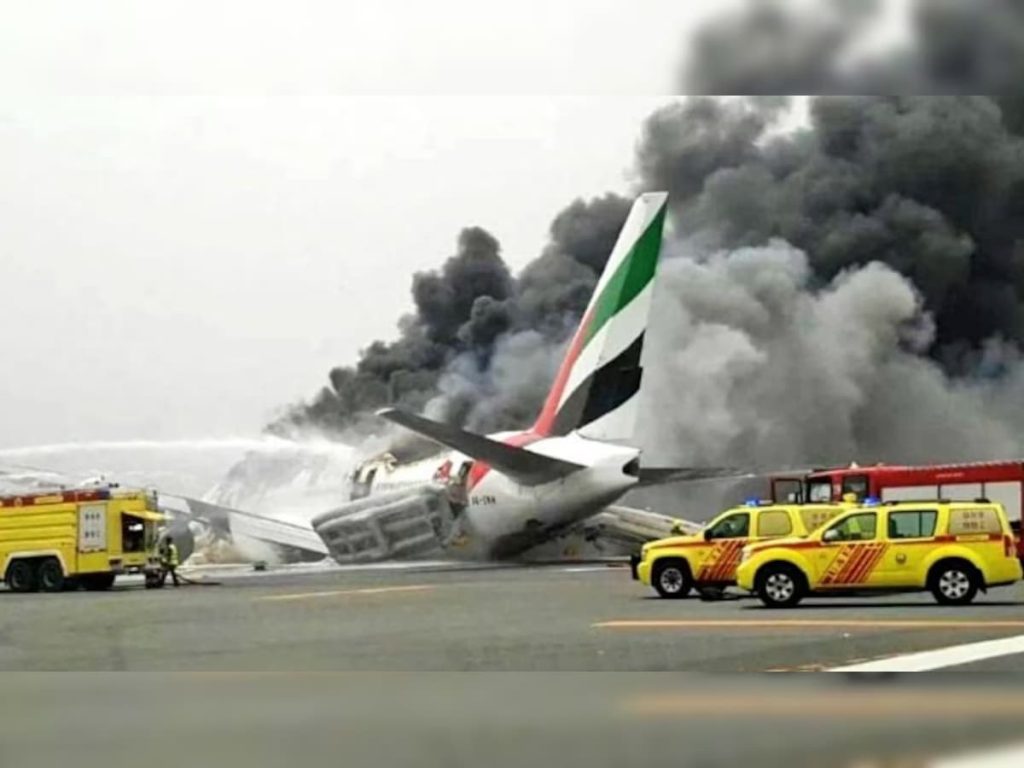
A terrifying aviation accident unfolded at Dubai International Airport on August 3, 2016, when Emirates Flight 521, a Boeing 777-300 passenger aircraft, crashed onto the runway just 18 seconds after its pilots initiated a go-around. Despite the violent impact and massive fire that followed, all 300 passengers and crew members survived the crash. However, an airport firefighter tragically lost his life while responding to the emergency.
The aircraft, registered as A6-EMW, was operating as Emirates Flight EK521 from Thiruvananthapuram, India, to Dubai, United Arab Emirates. It was carrying 282 passengers and 18 crew members when the accident occurred during its landing attempt at Dubai International Airport.
According to the investigation conducted by the United Arab Emirates General Civil Aviation Authority (GCAA), the aircraft encountered changing wind conditions as it approached the runway, contributing to a prolonged landing flare and an extended float before touchdown.
As the Boeing 777 approached Runway 12L, it floated above the runway before its main landing gear eventually touched down. Believing that the aircraft had not properly landed, the pilots decided to initiate a go-around, a standard aviation procedure that allows an aircraft to abandon its landing attempt and climb for another approach.
READ MORE:
- Emirates Flight 521: How a Failed Go-Around Caused Dubai Crash
- Philippines to Host 49th ASEAN Summit in Manila From November 15 to 18
- vnadexpress.com Faces Scam Allegations Over Online
- Suspected North Korean Hackers Steal $6.36 Billion in Binance Heist
- Foxiz Fails to Issue Refund as Customer Support Concerns Grow
However, a critical problem occurred during the maneuver.
Because the aircraft’s landing gear had already touched the runway, the Boeing 777’s Takeoff/Go-Around (TO/GA) system was inhibited. As a result, the automated system did not advance the engine thrust levers to the required takeoff or go-around power setting.
The pilots initiated the go-around and began retracting the landing gear, apparently expecting the aircraft’s automated systems to increase engine power.
However, the engines remained at idle thrust.
Without sufficient engine power, the aircraft could not maintain the energy needed to continue climbing. Although the Boeing 777 briefly reached approximately 85 feet above the runway, it rapidly lost airspeed and altitude.
The investigation found that the flight crew failed to adequately monitor the primary flight instruments and recognize that the autothrottle had not advanced the thrust levers as expected.
The aircraft commander eventually pushed both thrust levers forward to maximum power, but this corrective action came only three seconds before the aircraft struck the runway.
Approximately 18 seconds after the go-around was initiated, the Boeing 777 crashed back onto the runway, with its rear fuselage striking the ground. The aircraft slid along the runway before coming to a stop near a taxiway.
The impact severely damaged the aircraft, and a fire quickly broke out, prompting an emergency evacuation.
Despite the destruction, all 300 occupants managed to escape before the aircraft was engulfed in flames. Passengers and crew members used the emergency evacuation slides to flee the burning aircraft.
However, the emergency response took a tragic turn when the aircraft’s center wing fuel tank exploded approximately 10 minutes after the aircraft came to a stop.
The explosion caused a large section of the aircraft’s wing structure to separate, fatally striking an airport firefighter who was responding to the fire.
The firefighter was identified as Jasim Issa Mohammed Hassan Al Baloushi, a 27-year-old Emirati emergency responder. His death was the only fatality associated with the Emirates Flight 521 accident.
According to the final investigation report, 32 people aboard the aircraft sustained injuries. These included 21 passengers and seven crew members who suffered minor injuries, along with four cabin crew members who sustained serious injuries. Five firefighters and two police officers also suffered minor injuries during the emergency response.
The investigation identified several factors that contributed to the accident, particularly the flight crew’s failure to recognize that the engines remained at idle thrust during the attempted go-around.
Investigators also highlighted the crew’s ineffective monitoring of flight instruments, their failure to recognize the autothrottle’s response, and their omission of essential thrust verification procedures.
Although changing wind conditions contributed to the challenging landing, investigators identified flight crew actions and the failure to detect the lack of engine thrust as the principal causes of the accident.
The investigation also examined weaknesses in pilot training, cockpit procedures, and automation awareness, as well as the absence of certain alerts that could have warned the crew about insufficient engine thrust during the attempted go-around.
The Emirates Flight 521 accident became an important case in aviation safety, demonstrating the dangers of relying on automated flight systems without verifying whether they are responding as expected.
It also highlighted the importance of monitoring engine power, understanding aircraft automation, and ensuring that pilots can quickly recognize and correct unexpected flight conditions.
Although the Boeing 777 was ultimately destroyed by the impact and subsequent fire, the successful evacuation of all 300 occupants prevented an even greater tragedy.
The incident remains a significant reminder that even a routine landing maneuver can turn into a life-threatening emergency within seconds when critical flight controls and engine thrust are not properly monitored.
ADS