Türkiye’s push to acquire U.S.-made F-35 fighter jets has regained momentum after President Recep Tayyip Erdoğan expressed hope that Washington would approve the sale, while President Donald Trump said the request remains under consideration, as NATO leaders gather in Ankara for a crucial summit focused on defense spending, military modernization, and continued support for Ukraine.
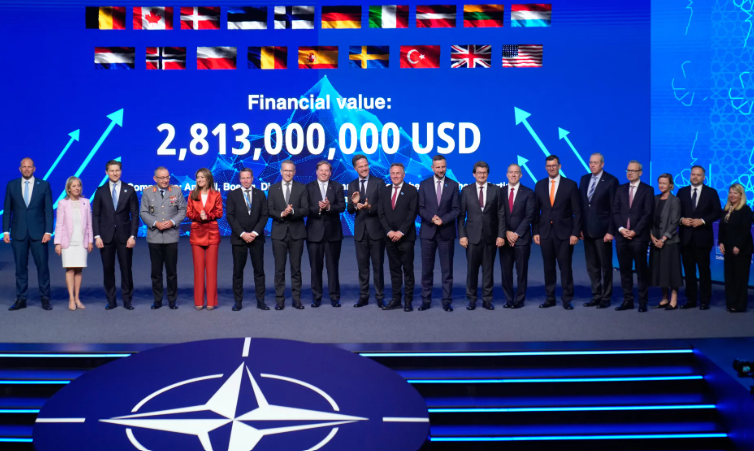
Türkiye is seeking to strengthen its defense partnership with the United States as President Recep Tayyip Erdoğan expressed optimism that Washington would eventually approve the sale of advanced F-35 fighter jets to Ankara. His remarks came as U.S. President Donald Trump said his administration is considering the request, signaling a possible shift in one of the most closely watched defense issues between the two NATO allies.
The renewed discussion over the fifth-generation fighter aircraft coincides with a critical gathering of leaders from the North Atlantic Treaty Organization, who are convening in Ankara for a summit expected to shape the alliance’s future security strategy amid mounting geopolitical tensions.
READ MORE ARTICLES:
- Millions Mourn Supreme Leader Ali Khamenei as Middle East Violence
- China Activates Level-IV Emergency Response Ahead of Approaching Typhoon
- Southern China, Typhoon Maysak Forces Evacuations Ahead Of Second Landfall
- THAILAND: 10 Monks Killed, Multiple Injured as 11-Year-Old Boy Drives Truck
- 21,000 Join Visayas Job Fairs for Skills and Careers
- Team Leyte Pilipinas Shines in Taiwan Cage Invitational
The summit comes at a time when NATO members are under increasing pressure to strengthen their military capabilities, modernize their armed forces, and reinforce collective defense commitments. One of the central issues dominating discussions is the alliance’s continued support for Ukraine as it faces ongoing military challenges in its conflict with Russia. Member states are expected to coordinate additional military assistance, defense production initiatives, and long-term security commitments aimed at sustaining Ukraine’s ability to defend its territory.
Defense spending has also emerged as a defining issue at the summit, reflecting years of calls from the United States for NATO members to contribute a greater share to the alliance’s collective security. President Trump has consistently urged European allies to increase their military budgets, arguing that a stronger financial commitment from member nations is essential for maintaining NATO’s credibility and readiness against emerging global threats.
In response, several allied governments have announced massive defense procurement packages valued at tens of billions of dollars. The agreements include investments in advanced fighter aircraft, missile defense systems, armored vehicles, naval capabilities, and expanded domestic weapons production. These commitments are widely viewed as an effort to demonstrate that NATO members are responding to Washington’s demands while adapting to an increasingly volatile international security environment.
Türkiye’s pursuit of the F-35 program has become one of the most closely watched issues within the alliance. The aircraft is regarded as one of the world’s most advanced multirole stealth fighters, capable of enhancing air superiority, intelligence gathering, and interoperability among NATO forces. A potential agreement could significantly strengthen Türkiye’s air force while also reinforcing military cooperation between Ankara and Washington after years of strained relations over defense policy.
Analysts say the discussions surrounding the F-35 sale could carry implications beyond bilateral relations, potentially influencing NATO’s broader strategic posture in Europe, the Middle East, and the Black Sea region. As security challenges continue to evolve, member nations are increasingly focused on ensuring that the alliance remains technologically advanced, financially prepared, and operationally capable of responding to future crises.
With defense modernization, increased military investment, and continued support for Ukraine dominating the agenda, the Ankara summit is expected to underscore NATO’s efforts to present a united front while addressing both regional conflicts and long-term strategic competition. The outcome of the meeting—and any progress on Türkiye’s request for the F-35 fighter jets—will likely be closely monitored by allies and adversaries alike as the alliance seeks to reinforce its collective security in an increasingly uncertain global landscape.
Trump’s Push for Higher Defense Spending Reshapes NATO Debate Ahead of Summit
As NATO leaders prepare for crucial discussions on the future of the alliance, political analyst Alexandru Hudisteanu says U.S. President Donald Trump is aggressively pressing European allies to take greater responsibility for their own defense, signaling a strategic shift in Washington’s expectations of the military alliance.
Speaking to Al Jazeera, Hudisteanu said Trump’s approach is intended to “wake up Europeans” by encouraging them to invest more heavily in their military capabilities, allowing the United States to redirect more of its attention and resources toward other global priorities. According to the analyst, the message from Washington reflects a growing belief that Europe should become more self-reliant in maintaining regional security rather than depending heavily on American military support.
The comments come as leaders from the North Atlantic Treaty Organization gather for a high-level summit expected to focus on strengthening the alliance amid rising geopolitical tensions, continued support for Ukraine, and expanding defense cooperation among member states.
Despite the renewed emphasis on military spending, NATO Secretary General Mark Rutte sought to frame the discussion differently. Rather than concentrating solely on the amount of money member states commit to defense, Rutte emphasized that the summit’s primary objective is to determine how those resources can be spent more effectively to improve military readiness, interoperability, and collective security.
His remarks underscore a broader effort within the alliance to ensure that increased defense budgets translate into stronger operational capabilities, modern equipment, and faster response mechanisms rather than simply larger financial commitments.
Hudisteanu also pointed to recent tensions between Washington and its European partners following what President Trump viewed as insufficient European support during the U.S.-Israeli military campaign against Iran. The perceived lack of backing reinforced Trump’s longstanding criticism that many NATO members have failed to shoulder an equitable share of collective security responsibilities.
However, the analyst argued that Trump’s criticism of NATO in this context overlooks the alliance’s fundamental purpose. He stressed that NATO is a defensive organization whose mandate is based on protecting member states from external aggression rather than participating in conflicts that are not covered by its collective defense obligations.
“NATO cannot go into a war of choice; it’s a defensive alliance,” Hudisteanu said, emphasizing that the organization’s legal framework and strategic mission limit its role in conflicts that fall outside its treaty commitments.
The debate reflects broader questions about NATO’s future direction as member nations seek to balance increased military investment with evolving global security challenges. While Washington continues to push for greater European defense responsibility, alliance leaders are also working to preserve unity and ensure that strategic decisions remain aligned with NATO’s founding principles.
As the summit continues, discussions are expected to shape not only future defense spending priorities but also the alliance’s long-term strategy in responding to emerging threats, maintaining transatlantic cooperation, and adapting to an increasingly complex global security environment.
APTIKONS