Thousands of Iglesia ni Cristo members gathered in an unexpected rally along EDSA, causing heavy traffic congestion and prompting the Philippine National Police to raise its alert status. Meanwhile, the Department of Labor and Employment approved an ₱85 increase in the daily minimum wage for workers in Metro Manila.
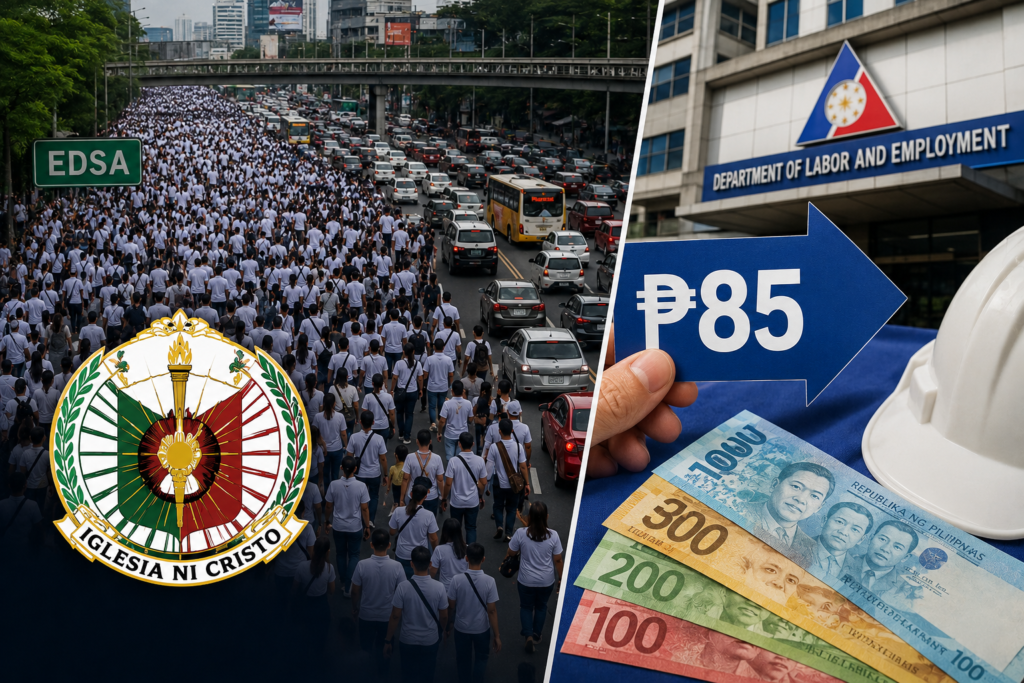
The scenes unfolding along EDSA are a reminder of a reality that every democracy must confront: the right to protest and the public’s right to mobility often collide in the busiest and most visible spaces of national life.
Thousands of members of the Iglesia ni Cristo gathered at strategic locations along EDSA, including the People Power Monument and the Ortigas business district, to voice concerns over what they described as “selective justice.” Their message was intended to be impossible to ignore and judging by the paralysis that gripped Metro Manila’s main artery, it certainly was.
The decision to park buses along major thoroughfares and obstruct portions of the busway transformed a political demonstration into a metropolitan crisis. Commuters were stranded for hours. Employees arrived late to work. Businesses absorbed losses in productivity. Ambulances and emergency vehicles faced delays in navigating already congested roads.
READ MORE ARTICLES:
- Supreme Court Orders Overtime Pay for Security Guards on Broken Shifts in Landmark Labor Ruling
- CEBU:Mayor Gungun Gica Nagpatupad ng Total Cellphone Ban sa mga Paaralan sa Dumanjug
- BPI Eliminates InstaPay and PESONet Transfer Fees Starting July 1 in Major Boost for Digital Banking
- Korte Suprema: Ang Pagtataksil sa Asawa ay Maaaring Maging Krimen sa Ilalim ng Anti-VAWC Law
Supporters of the rally argue that protests are designed to disrupt normal routines in order to force public attention toward issues that might otherwise be overlooked. History offers many examples where civil demonstrations altered the course of national conversations precisely because they interrupted daily life.
Critics, however, raise an equally important question: when does the exercise of one constitutional right begin to infringe upon the rights of millions of others? Freedom of expression and peaceful assembly are pillars of democracy, but so too are public order, accessibility, and the welfare of ordinary citizens who have no direct involvement in the dispute.
The challenge for authorities is not merely managing traffic but balancing competing rights without appearing partisan or suppressive. Law enforcement agencies must ensure public safety while preserving the constitutional freedoms that allow citizens and organizations to voice dissent.
What happened on EDSA is likely to reignite a broader national debate about the rules governing mass demonstrations in heavily populated urban centers. The issue extends beyond a single organization or a single day of gridlock. It touches on a fundamental question for modern democracies: how can societies protect the right to be heard without silencing the daily lives of everyone else?
In the end, the traffic may clear and the buses may move, but the questions raised by the protest will remain long after EDSA returns to normal.
Why Preparedness Matters in Times of Public Disruption
When thousands gather on the streets and the country’s busiest highway slows to a crawl, government response becomes more than a matter of logistics it becomes a test of leadership.
Faced with large-scale demonstrations and mounting traffic disruptions across Metro Manila, authorities moved swiftly. Nearly 6,000 personnel from the Philippine National Police were placed on full alert and deployed to maintain order, manage traffic flow, and ensure public safety.
At the same time, Ferdinand Marcos Jr. reportedly cancelled scheduled public engagements to personally monitor the evolving security and transportation situation.
Some will see these actions as necessary caution. Others may view them as evidence of the scale of the disruption confronting authorities. Regardless of perspective, one reality remains clear: in moments of uncertainty, governments are judged not by the absence of crises but by the quality of their response to them.
Public demonstrations are a normal feature of democratic societies. They reflect the freedom of citizens and organizations to express grievances and demand attention for issues they believe matter. Yet governments carry an equally important responsibility to protect that freedom while ensuring the safety and mobility of millions of citizens who are not participants in the protest.
The deployment of thousands of police officers was not merely about crowd control. It was about preventing isolated incidents from escalating, ensuring emergency services remained accessible, and reassuring the public that institutions remained in control of the situation.
The President’s decision to prioritize monitoring over ceremonial appearances sends another message: governance does not pause during moments of public tension. Leadership often reveals itself not on stages or podiums but in command centers, traffic briefings, and emergency meetings where decisions carry immediate consequences for ordinary people.
Still, the events raise important questions for the future. As Metro Manila continues to grow and public gatherings become larger and more complex, authorities may need to rethink how major demonstrations are managed without bringing the country’s economic heart to a standstill.
Preparedness, coordination, and communication will become increasingly important. So too will the ability to balance competing rights the right to protest, the right to public safety, and the right of millions of commuters to move freely through the city.
Crises eventually pass. Traffic eventually clears. But the lessons they leave behind often shape how nations respond to the next challenge that arrives unexpectedly at their doorstep.
A Small Raise That Speaks to a Bigger Struggle
For millions of workers across Metro Manila, an additional ₱85 a day may appear modest on paper. But for families carefully stretching every peso to cover food, transportation, rent, and education, the increase carries a significance far greater than its numerical value.
The decision by the Department of Labor and Employment to approve an ₱85 increase in the daily minimum wage for workers in the National Capital Region is more than a policy adjustment it is an acknowledgment of the economic pressures that ordinary Filipinos face every day.
Prices have continued to rise over the years. A trip to the market costs more than it did a year ago. Transportation expenses have climbed. Utility bills consume a larger share of household income. For many minimum wage earners, budgeting has become an exercise in deciding not what to buy, but what to sacrifice.
An extra ₱85 will not solve poverty. It will not instantly make housing affordable or shield families from inflation. But it could mean additional fare money for the week, another kilo of rice for the household, or enough savings to buy school supplies for a child without borrowing money.
Business groups have expressed concern that higher labor costs may place additional burdens on employers, particularly small businesses still recovering from economic challenges. Their concerns are valid and deserve consideration. Sustainable businesses create jobs, and strong enterprises are essential to economic growth.
However, economic growth cannot be considered truly inclusive if the workers driving that growth are unable to afford the basics of daily life. An economy is ultimately measured not only by corporate earnings or investment figures but by the quality of life of the people who keep it moving.
The wage hike should therefore be seen not merely as an added expense for employers but as an investment in human dignity, productivity, and consumer spending. Workers with greater purchasing power contribute directly to the economy they help sustain.
The larger challenge remains unchanged. Wage increases offer relief, but they are not substitutes for controlling inflation, improving public transportation, lowering the cost of essential goods, and creating higher-paying jobs.
Still, for many workers in Metro Manila, the announcement represents something important: recognition that their struggles are being heard.
Because sometimes, a small raise tells a much bigger story about the value of work and the people behind it.